15 Best UX Research Agencies in 2026: Services, Pricing & More


- UX research helps teams replace product assumptions with evidence from real users before making costly decisions.
- Companies hire UX research agencies to uncover user needs, identify usability problems, validate ideas, and understand why users behave a certain way.
- The right research method depends on the question. Interviews, usability testing, surveys, and behavioral research each answer different problems.
- A good UX research agency doesn’t just deliver findings. It turns research into clear recommendations that teams can use to improve the product.
- Look beyond a long list of research methods. Evaluate an agency by its experience, methodology, case studies, research quality, and ability to connect insights to product decisions.
- The best agency depends on your situation. A startup validating an MVP needs different research expertise than an enterprise redesigning a complex product.
It's easy to assume you know what your users want when you're the one building the product. Your team sees the roadmap, talks about features every day, and knows how everything is supposed to work. Your users don't have that context.
That's why research can reveal things the product team simply can't see from the inside. A few well-planned interviews might uncover a completely different need. Even a simple concept test can tell you whether an idea is worth building before development begins.
For companies that need this kind of insight, a UX research agency can bring the people, methods, and experience needed to get reliable answers. The challenge is finding one that fits your product and research goals.
Here, we've selected 15 of the best UX research agencies to hire in 2026 and broken down what each one does best.
Quick Overview of the 15 Best UX Research Agencies
Not every UX research agency is built for the same kind of project. Some focus on enterprise research, while others specialize in SaaS, startups, healthcare, or product innovation. This quick overview compares the 15 agencies at a glance, so you can see what each one does best before diving into the details.
How We Picked the Top UX Research Agencies
There’s no single official ranking for UX research agencies, so we evaluated each agency against the factors that matter when choosing a research partner.
We looked at their research capabilities, experience, pricing, reputation, and ability to turn research findings into useful product decisions. The ranking reflects the overall strength of these factors rather than any single metric.
- UX research capabilities: We looked at the depth and range of each agency’s research services, including user interviews, usability testing, surveys, behavioral research, discovery research, and other qualitative or quantitative methods. Agencies with broader and more specialized research capabilities scored higher.
- Industry and project experience: Experience matters when research involves complex products, unfamiliar users, or specialized industries. We considered the types of products and industries each agency has worked with, along with the complexity and scale of its projects.
- Research methodology: We looked at how agencies approach research, including whether they choose methods based on the research question rather than relying on a one-size-fits-all process. Agencies with structured, evidence-based research approaches ranked higher.
- Quality of case studies and portfolio: Case studies show how an agency applies research in real projects. We considered the quality of documented work, the problems researched, the methods used, and whether the findings led to clear product or business outcomes.
- Ability to turn research into action: Research is only useful when teams can do something with it. We considered how well each agency connects research findings to product strategy, UX decisions, design improvements, and other actionable recommendations.
- Client reputation and reviews: Client feedback provides another perspective on an agency's reliability, communication, expertise, and quality of work. We considered publicly available reviews, ratings, testimonials, and client relationships where available.
- Pricing and value: Cost was considered as an important factor, but not simply as “the cheaper, the better.” We looked at published pricing, project minimums, pricing transparency, and the overall value an agency provides relative to its expertise and scope of work.
- Specialization: Some agencies are particularly strong in areas such as SaaS, enterprise software, healthcare, AI, consumer products, or complex digital experiences. We considered these specializations when determining which types of companies each agency is best suited for.
- Global research capabilities: For companies with users across different markets, research needs to work across locations and cultures. We considered an agency's geographic reach, international research capabilities, and ability to work with users across different markets.
- Overall fit for buyers: Finally, we considered how well each agency fits the needs of someone actively looking for a UX research partner. This includes factors such as project flexibility, engagement model, research expertise, and the types of teams the agency is best equipped to support.
Top 15 UX Research Agencies in 2026
There is no single best UX research agency. The right one depends on what you are building, who your users are, and how deep you need to go.
To make the decision easier, we compared the top 15 UX research agencies in 2026 on what they do best, their core research services, location, and pricing.
1. Orbix Studio
- Website: orbix.studio
- Founded: 2023
- Location: Queens Village, New York, USA
- Team size: 10 to 49
- Hourly rate: $50 to $99/hr
- Minimum project: $10,000
- Best for: Startups and SaaS teams that want testing, redesign and development handled by one team
About Orbix Studio
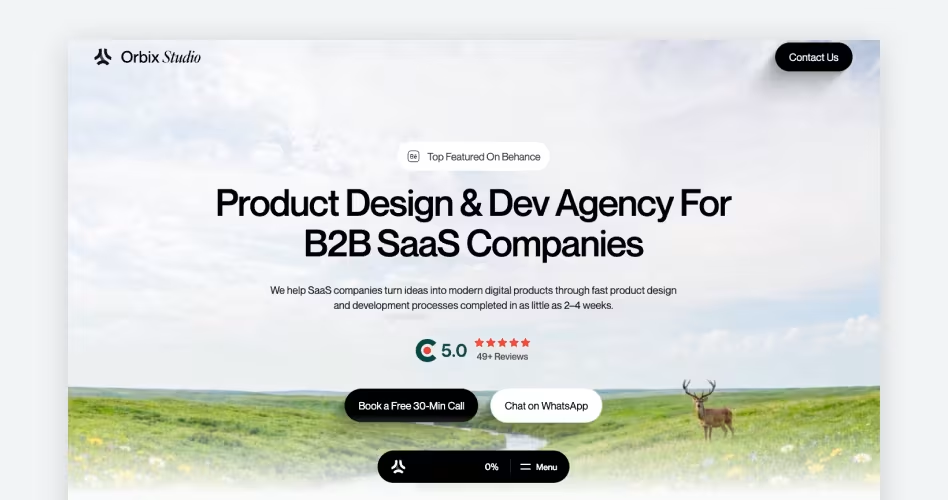
Orbix Studio is a product design and development agency for B2B SaaS and AI companies, with 35+ specialists across the USA, UAE, KSA and South Asia. Usability testing and user research make up a large share of its UX work, alongside design and development.
That combination changes what happens after testing. Instead of handing over a report, the same team fixes what the sessions uncover. For one real estate client, Orbix Studio ran user research, prototyped and built a new site, and conversion rose 52% within three months, with organic traffic up 37%.
Orbix Studio's Core Services
- Usability testing and UX audits: Finding where users struggle in existing products, then prioritizing what to fix.
- User research: Interviews and testing to validate flows before anything goes to development.
- SaaS product and UI/UX design: Dashboards, onboarding flows and pricing pages redesigned from the findings.
- MVP and full-stack development: Building and shipping the fixes, with WCAG 2.2 AA compliance available.
Why Orbix Studio
Most startups can't afford a research firm plus a design agency plus a dev shop. Orbix Studio brings all three into one team at $50 to $99 an hour, often delivering launch-ready work in 2 to 4 weeks. Book a free call to talk through what to test first.
2. Blink UX
- Website: blinkux.com
- Founded: 2000
- Location: Seattle, WA (offices in Austin, Boston, San Diego, San Francisco)
- Team size: 100 to 249
- Starting price: Custom quote
- Best for: Enterprise teams and high-stakes product launches
About Blink UX
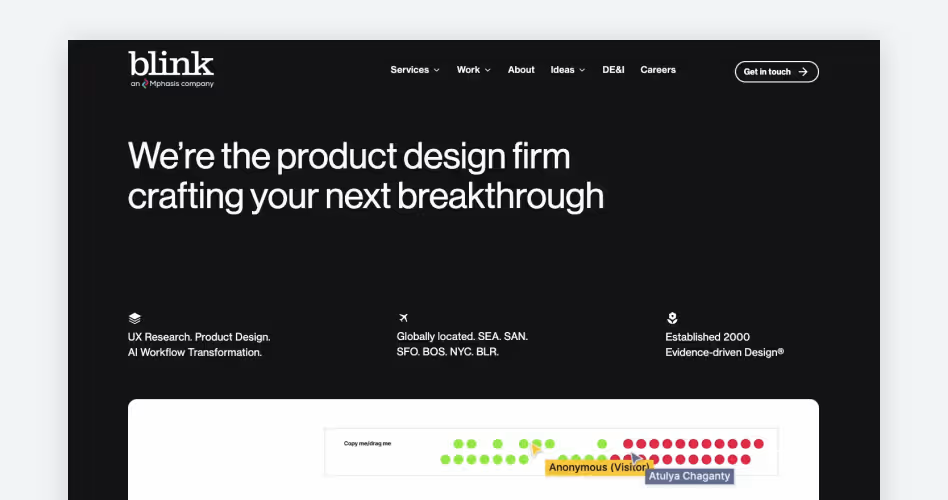
Blink has been doing this since 2000, which makes it one of the older research-led firms still operating at scale. The approach it is known for is called Evidence-Driven Design, and the name is basically the pitch: no decision ships on a hunch if a study can settle it instead. Research, strategy, and design all sit under one roof.
The client list is the kind most agencies would frame on a wall. Amazon, Google, Meta, Microsoft, NASA, and The New York Times have all run work through Blink. The firm also keeps its own research labs for moderated, in-person sessions. This matters when you are testing hardware, prototypes, or anything that does not sit neatly inside a browser window.
Blink UX's Core Services
- User research: Generative and evaluative studies across the full product lifecycle.
- Usability testing: Lab-based and remote sessions, with dedicated research facilities.
- Product strategy: Turning research into roadmaps and prioritization calls.
- AI research: Studying how people understand and trust AI-driven features.
Why Blink UX
If you are a large organization with a complex product and real budget, Blink is a safe, proven choice. Two decades of enterprise work means the team has almost certainly seen a problem like yours before.
3. AnswerLab
- Website: answerlab.com
- Founded: 2004
- Location: San Francisco, CA (plus New York, NY)
- Team size: 200+ researchers and research ops professionals
- Starting price: Custom quote
- Best for: Enterprises running research at scale
About AnswerLab
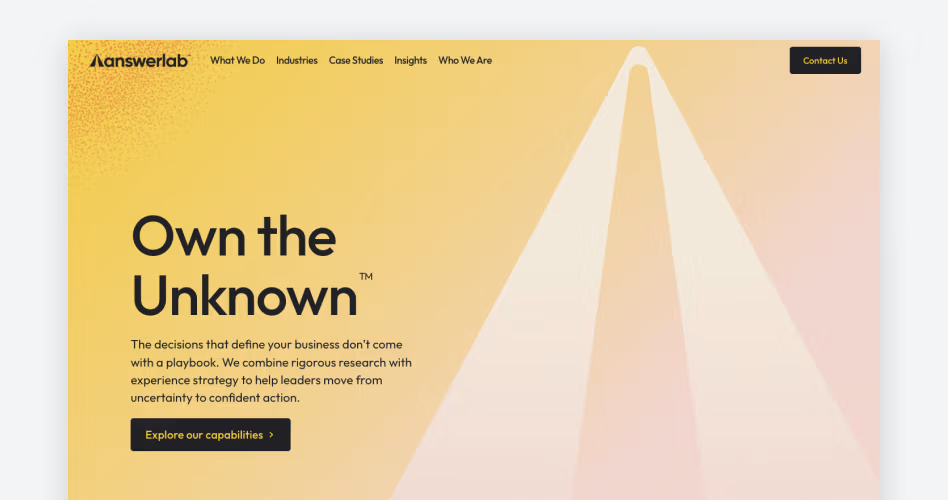
AnswerLab does one thing and does not pretend otherwise: UX research, full stop. No design services, no development, just research. That focus is the whole point. Founded in 2004 by Amy Buckner Chowdhry and Dan Clifford. The firm has spent two decades building the muscle for large, ongoing research programs that would overwhelm a smaller team.
Where AnswerLab stands out is scale. The firm runs dedicated research teams that embed with a client's product org and feed them a steady stream of insights, rather than one study at a time. Its Flex and enterprise programs are built for companies like Google, Meta, Amazon, American Express, PayPal, and Airbnb, who need research running continuously, not in occasional bursts. In 2025, the firm leaned further into emerging tech, opening a New York innovation lab to test AI and hardware experiences that can't be evaluated remotely.
AnswerLab's Core Services
- User research: Qualitative and quantitative studies across the product lifecycle.
- Usability testing: Moderated and unmoderated evaluation of digital products.
- Journey research: Mapping how users move across touchpoints over time.
- Quantitative research: Benchmarking and large-sample studies for measurable UX signals.
- Research operations: Managing recruiting, scheduling, and logistics at scale.
Why AnswerLab
Choose AnswerLab when research is a program, not a project. If you have multiple product teams all asking for insights and an in-house team that cannot keep up, this is the firm built for exactly that load. It is an enterprise-first partner, so it fits best when you need research capacity at scale rather than a one-off study.
4. Nielsen Norman Group (NN/g)
- Website: nngroup.com
- Founded: 1998
- Location: Fremont, CA (works globally)
- Team size: 10 to 49
- Starting price: $38K+ per project
- Best for: Teams that want research from the people who wrote the rulebook
About Nielsen Norman Group
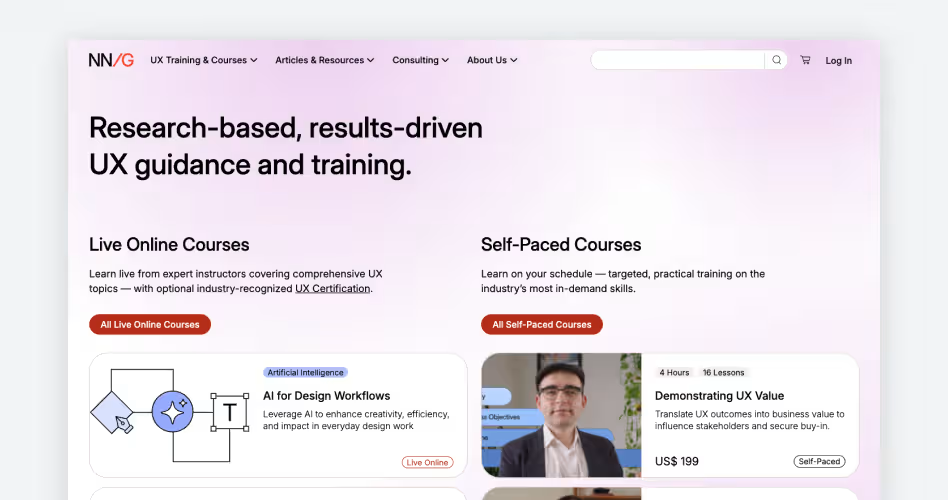
If UX has a founding institution, this is it. NN/g was started in 1998 by Jakob Nielsen and Don Norman, the two people most responsible for turning usability into a real discipline. Norman coined the term "user experience" in the first place, and Nielsen's 10 usability heuristics are still taught in design programs worldwide. When a firm's own research gets cited as the standard, you know what you are buying.
In practice, NN/g splits its work across three things: research studies, consulting, and the training and certification programs it is famous for. A lot of the industry has gone through its courses. The consulting side applies the same evidence-based methods the firm has published for over two decades, which is reassuring if you want research grounded in method rather than opinion.
Nielsen Norman Group's Core Services
- User testing: Moderated usability studies run by senior practitioners.
- User interviews: Qualitative discovery into needs and behavior.
- Card sorting and tree testing: Information architecture validation.
- Eye-tracking: Attention and scan-pattern studies.
- Diary studies: Longitudinal research into real-world usage.
- Quantitative research: Benchmarking and statistically grounded studies.
Why Nielsen Norman Group
You go to NN/g for authority and methodological rigor. The research will be textbook-correct, because in many cases the team quite literally wrote the textbook. The trade-offs are cost and speed: with project pricing starting around $38K and a small senior team, it is not built for fast, scrappy startup work. It fits organizations that value credibility and want findings nobody will argue with.
5. Bold Insight
- Website: boldinsight.com
- Founded: 2018
- Location: Downers Grove, IL (Chicago area) and London, UK
- Team size: 70+ researchers
- Starting price: Custom quote
- Best for: Healthcare, medical devices, and other regulated or high-stakes products
About Bold Insight
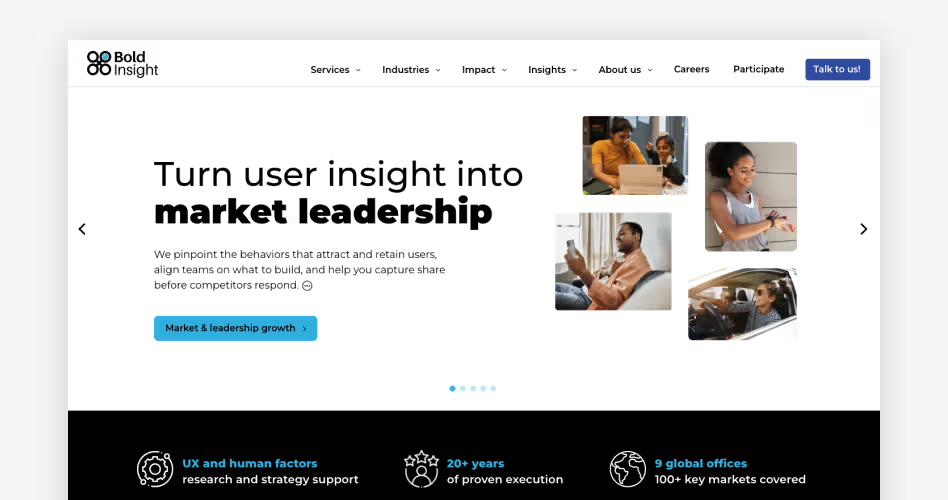
Bold Insight is where you go when getting it wrong is not an option. The firm specializes in human factors research, the discipline concerned with how people physically and cognitively interact with products. It has deep roots in medical devices, where a usability failure can mean a safety failure. This is regulated, validation-grade research, not a quick opinion poll.
Founded in 2018 but led by people who have run UX labs for two decades, Bold Insight is employee-owned and part of ReSight Global. It’s a network of UX agencies that together reach more than 100 markets worldwide. Its work spans medical devices, in-car systems, home appliances, and other products where the physical interaction is as important as the screen.
Bold Insight's Core Services
- UX research: Discovery and evaluative studies across the product lifecycle.
- Human factors research: Formative and summative studies for regulated products.
- Usability testing: Lab-based and global, including validation testing.
- Mixed-method research: Combining qualitative and quantitative approaches.
- Expert review: Heuristic and standards-based evaluation.
Why Bold Insight
If your product lives in healthcare, med-tech, or any regulated space where research has to stand up to scrutiny, Bold Insight is purpose-built for it. The human factors expertise and validation experience are genuinely specialist, not something generalist agencies can fake.
6. Key Lime Interactive
- Website: keylimeinteractive.com
- Founded: 2009
- Location: Miami (Doral), FL (serves clients globally)
- Team size: 21 to 50
- Starting price: Custom quote
- Best for: Enterprise teams that need CX and UX research together, plus emerging-tech experience
About Key Lime Interactive
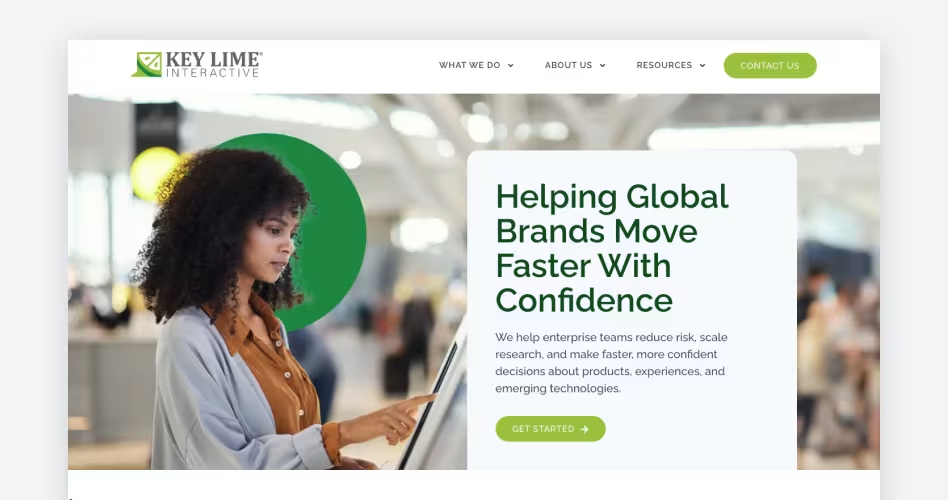
Key Lime Interactive sits at the intersection of two things most agencies treat separately: user experience and customer experience. The firm researches not just how someone uses a product, but how they move through the whole relationship with a brand. That CX plus UX angle is what its Fortune 500 clients, including Amazon, Google, Bose, and Roku, come for.
Founded in Miami in 2009, Key Lime is a woman and minority-owned firm, and it has carved out a genuine niche in emerging technology. While many agencies are still catching up, Key Lime has been running research on VR, extended reality, and voice and conversational interfaces for years.
Key Lime Interactive's Core Services
- User interviews: Qualitative discovery into motivation and behavior.
- Ethnography: Studying users in their real environments.
- Diary studies: Tracking experiences over time.
- Usability testing: Evaluating products with target users.
- Surveys: Quantitative measurement at scale.
- Eye-tracking: Attention and visual-behavior analysis.
- Journey research: Mapping the full customer and user path.
Why Key Lime Interactive
Key Lime fits enterprises that want research across the entire experience, not just the interface, and especially those building with emerging tech. The mixed-method range is broad, so a single partner can handle qualitative depth and quantitative scale.
7. Touchstone Research
- Website: touchstoneresearch.com
- Founded: 1991
- Location: New Haven, CT (research across 60+ markets)
- Team size: 40+ researchers
- Starting price: $65/hr+
- Best for: Consumer-facing products and global, multi-market research
About Touchstone Research
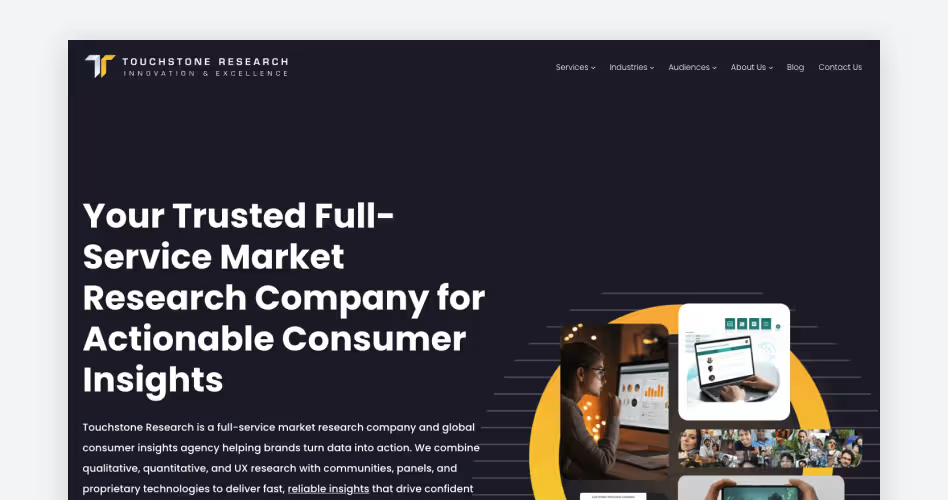
Touchstone has been in the insights business since 1991, which is a rare amount of history in a field this young. It started as a full-service market research firm and grew a dedicated UX practice on top of that foundation.
Touchstone runs research across more than 60 markets, with in-house recruitment and fieldwork teams. This makes it a practical choice when you need culturally grounded insights from several countries at once. In late 2025, Touchstone also launched a dedicated Generative AI UX research practice for testing chatbots, copilots, and other AI tools.
Touchstone Research's Core Services
- UX research: Studies across the full product lifecycle.
- Usability testing: Moderated and unmoderated evaluation.
- User interviews: In-depth qualitative sessions.
- Diary studies: Longitudinal tracking of real usage.
- Ethnography: Contextual, in-environment research.
- Concept testing: Validating ideas before build.
Why Touchstone Research
Touchstone is a strong fit for consumer products, global studies, and teams that value a market-research backbone under their UX work. The large participant reach and recruitment muscle handle multi-market projects that would stall a smaller agency. With rates starting around $65/hr, it is also more accessible than the enterprise-only firms higher on this list.
8. IDEO

- Website: ideo.com
- Founded: 1991 (roots back to 1978)
- Location: Palo Alto and San Francisco, CA (offices across the US, UK, and China)
- Team size: 500+ globally
- Starting price: Custom quote
- Best for: Innovation projects and early-stage, open-ended product questions
About IDEO
IDEO is the agency that gave the industry much of its vocabulary. The firm did not just practice human-centered design, it helped define and popularize design thinking as a method, the empathize-ideate-prototype-test loop now taught everywhere. Founded in 1991 from the merger of three design studios, IDEO has spent decades proving that watching real people closely is where good ideas start.
Its most famous work tends to be the kind that reshapes an entire experience, not just a screen. IDEO redesigned the Kaiser Permanente patient journey, rethought retail banking for Bank of America. Research at IDEO leans heavily on ethnography and observation, uncovering the needs people cannot articulate themselves.
IDEO's Core Services
- User research: Ethnographic and observational discovery into human behavior.
- Design research: Translating field insights into product direction.
- Ethnography: Immersive, in-context study of real users.
- Prototyping: Rapid, testable models of new ideas.
- Concept testing: Validating early directions with people.
Why IDEO
IDEO fits ambitious, open-ended problems where you are not just refining a flow but asking what to build in the first place. If your challenge is "reimagine this experience," few firms bring more pedigree.
9. UX Studio
- Website: uxstudioteam.com
- Founded: 2013
- Location: Budapest, Hungary (works with clients globally)
- Team size: 60+ experts across 13 countries
- Starting price: $50 to $99/hr (projects from $10K)
- Best for: B2B SaaS and digital product teams that want research tightly paired with design
About UX Studio
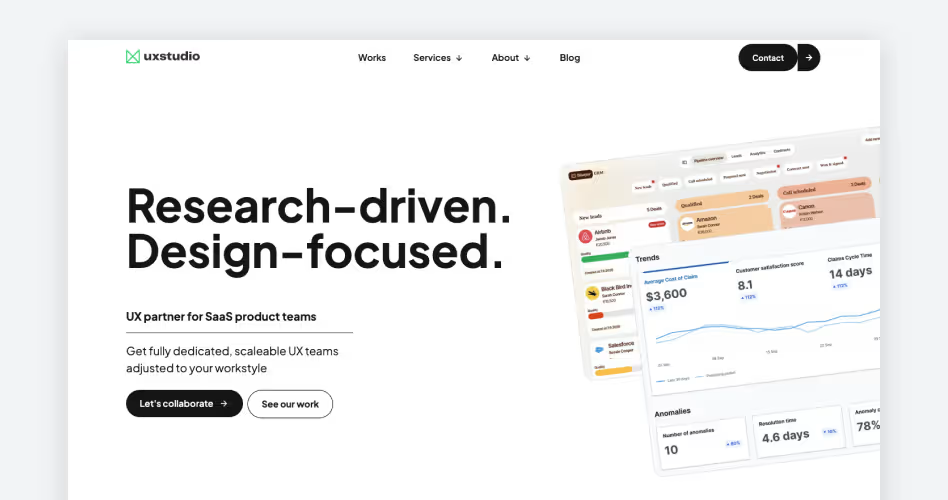
UX Studio is built around one unusual habit: it keeps researchers and designers as separate, specialized roles, then pairs them. A lot of agencies treat research as something a designer does on the side. Here it is its own discipline, which is exactly why the research tends to actually shape the product rather than decorate it. Founded in Budapest in 2013 by Dávid Pásztor, the firm has grown into a genuinely international team.
The focus is squarely on B2B SaaS and complex digital products, and the client list backs that up: HBO, Samsung, UEFA, Bosch, and Wizz Air among them. UX Studio also builds its own software product, a portfolio tool for UX professionals.
UX Studio's Core Services
- Discovery research: Early exploration to frame the right problem.
- User interviews: Qualitative insight into needs and behavior.
- Usability testing: Evaluating products with real users.
- Concept testing: Validating directions before build.
- UX audits: Expert review of existing products.
- Surveys: Quantitative input at scale.
Why UX Studio
UX Studio is a strong pick for SaaS and product teams that want research and design from one tight-knit group. Their pricing works for mid-sized budgets rather than enterprise-only. The dedicated researcher-designer pairing is the real differentiator, and the firm's own product experience means it thinks like a product team, not just a vendor.
10. Foolproof
- Website: foolproof.co.uk
- Founded: 2002
- Location: London and Norwich, UK (plus Singapore, India, and South Africa)
- Team size: 100 to 185
- Starting price: $10K+
- Best for: Experience strategy and behavioral research for established brands
About Foolproof
Foolproof started in 2002 with research at its core, back when "experience design" was barely a job title. That early bet gave the firm a two-decade head start on the behavioral side of UX, understanding not just what users do but the psychology behind why they do it. For brands trying to shift customer behavior, that depth is the draw.
The firm runs out of London and Norwich, with additional studios in Singapore, India, and South Africa, and it is now part of Zensar, a global technology company. That pairing is useful in practice: Foolproof brings the research and experience strategy, while the Zensar connection gives it the engineering muscle to carry findings through to large-scale digital transformation.
Foolproof's Core Services
- User research: Qualitative and quantitative studies into user needs.
- Behavioral research: Understanding the psychology behind user decisions.
- Usability testing: Evaluating real products with target users.
- Experience strategy: Turning insight into long-term UX direction.
Why Foolproof
Foolproof suits established brands and larger organizations that want research tied to strategy, not just a one-off test. For a lean startup it may skew enterprise, but for serious experience programs it brings real depth.
11. Loop UX
- Website: loop-ux.com
- Founded: 2011
- Location: Copenhagen, Denmark and Austin, TX (global consultant network)
- Team size: 20 to 50 (plus a worldwide network)
- Starting price: Custom quote
- Best for: Global, multi-country qualitative research
About Loop UX
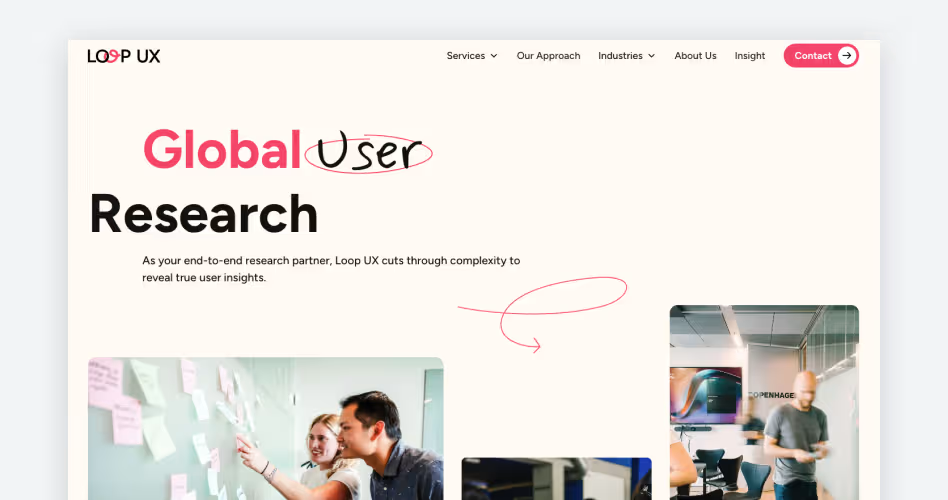
Loop UX solves a specific, genuinely hard problem: running quality user research across many countries and cultures at once. Since 2011, the firm has conducted studies in 47 countries across 6 continents, and that international reach is the entire proposition. If you need to understand users in markets you have never operated in, this is the kind of specialist that makes it possible.
Based in Copenhagen with a second base in Austin, Loop UX runs on an in-house team backed by a global network of moderators, translators, and recruiters. It handles the messy operational parts that sink most international studies: recruiting the right people, moderating in local languages, and coordinating fieldwork across time zones.
Loop UX's Core Services
- End-to-end UX research: Full project ownership from planning to reporting.
- Research operations: Recruiting, scheduling, and in-field coordination.
- User interviews: Qualitative sessions across languages and cultures.
- Usability research: Evaluating products with local users.
- Global fieldwork: Multi-country study execution and translation.
Why Loop UX
Loop UX is the clear pick when your research needs to cross borders. Most agencies can test users in one market; far fewer can run a coordinated study across a dozen. If international grounded insight is what you are after, Loop UX is built precisely for that.
12. Momentum Design Lab
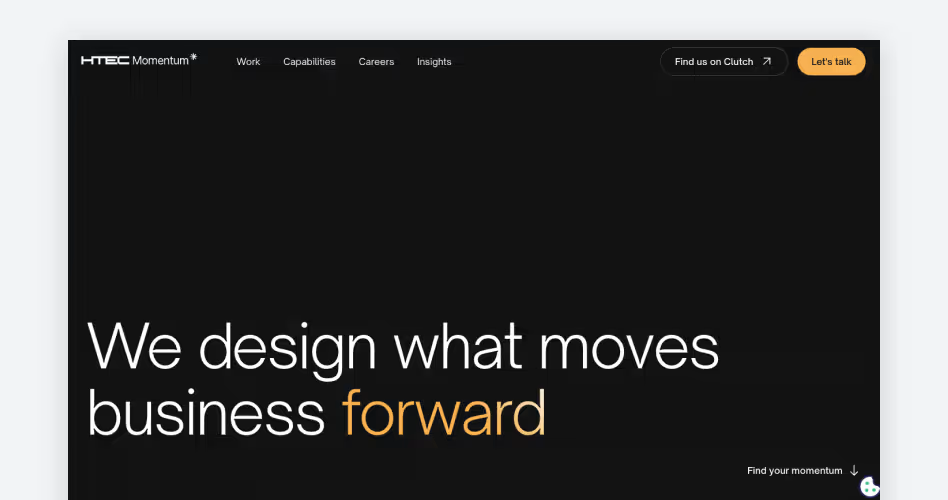
- Website: momentumdesignlab.com
- Founded: 2002
- Location: Palo Alto, CA (plus New York and London)
- Team size: 50+
- Starting price: $25K+ (most projects $50K to $250K)
- Best for: Enterprise product teams that want research, design, and engineering under one roof
About Momentum Design Lab
Momentum Design Lab treats research as the front end of a much longer pipeline. The firm is a product strategy, design, and engineering consultancy, which means user research does not stop at a report.
It feeds directly into design decisions and, when needed, into the actual build. For teams that want continuity from insight to shipped product, that integration is the appeal.
Momentum Design Lab's Core Services
- UX research: Discovery and evaluative studies to guide product direction.
- Product strategy: Connecting research to roadmap and business goals.
- Usability testing: Validating designs with real users.
- UX/UI design: Turning insights into polished, usable interfaces.
Why Momentum Design Lab
Momentum fits enterprises that want one partner from research through to engineering, rather than stitching together three vendors. With most projects landing between $50K and $250K, it is an investment-level choice aimed at serious product work, not quick tests.
13. UXReactor
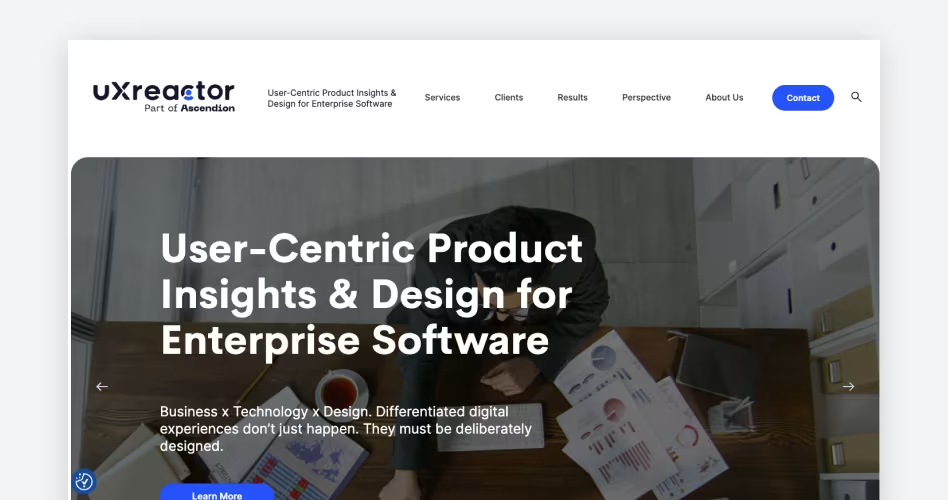
- Website: uxreactor.com
- Founded: 2014
- Location: Pleasanton, CA (plus Hyderabad, India and Medellín, Colombia)
- Team size: 60+ across three continents
- Starting price: $150 to $199/hr (premium project sizes)
- Best for: Enterprise B2B software where research must move business metrics
About UXReactor
UXReactor was founded in 2014 by Satyam and Prasad Kantamneni with a pointed thesis: too many companies treat UX as decoration instead of a growth engine. The firm built its entire practice around proving the opposite, tying research directly to business outcomes like adoption, retention, and customer lifetime value.
The firm specializes in complex B2B enterprise software. That includes legacy systems that most agencies avoid, and runs everything through its proprietary PragmaticUX methodology. UXReactor has landed on the Inc. 5000 list of fastest-growing companies for several consecutive years, which backs up the growth story.
UXReactor's Core Services
- UX research: Studies tied explicitly to business metrics.
- Product strategy: Aligning UX work with enterprise goals.
- Usability testing: Evaluating complex workflows with real users.
- UX design: Translating research into enterprise-grade interfaces.
Why UXReactor
UXReactor is a strong fit for enterprise software companies, especially those wrestling with complicated or legacy products, that need research framed around measurable business impact. Pricing sits at the premium end, so it suits organizations ready to invest in UX as a strategic lever.
14. Fuzzy Math
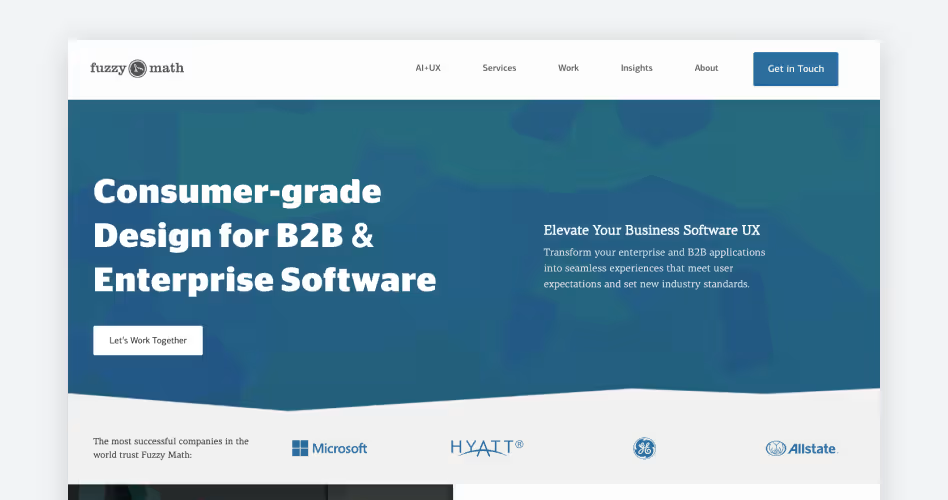
- Website: fuzzymath.com
- Founded: Late 2000s
- Location: Chicago, IL
- Team size: 10 to 49
- Starting price: 35K+(projectsupto~$35K+ (projects up to ~$850K)
- Best for: Complex, enterprise-grade digital products and B2B software
About Fuzzy Math
Fuzzy Math has built its name in one city and one kind of work: it is consistently ranked among the top UX firms in Chicago. It specializes in the unglamorous but valuable problem of making complex enterprise software usable. Their focus is the foundational logic that keeps dense, and workflow-heavy products functional.
Co-founded by Mark Baldino, the firm pairs research with information architecture and strategy. Clients include large research institutions and software companies, and the firm's Clutch track record in usability testing. It is a boutique operation that stays small on purpose, which keeps engagements close and senior.
Fuzzy Math's Core Services
- Discovery research: Framing the real problem before design starts.
- Contextual inquiry: Studying users within their actual workflows.
- Ethnography: In-environment observation of behavior.
- Surveys: Quantitative input across user groups.
- Diary studies: Longitudinal tracking of real usage.
- Usability research: Evaluating complex products with target users.
Why Fuzzy Math
Fuzzy Math suits teams wrestling with complicated, information-dense products, especially in B2B and enterprise, who want a research partner that prioritizes clarity over decoration. Their boutique size means senior attention rather than being passed to juniors.
15. Coalesce
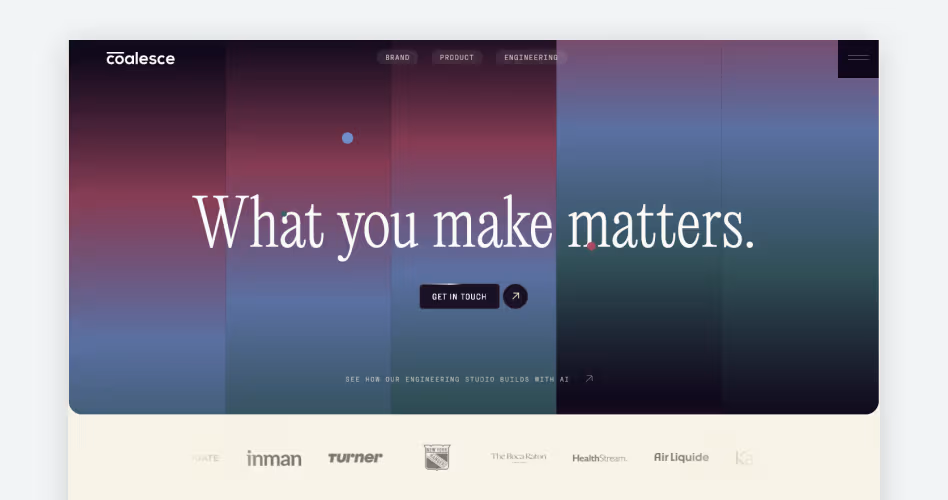
- Website: coalesce.nyc
- Founded: 2006
- Location: New York City, NY
- Team size: 10 to 49
- Starting price: ~$15K+
- Best for: Teams that want research, product strategy, and build from one studio
About Coalesce
Coalesce has been running since 2006, and it works as a full-stack product shop rather than a research-only firm. The team is organized into distinct studios, Brand, Product, Content, and Engineering, that operate as one unit, so research does not sit in isolation.
On the research side, Coalesce runs generative research, discovery sprints, UX audits, and usability testing. It has particular experience in financial, healthcare, and media and entertainment products. The firm tends to work closely and collaboratively, often positioning itself as an extension of the client's own team rather than an outside contractor handing over deliverables.
Coalesce's Core Services
- Generative research: Early discovery into user needs and opportunities.
- Usability testing: Evaluating products with real users.
- UX audits: Expert review of existing experiences.
- Surveys: Quantitative input to support decisions.
- Discovery sprints: Fast, focused research bursts to frame direction.
- Research retainers: Ongoing research support over time.
Why Coalesce
Coalesce fits teams that want research connected to strategy and build under one roof, with the flexibility to use one studio or all of them. The collaborative, embedded style works well for companies that want a hands-on partner.
How to Choose the Right UX Research Agency
Choosing a UX research agency isn't just about picking the agency with the biggest portfolio or the longest list of services. The right partner depends on what you need to learn, who your users are, and how the research will influence your product decisions.
Before reaching out to agencies, define the problem you need research to solve. Then use the steps below to narrow down your options and find an agency that fits your product, users, timeline, and budget.
1. Start With the Problem You Need to Solve
Before comparing agencies, get clear on what you need to learn. Are you validating an MVP, trying to understand why users drop off, testing a new feature, or researching customers before a redesign?
Your research goal should guide the agency you choose. An agency that's great at usability testing may not be the best fit for deep discovery research or market exploration. Give agencies the problem first and see how they propose solving it.
2. Match Their Expertise to Your Product and Users
Look for agencies that have experience with products, industries, and audiences similar to yours. Check their case studies to see whether they've worked with SaaS products, enterprise software, healthcare, consumer apps, AI products, or whatever matches your situation.
Also consider whether they can recruit the right participants. Strong research with the wrong audience can still lead to the wrong conclusions.
3. Evaluate Their Research Approach and Deliverables
Don't choose an agency simply because it lists every research method imaginable. Ask how it decides which methods to use and what the actual research process looks like.
Look for a clear approach to planning, recruiting participants, conducting research, analyzing findings, and presenting recommendations.
More importantly, find out what you'll receive at the end and how those findings will help your product team make decisions.
4. Compare Case Studies, Reputation, and Cost
Now compare your shortlisted agencies side by side. Look at the quality of their case studies, client reviews, relevant experience, pricing model, project scope, and timeline.
Don't automatically choose the cheapest option. A lower quote isn't much of a bargain if the research doesn't answer the questions your team actually has.
Instead, compare the expected value of the research against the investment.
5. Talk to the Team Before You Hire Them
Set up a discovery call with your top two or three choices. Explain your product, users, challenges, and what you're hoping to learn, then pay attention to the questions they ask.
A strong UX research agency should be curious about the problem before recommending a solution. If they quickly understand your situation, challenge your assumptions when necessary, and explain how their research could lead to better product decisions, you've probably found a strong candidate.
Red Flags to Watch for When Hiring a UX Research Agency
Before hiring a UX research agency, you should have a clear idea of who your target users are. From there, you can look for an agency that fits your goals, product, and budget.
But even when an agency seems like a good match, there are warning signs you shouldn't overlook. Spotting these red flags early can help you avoid poor research and costly product decisions later.
- The agency only talks about the product: Many agencies focus heavily on your interface, features, or business goals. But if they can't explain how they plan to understand your target users, that's a red flag. Good UX research starts with the people using the product, not the product itself.
- The agency only talks about the product: Many agencies focus heavily on your interface, features, or business goals. But if they can't explain how they plan to understand your target users, that's a red flag. Good UX research starts with the people using the product, not the product itself.
- The agency recommends a research method too early: Some agencies may immediately suggest interviews, surveys, or usability testing before understanding your actual problem. This can lead to a one-size-fits-all approach. A good research partner should first understand what you need to learn, then recommend a method that fits the problem.
- The agency shows polished designs instead of research: A polished portfolio can look impressive, but it doesn't necessarily prove strong research capabilities. If the case studies focus mostly on the final interface without explaining the research process, findings, or decisions behind the work, that's something to watch for. Good UX research should show how user insights influenced the product.
- The agency can't explain how it recruits participants: The people included in your research can directly affect the quality of your findings. If an agency can't clearly explain where participants come from or how they match your target users, the research may not reflect the people you're actually designing for. A good agency should have a clear process for finding and screening relevant participants.
Frequently Asked Questions
What does a UX research agency do?
A UX research agency plans and runs studies to uncover how real users behave, think, and struggle with a product. It handles participant recruitment, moderated and unmoderated testing, interviews, and analysis, then delivers prioritized insights that guide design, product, and business decisions.
How much does a UX research agency cost?
UX research agency pricing typically ranges from about $5,000 for a single usability study to $50,000+ for a full research program. Costs depend on method, number of participants, recruitment difficulty, and whether you need a one-off project or ongoing research.
What is the difference between a UX design agency and a UX research agency?
A UX research agency focuses on understanding users through studies, testing, and analysis. A UX design agency focuses on building the interface and visual experience. Research agencies tell you what to fix and why; design agencies create the solution.
How do you choose the best UX research agency?
Choose a UX research agency by matching their method expertise to your question, checking relevant industry experience, and reviewing past deliverables. Confirm their recruitment reach, ask how they turn findings into decisions, and make sure their process fits your timeline and budget.
How do UX research agencies recruit specialized participants?
UX research agencies recruit specialized participants through vetted panels, screener surveys, and global recruitment networks. For hard-to-reach groups like clinicians, developers, or enterprise buyers, they use targeted sourcing, professional databases, and partner recruiters to verify each participant matches your exact user profile.
Can a UX research agency help with AI products and LLM interfaces?
Yes. Experienced UX research agencies now test AI products and LLM interfaces, studying how users trust, interpret, and act on AI outputs. They evaluate prompt flows, error handling, and conversational experiences to make AI features feel reliable, clear, and genuinely useful.
Should you hire a UX research agency or build an in-house team?
Hire a UX research agency for specialized expertise, faster setup, and flexible project work without long-term overhead. Build in-house for continuous, deeply embedded research. Many teams combine both: an agency for scale and senior methods, in-house researchers for day-to-day product decisions.
Which UX research agency is best for startups and B2B SaaS?
For startups and B2B SaaS, the best UX research agency moves fast, understands complex workflows, and runs lean research sprints that fit product timelines. Look for SaaS experience, flexible engagement models, and researchers who connect findings directly to product and growth metrics.
Final Thoughts
The right UX research agency can do more than uncover usability problems. It can help your team understand what users actually need, and make better product decisions.
But the best agency isn't necessarily the biggest or the most expensive one. Look for a partner that understands your product, knows how to reach your users, and can turn findings into clear actions.
The 15 agencies on this list offer different strengths, from enterprise research and usability testing to SaaS, and AI. Take the time to compare them against your specific needs.