%201%201.svg)
Trusted by 105+ SaaS Founders and Product Teams




.webp)

.webp)



.webp)








A Faster Way to Create Polished, On-Brand Marketing Assets
You need more creatives faster, without expanding the team or increasing resources. That’s where we come in. Our team of creative experts, combined with advanced AI tools, produces high-quality visuals that highlight your product’s quality while following best practices for AI-driven production.
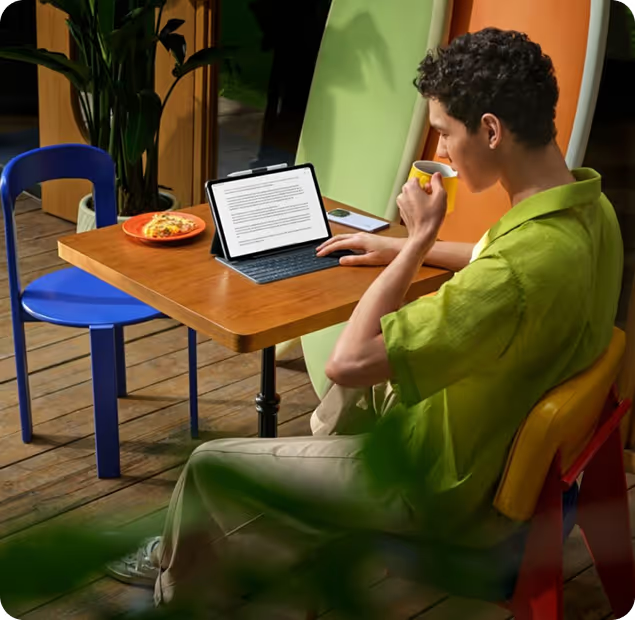

Fast Ad Creative With AI Tools
Produce more campaign-ready content in less time with a process designed for speed, consistency, and scale.

Lower Production Costs
Cut down on production drag and create more high-quality assets without expanding internal resources.

Brand-Safe AI Creative Production
Every asset is shaped around your brand standards, visual system, and review process so the output stays consistent, polished, and safe to use.

Human-Guided Creative Control
AI speeds up production, but the process stays directed by real creative oversight so every output aligns with your goals, quality bar, and approvals.
What Better AI Production Looks Like
We help teams produce more creative, move faster, and stay consistent across every asset.
AI creative projects delivered
140+
Brands and teams supported
35+
Years using AI in creative workflows
03+
Average client rating
4.9
AI Helps Creative Teams Move Faster Without Lowering the Bar
Strong creative still starts with ideas, direction, and taste. AI simply helps speed up production, create more variations, and support faster delivery without losing quality.
For SaaS and AI teams, that means more launch assets, campaign visuals, and branded content delivered on time, with a process that stays efficient, controlled, and aligned with your brand.
.avif)
.avif)
Scalable Creative Production for Brands That Need Speed and Consistency
We help teams produce high-quality creative faster while keeping every asset aligned with the brand and ready for launch.
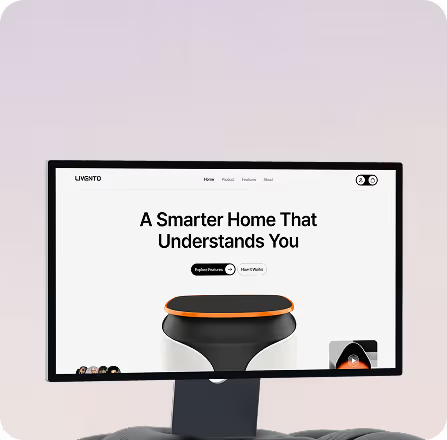
Product Visuals
Need visuals for a launch or update? Our AI process delivers polished imagery quickly, bypassing lengthy production cycles.
.avif)
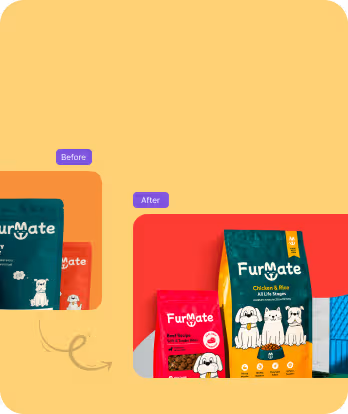
Brand Imagery
Build a flexible library of on-brand visuals that can be reused across campaigns, content, ads, and launch materials.

Production at Scale
As an AI partner, we transform a single concept into various formats and versions for all channels.
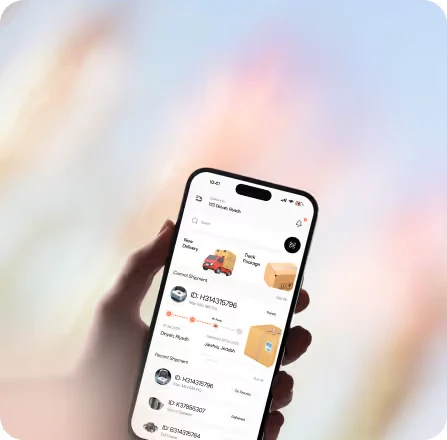
Creative Variations
Generate multiple concept versions with AI to enhance testing and accelerate learning.
.avif)
Image Enhancements
Improve lighting, clarity, color, and overall polish with AI-powered design services that make existing visuals cleaner, sharper, and more campaign-ready.
.avif)
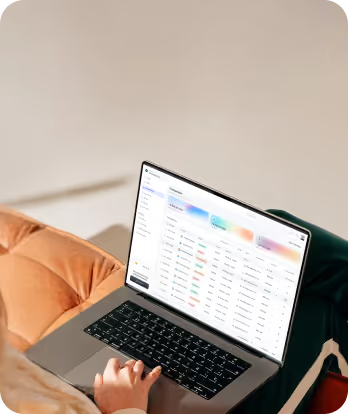
Scene Generation
Use AI to place your product in new settings without needing a full reshoot.
.avif)
Visual Compositing
Integrate products and design layers into a unified, launch-ready asset.
Choose the Creative Production Model That Fits Your Team
You decide how AI is used in the process. We shape the workflow around your brand, approval needs, and production goals.
AI-Assisted
Best for high-volume creative where speed, variation, and efficiency matter most.

Fast asset production
More versions in less time
Useful for repeatable tasks
Great for testing and scale
Hybrid
A balanced model that combines AI speed with human creative direction and quality control.
Human-led creative thinking
AI-supported production speed
Flexible across most projects
Built for quality and scale
Human-Led
Perfect for projects requiring in-depth creativity, precise control, or traditional methods.
Fully custom creative work
More hands-on refinement
Greater review control
Ideal for high-stakes assets
What SaaS Teams Say About
Working with Orbix Studio

Jessica Epley
Finance Manager, TN HomeBuyers
5/5

"Attention to detail showed in every step of the project. The new website delivered stronger conversions, higher organic traffic, and a smooth development experience."
52%
Higher online conversion rate
37%
Increase in organic search traffic

Rizwan Chaudhry
CEO, Cenmed Enterprises
5/5
"Every design decision had a clear purpose behind it. The final product feels more cohesive and much easier for customers to navigate."
41%
Faster Task Completion
92%
Design Consistency

Mark Boudreau
COO, Healthfully
5/5
"Orbix Studio kept the project organized, communicated clearly, and delivered everything on schedule."
100%
On-Time Delivery
<24 hrs
Average Response Time
Robel Yemane
Engineering Leader, Privilee
5/5
"It was clear we were working with people who knew what they were doing. Every milestone stayed on track, and the final microsite met all our expectations."
3 Weeks
Launch Timeline
100%
Reusable Components.

Olha Lomako
Founder, Modern Etiquette with Olha
5/5
"It never felt like just another project. Every decision was made with our goals in mind, and the team genuinely cared about getting everything right."
100%
Brand Alignment
4 Weeks
Project Completion

Jamie Prickett
CEO, Experior Financial Group
5/5
"Orbix Studio has made our day-to-day work more efficient, and our users have noticed the difference too. It's been a great experience from start to finish."
35%
Less Manual Work
94%
User Satisfaction

Vladimir Plancak
Software Developer, TIAC d.o.o.
5/5
"Working together was easy from day one. Whenever priorities changed, the team adapted quickly and kept everything moving without delays."
98%
On-Time Delivery
95%
Issue Resolution
.svg)
.svg)

Got Questions?
We’ve Got Answers
If you’re unsure where to start or want to see how we can help, reach out, and we’ll walk you through it.

Let’s Talk
Book an Intro Call
Founder & CEO @OrbixStudio
.svg)
What is AI creative production?
When should I use AI instead of traditional production?
How do you keep AI-generated work on brand?
Is every project reviewed by your creative team?
Will AI-generated content look unique?
Can you combine AI with traditional design?
Can AI speed up content production?
Is AI-generated content safe for commercial use?
Can you create content at scale?
Is AI creative production right for every business?
Let’s Talk
Book an Intro Call
Founder & CEO @OrbixStudio

.svg)


.svg)

.svg)

.svg)
.svg)







.avif)



.svg)

