


.svg)

%201%201.svg)
The Design Thinking Behind Apple's New Mac Mini 2026
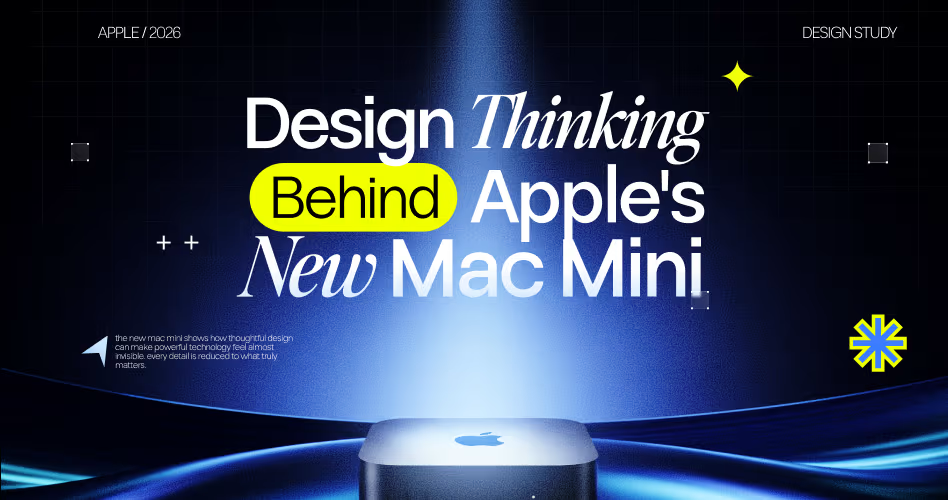
Great product design isn't always about adding something new. Sometimes, it's about making something more capable while keeping the experience familiar, simple, and focused.
Apple's new Mac mini with M6 is a good example of that thinking. The latest model brings a significant jump in performance, but Apple hasn't tried to make that progress feel visually complicated.
Instead, the product continues to follow the same simple idea: pack more capability into a small, familiar form and let the technology do the talking.
That raises a more interesting question than how fast the new Mac mini is: what can its design teach us about building better products?
Power in a Familiar Form
The new Mac mini brings a significant increase in performance without moving away from the compact form that defines it.
With the new M6 and M5 Pro chips, Mac mini can handle more demanding workloads, from AI and app development to video editing, 3D design, and scientific computing.
Yet, that increase in capability doesn't come with a dramatic change in how the product presents itself. The Mac mini remains compact and understated, keeping its familiar form while putting substantially more power inside.
That balance is an important part of its design. Instead of making the product physically larger or visually more complex to communicate its capabilities, Apple has focused on what the existing form can accommodate.
Simplicity Takes More Design Work
Products that stand out often make complexity feel effortless. They look simple, feel intuitive, and remain functional without overwhelming the people using them.
The Mac mini has continued to hit that benchmark. Apple redesigned the desktop around a smaller 5-by-5-inch footprint in 2024, cutting its size dramatically while keeping the familiar idea of a compact desktop.
For the new M6 and M5 Pro models, Apple has chosen not to reinvent that design again. Instead, it has kept the same compact form while increasing what the machine can handle, including significantly more demanding AI and professional workflows.
At Orbix Studio, this is something we appreciate ourselves. We love the Mac mini so much that many of our own design and development workflows are built around Mac minis. Its small footprint, quiet operation, and ability to handle demanding creative work make it a natural fit for the kind of work we do.
Familiarity Is Part of Good Design
People don't want to relearn a product every time it gets better. Familiarity creates a sense of confidence — you already know where things are, how they work, and what to expect. That makes it easier to notice what's improved rather than spending time figuring out what's changed.
The Mac mini benefits from that continuity. Its compact desktop format has become recognizable enough that the product can evolve without constantly redefining itself. The new generation keeps that established relationship while introducing support for newer technologies, from faster connectivity to more advanced workflows.
This is especially valuable for a product designed to fit into existing setups. Users can bring the new Mac mini into the same workspace, connect the displays and accessories they already use, and continue working without having to rethink the entire experience.
Good design doesn't always ask people to adapt to the product. Sometimes, it lets the product adapt while the experience they already know stays intact.
Designing Within Constraints
Every product has limits, but the best designs often make those limits work in their favor. The challenge is not simply fitting more into less space; it is finding the right balance between what a product needs to do and how much it needs to be.
The Mac mini is built around that balance. Its compact design gives it a clear purpose: deliver the capabilities of a desktop without taking over the desk.
With the latest M6 and M5 Pro models, Apple has pushed that idea further, bringing more performance and new technologies into the same compact footprint.
Rather than letting the added capabilities change the character of the product, Apple has continued to work within the boundaries that make the Mac mini what it is.
Letting the Product Get Out of the Way
The best products don't constantly ask for attention. They give you what you need, work the way you expect, and let you focus on what you came to do. When the design works well, the product becomes part of the background rather than the center of the experience.
Mac mini has always followed this idea. It doesn't need to dominate a workspace or dictate how the setup should look. Its compact form allows it to sit quietly alongside the display, keyboard, and other devices, becoming the foundation for whatever workflow the user wants to build.
With the latest generation, that role becomes even more important. Whether it is powering creative work, development, AI workflows, or everyday tasks, the Mac mini is designed to provide the capability without getting in the way of the work itself.
Good product design doesn't always make the product the star. Sometimes, its greatest success is giving the user more room to be.
The Design Lesson Behind the Mac mini
The interesting part of the new Mac mini isn't that Apple found another way to make a small computer more powerful. It's that the product doesn't need to constantly reinvent itself to remain relevant.
Its evolution has happened through refinement: better technology inside, stronger capabilities, and more possibilities for the people using it, while the fundamental idea of the product remains clear.
That reflects a different way of thinking about innovation. Not every generation needs to introduce a new visual language. Sometimes, progress comes from knowing which parts of a product have already been solved and putting the design effort into everything that can be better.






.svg)
.svg)


.svg)







.avif)



.svg)

