


.svg)

%201%201.svg)
In-House Design Team vs Design Agency: Cost, Speed, Quality & Fit
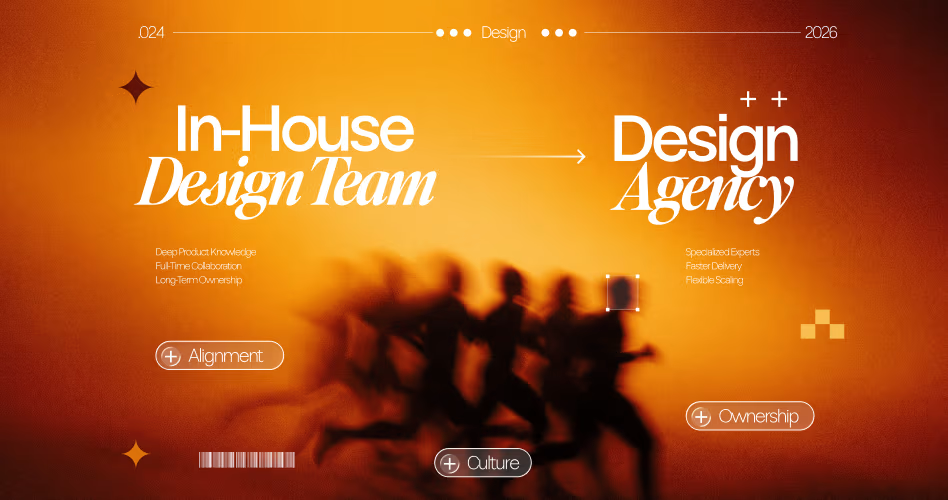
Imagine a huge product launch next week and you desperately need new website designs. Do you rely on the designer sitting next to you, or outsource to an agency? Making the wrong choice can completely derail your marketing.
The problem is that most advice online makes this sound way too simple. People just say "agencies are faster" or "in-house teams know your brand better."
But in the real world, it is never that black and white. There are factors like who owns your design files, how you handle unexpected sick days, and what happens when your project suddenly doubles in size.
Today, we are going to look at 35 crucial factors to compare the in-house vs design agency. By the end, you will have a clear roadmap to build a design setup that actually works for your business.
Why are you hiring design in the first place?
People get this step completely wrong. They start googling "in-house vs agency" before they even know what problem they are trying to solve. They just want a quick answer. But there isn't one.
Choosing a design team is exactly like buying a vehicle. You wouldn't buy a massive school bus just to drive yourself to the grocery store. That is a huge waste of money. But you also wouldn't buy a tiny skateboard to take thirty kids on a field trip. That would be a total disaster. You have to match the tool to the job.
Before you look at prices, you need to figure out what you are actually trying to build. Here are the three most common jobs people hire designers for:
- The Daily Chores (Social posts, email headers, website tweaks): If you need a steady stream of small tasks every single week, the scale tips toward In-House. They are like your everyday car. They are always parked outside, always ready to go, and perfect for short, daily trips.
- The Massive Build (A new website, a total rebrand, a product launch): If you need a huge, one-off project finished fast, the scale tips toward an Agency. An in-house designer will completely break under that pressure. An agency is like hiring a fleet of taxis to get a massive amount of work done at the exact same time.
- The Special Skill (3D animation, complex app design): If you need something highly specific that your current team doesn't know how to do, the scale tips toward an Agency. A UI/UX design agency, for example, has a whole roster of researchers and product designers you can borrow just for that one project.
In-house design team vs design agency: the core differences
Now that you know what you are actually trying to build, it is time to look at the raw facts. This is the meat of the guide.
Here, we are going to pit these two options against each other head-to-head. We will not just say "agencies are better" or "in-house is cheaper." That is useless advice.
Instead, we are going to break down exactly how each model handles your money, your time, your brand, and your stress levels.
Financial factors: the true cost of design
Most people think hiring an in-house designer is the cheap option. You just pay their salary, right? Wrong. That salary is just the tiny tip of a massive iceberg.
When you hire an employee, that $80,000 salary quickly jumps over $104,000 once you pay their hidden taxes, health insurance, and buy their expensive design laptop.With an agency, your monthly fee is the only fee. All those extra costs are already baked into our price, so you never get a surprise bill.
Then there is the "idle time" trap. If your business hits a slow month, an in-house designer still gets a full paycheck for sitting at their desk.
When you work with us, you only pay when work is actually getting done. Need to pause the contract in December? Just say the word.
Yes, an in-house designer is great because you can ask them for "just one more quick graphic" without getting charged extra. But you have to ask yourself: is paying an extra $25,000+ a year in hidden taxes and slow-month salaries really worth saving a few bucks on a last-minute social post?
Speed & turnaround factors: who is actually faster?
If you ask most people who is faster, they will usually guess the in-house designer. But that is a trick question. "Speed" isn't just one thing. It completely depends on the size of the task you are asking for.
If you need a logo resized in ten minutes, an in-house designer wins. They are sitting right there. You can just send a Slack message and it is done. An agency has to route that request through an account manager, assign it to a designer, and that takes at least a day.
But what happens when you need a whole new website, a video, and fifty ad graphics by next month? An in-house designer will completely choke under that pressure.
They are just one person. That is where an agency absolutely dominates. We call it the "swarm effect." We can put five different specialists on your project at the exact same time to brute-force it across the finish line.
Then there is the delay before any work even starts. If you want to hire someone internally, you are looking at 60 to 90 days of interviewing before they sit at a desk. You can onboard with an agency in just one to two weeks.
Read More about: Choosing Best SaaS Design Agency
Quality & brand knowledge factors
The biggest fear people have about hiring an agency is that we won't "get" their brand. They think an inside team will always do better because they are part of the company. But that is only half true.
It is true that an in-house designer absorbs your brand like a sponge. They sit in on your meetings, hear what customers complain about, and just know how things should look without being told.
When you first hire an agency, there is a small "learning curve." We have to spend a little time studying your brand guidelines and your tone of voice so we get it exactly right.
But here is the danger of keeping everything in-house: tunnel vision. When one person stares at the exact same brand colors and logos every single day, they run out of good ideas. It is called design fatigue.
An agency works with twenty different industries. We can take a cool strategy that works great for a tech company and use that fresh perspective to make your brand look even better.
You are stuck with whatever skills your in-house designer has. If you hired someone who is great at websites but terrible at drawing, you are out of luck. An agency is like a Swiss Army knife.
Scalability & elasticity factors: future-proofing your design
Businesses grow, and when they do, they need a lot more design work. But what happens when your workload suddenly doubles or cuts in half?
If you suddenly get a massive project, an in-house designer will simply break. They are just one person. You can't magically make them work 100 hours a week.
With an agency, you just let us know the goal is bigger, and we instantly throw more designers at the project to get it done.
Then there are the slow months. If January is dead and you have no design work, you still have to pay your in-house designer's full salary.
With an agency, your design costs are elastic. If you don't need us, you just pause the contract and keep your cash in the bank.
Agencies are perfect for seasonal spikes. If you sell retail and need five times the normal amount of design work for Black Friday, an agency handles it easily. Trying to hire three new employees just for November, and then firing them in December, is a total nightmare.
Read More about: Best Webflow Agency
Security, ip & risk factors: protecting your business
When you hire outside help, business owners naturally get worried about safety. Who actually owns the art? Is your secret product safe?
If you are building a top-secret invention and don't want anyone to know, an in-house team is slightly safer because they are physically inside your building. However, a good agency uses strict legal contracts (NDAs) to lock down your secrets anyway.
The biggest fear people have is losing their design files. Some bad agencies try to hold your raw files hostage so you can never leave them. We don't do that. You own 100% of the finished art, and if you ever want your raw files, we hand them over immediately.
You can stop an in-house designer from quitting and working for your biggest rival. By law, an agency can work for other companies.
But honestly? That just means we have more experience solving problems across different markets, which actually makes your designs better.
The alternative: hybrid models of 2026
By now, you might be thinking you have to pick a side. You either hire a full-time employee, or you sign with an agency. But in 2026, the smartest companies don't do either. They mix and match to get the best of both worlds.
First, there is Design-as-a-Service (or DaaS). These are online clubs where you pay one flat fee every month for unlimited design requests.
It feels like having an in-house designer because of the predictable price, but you don't have to pay their health insurance.
Then there is the Fractional model. Imagine hiring a super experienced Art Director, but only for ten hours a week. They don't do the daily grinding. They just guide your junior in-house team to make sure their work actually looks good.
But here is the ultimate setup, and the one we recommend most: The "Inside-Out" model. You keep one highly-paid in-house Design Lead who protects your brand.
Then, instead of hiring five more employees to sit under them, you hire an agency to do the heavy lifting. Your in-house lead acts as the boss, and we act as their on-demand design army. You get perfect brand safety, massive speed, and zero HR headaches.
Which one should you choose?
You have made it to the end. We have talked about the hidden costs, the speed differences, and the HR headaches. Now, it is time to make a final decision.
To make this incredibly easy, just look at these three paths and see which one sounds exactly like your business right now.
Choose an in-house team if
You should go this route if you have a never-ending, daily stream of small design tasks like social posts and email graphics. It is also the right move if you are working on top-secret products where you absolutely cannot risk anyone outside the company seeing your ideas.
Just make sure you actually have the budget to pay the full-time salary, cover the hidden benefits, and have the time to manage them. Then you still have to find the person, and how to hire a UX designer breaks that search into steps.
Choose a design agency if
You should pick an agency if your workload is completely unpredictable. If your business is super busy in November but completely dead in January, an agency lets you scale up and down without the financial pain.
You should also pick us if you have a massive launch coming up and need a whole website, a video, and fifty ads finished in just a few weeks. That whole website part is the one nobody in-house has usually done before, which is exactly the kind of web design agency brief we get called in for.
Finally, an agency is the only way to get highly specialized skills, like 3D animation or complex app design, that no single employee could possibly know how to do on their own.
The "hybrid" sweet spot
If you have the budget for it, there is a third option that is actually the ultimate setup for 2026.
You keep one highly-paid in-house Design Lead whose only job is to protect your brand. Then, instead of hiring a whole team of junior designers to sit under them, you hire an agency to handle the heavy lifting.
Your in-house lead acts as the boss, we act as their on-demand design army, and you get perfect brand safety mixed with massive agency speed.
Frequently asked questions
Is it cheaper to hire an in-house designer or an agency?
It depends on your workload. In-house is cheaper per hour, but you pay them during slow months too. Agencies cost more per hour, but you only pay when work is actively being done.
Do agencies own my design files?
They shouldn't. Some agencies try to hold your raw files hostage. A good agency will clearly state in your contract that you own 100% of the final art and the raw files.
Can an agency really understand my brand as well as an internal team?
Yes, but it takes a little time. An in-house person learns by osmosis. An agency needs a thorough onboarding phase first, but after that, they will know your brand perfectly.
What is Design-as-a-Service (DaaS)?
It is a middle-ground option. You pay one flat monthly fee for unlimited design requests. It gives you the predictable pricing of an in-house designer without the expensive HR headaches.
How fast can an agency actually start working on my project?
Much faster than hiring. Finding and interviewing an in-house designer takes two to three months. An agency can usually start your onboarding and design work in just one to two weeks.
What happens if I don't like the design the agency makes?
You simply ask for changes. Good agencies include "revision rounds" in their contract. This means you can give feedback and ask them to tweak the design until you are completely happy.
Can I hire an agency for just one small project?
Absolutely. You do not have to sign a long-term contract with an agency. If you just need one new logo or a single landing page built, most agencies are happy to do a one-off project for a flat fee.
Conclusion
Choosing how to handle your design work is one of the biggest decisions you will make for your business. If you need quick, daily tweaks and total secret control, an in-house designer is your best bet.
But if you need massive projects done fast, want to avoid HR headaches, and only want to pay for design when you actually need it, an agency is the clear winner.
The best part? You are not locked into this choice forever. Many successful startups actually start by hiring an agency to figure out exactly what kind of design help they need. Once they grow big enough, they bring someone in-house. You can always change your mind later as your business evolves.


.svg)
.svg)


.svg)







.avif)



.svg)

