- Top Usability Testing Agencies at a Glance
- How We Picked These Agencies
- 15 Best Usability Testing Agencies in 2026
- What Services Do Usability Testing Agencies Provide?
- How Usability Testing Agencies Price Their Work
- How to Choose a Usability Testing Agency: 5 Things to Evaluate
- Red Flags to Watch For
- Frequently Asked Questions
- Final Thoughts


Top 15 Usability Testing Agencies in 2026 (Compared + Pricing Guide)
- A usability testing agency handles the full study: planning, recruitment, moderation, analysis, and recommendations.
- Pick the agency by your biggest gap, not by its portfolio. If you lack researchers, you need moderation. If you lack users, you need recruitment. If you lack designers, you need an agency that can fix what it finds.
- Budget for the whole study, not just the hourly rate. Clutch puts the average at $100 to $200 per hour, while a moderated study with 20 qualified participants typically lands between $12,000 and $15,000 once recruitment, honorariums, moderation, and synthesis are included.
- Recruitment decides the quality of the findings. Testing with people who don't match your users gives you confident answers to the wrong questions.
- Ask for a sample report before you sign. A good one ranks issues by severity and tells your team what to fix first, not just what went wrong.
Finding usability issues before they cost you users is easier said than done. You need more than a few team members clicking through a prototype. You need real users, the right testing methods, and someone who knows how to turn feedback into actionable improvements.
That’s why choosing the right usability testing agency matters. The best agencies don’t just point out where users get stuck. They help you understand why it happens and what you can change to create a smoother product experience.
To make the choice easier, we’ve rounded up the top usability testing agencies worth considering in 2026. We’ll look at what each agency does best, the services they offer, and who they’re a good fit for.
Top Usability Testing Agencies at a Glance
Short on time? Here's a quick side-by-side look at all 15 agencies on this list. Compare where they're based, what they're best at, whether they recruit participants for you, and whether they can fix the issues they find. So, you can shortlist the right fit before diving into the full reviews.
How We Picked These Agencies
There are hundreds of agencies that list "usability testing" as a service, but only a fraction actually run real studies with real users.
To build this list, we reviewed each agency's website, service pages, case studies and Clutch profile, then scored them on the six factors below. We left out QA and bug-testing firms, and testing platforms like Maze or UserTesting, because they solve a different problem.
- Testing methods: We looked for agencies that offer both moderated and unmoderated testing, plus supporting methods like prototype testing, tree testing or accessibility testing. Agencies that sell one fixed test package to every client ranked lower.
- Participant recruitment: Testing with the wrong people gives you the wrong answers. We checked whether each agency recruits participants for you, uses screeners to match your real users, and can reach niche audiences like B2B buyers, healthcare professionals or finance users.
- Report quality: A good usability report tells your team what to fix first. We reviewed sample reports and case studies to see whether findings are ranked by severity, backed by session clips, and paired with clear recommendations.
- What happens after testing: Some agencies hand over a report and step away. Others can redesign, retest or build the fix. We noted which is which so you can choose based on whether your team has the capacity to act on the findings.
- Industry focus: Testing a banking app is different from testing a medical device or a SaaS dashboard. We highlighted agencies with proven depth in specific industries, so you can find a partner that already understands your users.
- Pricing transparency: We pulled minimum project sizes and hourly rates from each agency's Clutch profile or website. Where an agency doesn't publish pricing, we say so, so you know the budget time for a quote.
- Verified reviews: We checked each agency's client reviews on Clutch and looked for feedback on outcomes, not just friendliness: did they deliver on time, did the findings lead to real improvements, and would clients hire them again?
15 Best Usability Testing Agencies in 2026
Here are the 15 usability testing agencies worth your shortlist this year. The list covers a wide range of options: specialist research firms that do nothing but user studies, full product studios that can test, redesign and build, and niche experts in areas like fintech, healthcare and conversion optimization.
Some work with Fortune 100 companies on six-figure research programs, while others take on focused studies for startups with smaller budgets.
1. Orbix Studio
- Website: orbix.studio
- Founded: 2023
- Location: Queens Village, New York, USA
- Team size: 10 to 49
- Hourly rate: $50 to $99/hr
- Minimum project: $10,000
- Best for: Startups and SaaS teams that want testing, redesign and development handled by one team
About Orbix Studio
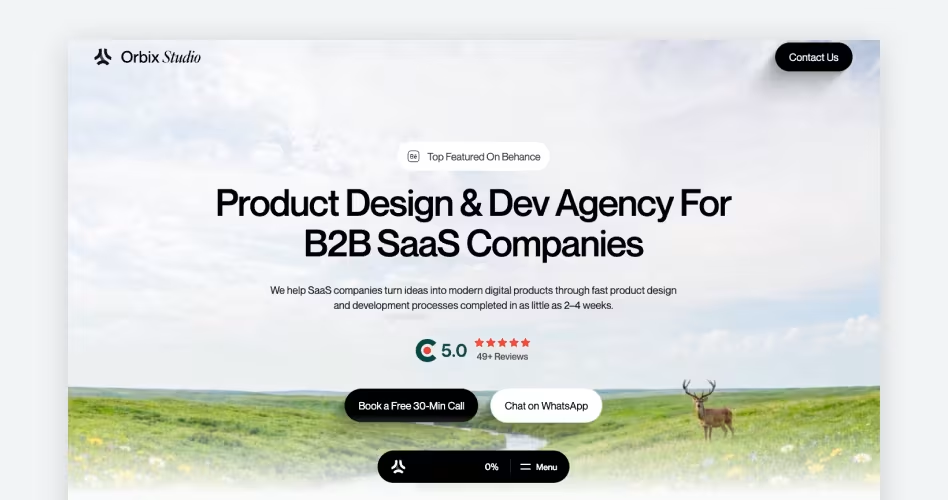
Orbix Studio is a product design and development agency for B2B SaaS and AI companies, with 35+ specialists across the USA, UAE, KSA and South Asia. Usability testing and user research make up a large share of its UX work, alongside design and development.
That combination changes what happens after testing. Instead of handing over a report, the same team fixes what the sessions uncover. For one real estate client, Orbix ran user research, prototyped and built a new site, and conversion rose 52% within three months, with organic traffic up 37%.
Orbix Studio's Core Services
- Usability testing and UX audits: Finding where users struggle in existing products, then prioritizing what to fix.
- User research: Interviews and testing to validate flows before anything goes to development.
- SaaS product and UI/UX design: Dashboards, onboarding flows and pricing pages redesigned from the findings.
- MVP and full-stack development: Building and shipping the fixes, with WCAG 2.2 AA compliance available.
Why Orbix Studio
Most startups can't afford a research firm plus a design agency plus a dev shop. Orbix brings all three into one team at $50 to $99 an hour, often delivering launch-ready work in 2 to 4 weeks. Book a free call to talk through what to test first.
2. Nielsen Norman Group
- Website: nngroup.com
- Founded: 1998
- Location: Fremont, California, USA
- Team size: 51 to 200
- Hourly rate: Quote-based
- Minimum project: $40,000
- Best for: Enterprise teams that want expert-led research and to train their own people at the same time
About Nielsen Norman Group
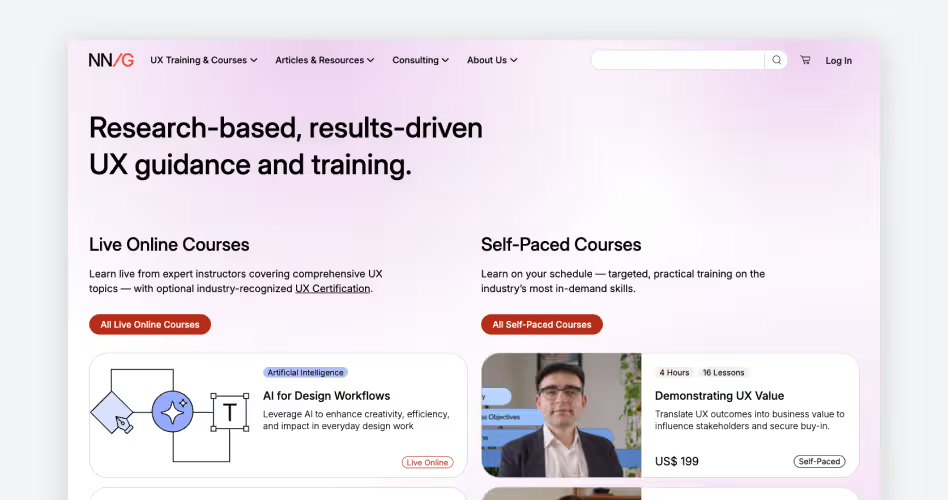
Founded by Jakob Nielsen and Don Norman, NN/g is a research, training and consulting firm with over 28 years of experience, known as the team whose research defines and advances UX. Many of the usability principles other agencies follow, including Nielsen's ten usability heuristics, came from here.
Their consulting arm runs studies for clients directly. Researchers help decide which type of study fits, plan the details, run the research, and deliver prioritized findings.
Nielsen Norman Group's Core Services
- Moderated usability testing: Think-aloud studies run in person or remotely, starting at $40,000.
- Competitive and benchmark testing: Comparing your interface against competitors, or measuring success and satisfaction to create performance benchmarks.
- UX consulting: Broader strategy, research and design engagements, typically $40K to $200K.
- Team training and certification: Private courses and an exam-based UX Certification for in-house teams.
Why Nielsen Norman Group
If a product decision carries serious risk and you want the most authoritative voice in the room, NN/g is the safest choice. The training side is a bonus: your team walks away with the findings and the skills to run the next study themselves.
3. AnswerLab
- Website: answerlab.com
- Founded: 2004
- Location: San Francisco, California, USA
- Team size: 201 to 500
- Hourly rate: Quote-based
- Minimum project: Quote-based
- Best for: Large product organizations running research across many teams and products
About AnswerLab
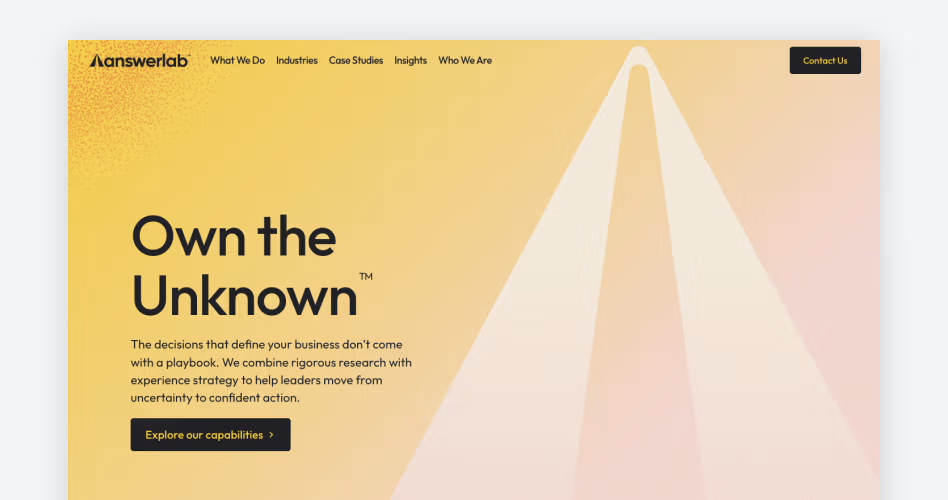
AnswerLab is a user experience research agency partnering with some of the world's biggest brands, including Google, Meta, and Amazon. It's a research-only firm, so everything is built around study quality rather than design delivery.
What sets it apart is the operational layer. A dedicated Research Ops team handles recruiting, scheduling and participant communication for every study, which matters when you're running several studies at once.
AnswerLab's Core Services
- Usability studies: Task-based sessions with representative users, using moderated or unmoderated formats depending on the decision at hand.
- Accessibility research: A Trusted Accessibility Participant (TAP) group of participants with disabilities speeds up accessibility feedback.
- Hardware research: Usability testing on physical devices once they're designed, to catch issues before manufacturing.
- UX benchmarking: Recurring studies that track product performance over time.
Why AnswerLab
Pick AnswerLab when research is a program, not a one-off. Its recruiting infrastructure and accessibility panel make it strong for enterprise teams that need consistent, repeatable studies across products and markets.
4. Blink UX
- Website: blinkux.com
- Founded: 2000
- Location: Seattle, USA (plus New York and Boston)
- Team size: 51 to 200
- Hourly rate: Quote-based
- Minimum project: $25,000
- Best for: Companies that want research and design delivered by the same senior team
About Blink UX
Blink has spent over two decades working with clients including Amazon, JPMorganChase, Qualcomm, Google, Blue Cross Blue Shield, and NASA. Its recent work includes the NASA.gov redesign and a study with Google on how neurodivergent knowledge workers use Gemini and other AI tools.
Blink also runs specialized labs for testing emerging technology, pairing usability testing with interviews and physiological measurements in AR and VR studies. Recruiting is handled in-house by team members who specialize in finding study participants.
Blink UX's Core Services
- Usability testing: Moderated sessions that pinpoint task failures and lead straight into flow-level design changes.
- Mobile app testing: Test protocols adapted for short, detailed mobile task flows.
- Accessibility and AI research: Studies on assistive use and how people adopt AI tools.
- Product and UX design: Turning findings into interfaces, design systems and full redesigns.
Why Blink UX
Blink suits teams building complex or emerging products, from AI tools to VR hardware, where testing needs specialized setups. You get research depth with a design team ready to act on it.
5. Bold Insight
- Website: boldinsight.com
- Founded: 2018
- Location: Downers Grove (Chicago area), USA
- Team size: 51 to 200
- Hourly rate: $150 to $199/hr
- Minimum project: $5,000
- Best for: Healthcare, medical device and automotive teams where usability is also a safety question
About Bold Insight
Bold Insight was created as an employee-owned firm by a group of UX leaders reunited from User Centric, a company that grew into one of the largest usability firms in the U.S. It works on complex products and counts Stryker, Genentech, and AbbVie among its collaborators.
Its reach goes well beyond Chicago. Through its parent company, it's connected to a network of 220 UX experts globally, with offices including Bangalore and Pune.
Bold Insight's Core Services
- Human factors and validation testing: Checking that medical and regulated products are usable and safe.
- Accessibility research: Testing with people using screen readers, voice controls and other assistive tools, backed by its Check UX: Accessibility scoring tool.
- Automotive UX research: Over 150 automotive projects for carmakers and suppliers.
- Researcher staffing: Embedding researchers into client teams to increase research capacity.
Why Bold Insight
When a usability issue could mean a patient safety risk or a failed regulatory review, you want specialists. Bold Insight brings human factors depth that most general UX agencies simply don't have.
6. UX studio
- Website: uxstudioteam.com
- Founded: 2013
- Location: Budapest, Hungary
- Team size: 50 to 249
- Hourly rate: $50 to $99/hr
- Minimum project: $10,000
- Best for: B2B SaaS teams that want a research-backed design team working inside their product cycle
About UX studio
UX studio is a research and design agency for B2B vertical SaaS teams, working on a subscription model that gives clients a dedicated UX/UI team embedded in their workflow. Designers are paired with researchers, so user insight shapes the design from day one.
The research team brings a background in psychology and sociology to its testing work. Results speak through clients like Brenntag, which reported higher user adoption, better task completion rates and fewer support requests after working with them.
UX studio's Core Services
- Usability testing: Testing existing products and prototypes with target users throughout the design process.
- UX research: Interviews, evaluative studies and discovery research, available as research-only projects.
- UX/UI design and redesign: Turning findings into production-ready screens and design systems.
- UX consultancy: Helping in-house teams improve their research and design processes.
Why UX Studio
UX studio works best for SaaS companies that want research and design running together sprint after sprint, at European rates well below most US firms.
7. Akendi
- Website: akendi.com
- Founded: 18+ years in operation
- Location: Toronto, Canada (plus Ottawa and New York)
- Team size: 11 to 50
- Hourly rate: $100 to $149/hr
- Minimum project: $5,000
- Best for: Organizations testing complex or older systems, including intranets and legacy software
About Akendi
Akendi is a Canadian UX agency that tests a wider range of products than most: websites, intranets, mobile apps, software, legacy systems and medical hardware. Its studies go beyond listing issues. The team runs a root cause analysis on results, using user tasks and industry heuristics as a guide.
Clients also note how closely Akendi works with in-house teams. One reviewer described it as fully integrated into their team rather than working separately.
Akendi's Core Services
- Usability testing: Protocol design, recruitment and sessions run throughout design and development.
- Website usability reviews: Expert evaluations for quick assessments, often followed by user testing on critical problems.
- Concept testing: Validating product ideas before investing in full design and development.
- UX research and design: Interviews, journey mapping and design recommendations under its Experience Thinking framework.
Why Akendi
Akendi's interactive workshop readouts make it a good fit for teams that need to get stakeholders aligned, not just informed. Results are presented live, with agreed short and long term actions.
8. Key Lime Interactive
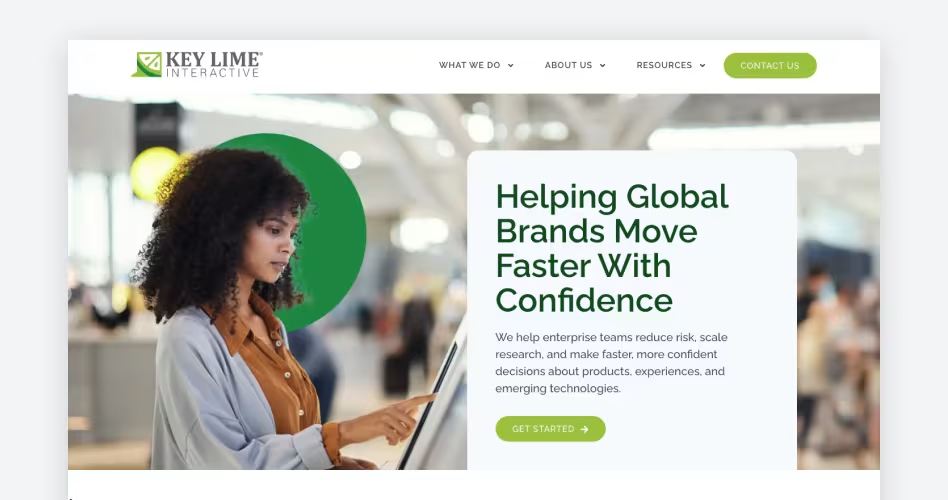
- Website: keylimeinteractive.com
- Founded: 2009
- Location: USA
- Team size: 11 to 50
- Hourly rate: $150 to $199/hr
- Minimum project: $25,000
- Best for: Teams needing advanced methods like eye tracking, biometrics or voice interface testing
About Key Lime Interactive
Key Lime describes itself as the preferred UX research partner for 100+ of the world's best-known brands, including companies working on XR and voice experiences. Diversity has been part of the company since 2009, with women leaders and a multicultural team.
Its methods toolkit is one of the broadest on this list, covering moderated testing, remote testing, eye tracking, card sorting, beta testing and journey mapping.
Key Lime Interactive's Core Services
- Validation testing: In-lab usability testing, eye tracking, biometrics, and benchmark or longitudinal studies.
- QuickInsights: Fast testing projects that finish in days rather than weeks.
- Voice UI testing: Research to refine the performance of voice user interfaces.
- Research team extension: Acting as an extension of enterprise UX research programs.
Why Key Lime Interactive
If your product involves voice, XR or dense interfaces where you need to see exactly where users look, Key Lime has the specialist equipment and experience most agencies lack.
9. UEGroup
- Website: uegroup.com
- Founded: 2001
- Location: San Jose, California, USA
- Team size: 11 to 50
- Hourly rate: Quote-based
- Minimum project: Quote-based
- Best for: Hardware, consumer electronics and pre-launch products that need lab testing
About UEGroup
UEGroup is a full-service UX agency in Silicon Valley combining strategy, research, design and development in one practice. Its state-of-the-art facilities can be configured to test almost any product, with team members in Lisbon, Los Angeles and San Diego.
The team handles every piece of the study, from recruiting to paying participants. It also built youXtools, its own platform for remote testing, diary studies and emotional journey mapping.
UEGroup's Core Services
- Agile usability testing: Testing paper prototypes, interactive mockups, proofs of concept or nearly finished products, in-lab or remote.
- Hybrid testing: Remote clients control the San Jose lab while a team member runs sessions onsite, keeping confidential products protected.
- Biometric capture: Eye tracking, emotion reporting and screen mirroring during sessions.
- Industrial and UX design: Product design, branding and packaging alongside research.
Why UEGroup
UEGroup is the pick when your product can't leave the building. Its hybrid lab setup lets you test unreleased hardware with real users without flying your team to California.
10. Touchstone Research
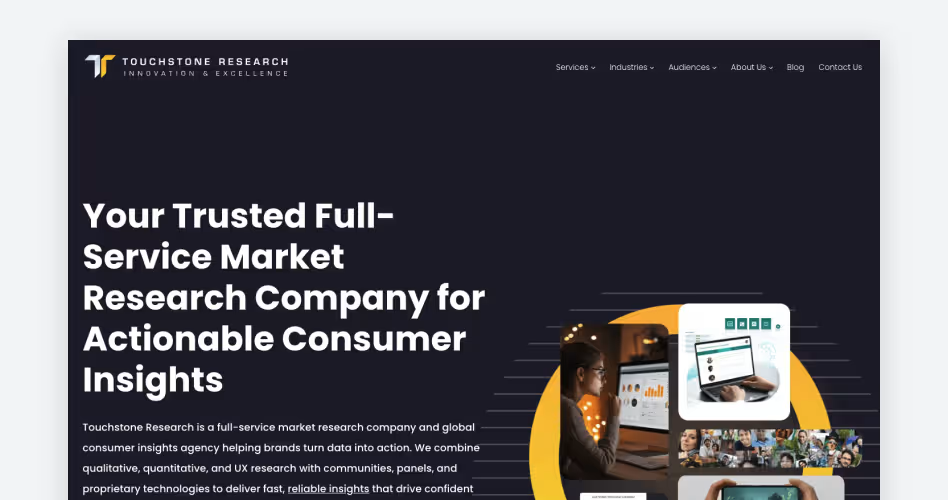
- Website: touchstoneresearch.com
- Founded: 1991
- Location: New Haven, Connecticut, USA
- Team size: 11 to 50
- Hourly rate: Quote-based
- Minimum project: Quote-based
- Best for: Brands testing with specific audiences across many countries, including kids and teens
About Touchstone Research
Touchstone is a full-service UX research company covering the US and more than 60 international markets. Its research team works as a fully remote, distributed workforce across the US.
Because Touchstone started in market research, recruitment is a core strength. It's also a specialist recruitment agency for qualitative and UX studies, so finding hard-to-reach participants is part of its everyday work.
Touchstone Research's Core Services
- Usability testing: Moderated and unmoderated testing, concept evaluation, diary studies and journey research.
- Youth and family research: COPPA-compliant usability testing with kids and Gen Z.
- Participant recruitment: Custom recruitment of your exact target users.
- Insight communities: Online research panels that give brands ongoing access to consumer feedback.
Why Touchstone Research
If your product serves children, or you need to test in several countries at once, Touchstone's recruitment reach and compliance experience are hard to match.
11. Craft Innovations
- Website: craftinnovations.global
- Founded: 2019
- Location: Toronto, Canada
- Team size: 21 to 50
- Hourly rate: $50 to $99/hr
- Minimum project: $10,000
- Best for: Fintech, banking and credit union products
About Craft Innovations
Craft Innovations is a global UX and product research agency focused on fintech, banking, and financial services. It has logged 35,000+ hours of user research and usability testing, working with brands like Mastercard, UNDP, Glovo, and PrivatBank.
Its projects often combine methods. For a mobile banking app's new personal finance feature, the team ran moderated testing with 12 people, in-depth interviews with the same group, and a review of best practices before launch.
Craft Innovations' Core Services
- Fintech usability testing: Moderated and unmoderated tests, prototype testing and behavioral transcripts for complex financial flows.
- Eye tracking: Analyzing gaze and navigation on trading platforms and heavy dashboards.
- UX audits: Expert reviews based on heuristics, as a single audit or ongoing partnership.
- UX/UI design: Designing the solution from research findings.
Why Craft Innovations
Financial products carry trust and compliance weight that generalist agencies can underestimate. Craft already understands lending, payments and insurtech users, and even offers a free sample banking app usability report so you can judge its work first.
12. Experiment Zone
- Website: experimentzone.com
- Founded: Not published
- Location: USA
- Team size: 21 to 50
- Hourly rate: $100 to $149/hr
- Minimum project: $1,000
- Best for: E-commerce and SaaS teams whose main problem is conversion
About Experiment Zone
Experiment Zone is a UX research agency for websites, SaaS software, and conversion rate optimization. Every study ties back to revenue: research findings connect directly to conversion rates.
Its usability evaluation follows a clear path. The team defines recruitment and screening questions, runs the study, then a Conversion Strategist prioritizes specific fixes, reviewed with you on a 2-hour call.
Experiment Zone's Core Services
- Usability evaluations: Expert-led testing with conversion-focused recommendations.
- Heuristic reviews: Expert audits of pages and flows hurting conversion.
- A/B test design: Turning usability findings into validated experiments.
- Design implementation: Recommending and implementing site updates to lift conversion.
Why Experiment Zone
With a $1,000 minimum, Experiment Zone is the most accessible entry point on this list. Start with its free 30-minute website audit to see where the biggest leaks are.
13. UX Firm
- Website: uxfirm.com
- Founded: 2013
- Location: Atlanta, Georgia, USA
- Team size: Under 10
- Hourly rate: Quote-based
- Minimum project: Quote-based
- Best for: Small teams and medical device makers that want a focused study run by senior researchers
About UX Firm
UX Firm is a boutique research consultancy with usability testing at its core. Its methods are based on Carol Barnum's handbook Usability Testing Essentials, a practical guide used by practitioners and students worldwide.
Clients deal directly with the experts, not junior staff assigned to the project. That seniority is the firm's main selling point.
UX Firm's Core Services
- Usability testing: One-on-one in-person testing and moderated remote testing.
- Human factors validation testing: Formal testing for products that need regulatory-level evidence.
- UX research toolkit: 12+ specialized methodologies, from early research to behavior analysis.
- Remote mobile testing: Recording users as they use your app on their own devices.
Why UX Firm
UX Firm shows you don't need a large budget for real results. Its most popular service is small usability studies that deliver actionable findings fast, ideal for a first study.
14. Browser London
- Website: browserlondon.com
- Founded: 15+ years in operation
- Location: London, UK
- Team size: 11 to 50
- Hourly rate: $100 to $149/hr
- Minimum project: $10,000
- Best for: UK and European organizations that want tested designs built and launched
About Browser London
Browser London is an award-winning UX and UI agency specialising in research-backed digital design validated by user testing. It brings over 15 years of experience in user research-led UX, UI design, and front-end engineering.
Project sizes vary widely, from £5,000 to £500,000, and the team works across platforms like WordPress, React, and Symfony. That range makes it a practical option for both focused studies and long-term product work.
Browser London's Core Services
- Usability testing: Identifying new opportunities through testing, stakeholder engagement and competitor analysis.
- User research-led UX: Research that shapes design direction before build.
- UI design: Interfaces validated with real users.
- Front-end engineering: Building the tested designs into production.
Why Browser London
For UK and EU teams that want a local partner, Browser London offers research, design and engineering in the same time zone, with GDPR-friendly working practices and a long client track record.
15. DOOR3
- Website: door3.com
- Founded: Not published
- Location: New York, USA
- Team size: 50 to 249
- Hourly rate: $100 to $149/hr
- Minimum project: $25,000
- Best for: Enterprise software teams that need testing, accessibility checks and development in one place
About DOOR3
DOOR3 is primarily a software development company that also offers usability testing, from preliminary tests to product validation and accessibility testing. Its clients include Morgan Stanley, AIG, FreshDirect, and HP.
Clients consistently point to its discovery and planning phases as a key strength, with clearly defined requirements tied to business goals.
DOOR3's Core Services
- Usability testing: Early tests through to product validation.
- Accessibility testing: Specialized research for compliance and inclusive design.
- Discovery and UX design: Requirements, wireframes and prototypes in Figma.
- Custom software development: Building the product once testing confirms direction.
Why DOOR3
DOOR3 fits enterprise teams with larger budgets who want testing to feed straight into engineering. Projects range from $15,000 to over $1 million.
What Services Do Usability Testing Agencies Provide?
Most usability testing agencies offer more than just running test sessions. Depending on the agency, services can cover everything from planning the study to fixing the problems it uncovers. Here's what you can typically expect.
Core Testing Services
- Moderated usability testing. A researcher guides each participant through tasks in real time, asking follow-up questions to understand why they get stuck. Best for complex flows and early-stage products.
- Unmoderated remote testing. Participants complete tasks on their own time while their screen and voice are recorded. It's faster and cheaper, and works well for simple tasks and larger sample sizes.
- In-person lab testing. Sessions run in a controlled lab setting. This is useful for physical products, hardware, or confidential prototypes that can't be shared remotely.
- Prototype testing. Testing wireframes or clickable prototypes before development starts, when changes are still cheap to make.
- Website and mobile app testing. Testing live products across desktop, tablet, and mobile to find issues on each device.
Specialized Testing Services
- Accessibility testing. Testing with people who use screen readers, voice controls, and other assistive tools to make sure your product works for everyone.
- Card sorting and tree testing. Methods for checking whether your navigation and information architecture make sense to users.
- First-click and preference testing. Quick tests that show where users click first or which design option they prefer.
- Eye tracking. Tracks where users look on a screen, helpful for dense dashboards, landing pages, and ad placements.
- Benchmark and competitor testing. Measuring task success and satisfaction over time, or comparing your product against competitors.
Research Support Services
- Participant recruitment. Finding and screening people who match your real users, scheduling sessions, and handling incentive payments.
- User interviews. One-on-one conversations to understand user needs, habits, and pain points before or alongside testing.
- UX audits and expert reviews. An expert evaluation of your product against usability principles, often used to decide what to test first.
After Testing
- Reporting and readouts. A prioritized report with severity ratings, video clips, and recommendations, usually presented in a live session with your team.
- Redesign and retesting. Some agencies, like Orbix Studio, go a step further: redesigning the problem areas, working with your developers, and running a second round of testing to confirm the fixes work.
How Usability Testing Agencies Price Their Work
Usability testing agencies usually price their work in one of three ways: by the hour, by the study, or through an ongoing retainer. Each model suits a different kind of project, so it helps to know the trade-offs before you ask for quotes.
1. Hourly or Daily Rates
Hourly billing works well for smaller or loosely defined work, like a quick UX audit, a few extra sessions, or a researcher supporting your team for a few weeks. It's flexible, but you'll need to keep an eye on hours so the bill doesn't grow faster than the findings.
Typical rates in 2026:
- Central and Eastern Europe: around €70/hr (median)
- Western Europe and UK: around €125/hr (median)
- USA: $100 to $200/hr for dedicated usability testing providers
- Global studios with offshore teams: $50 to $99/hr, such as UX studio and Orbix Studio
2. Per-Study (Fixed Price)
If you have one clear question to answer, like "why are users abandoning signup?", a fixed-price study gives you a predictable budget. The price covers planning, recruitment, sessions, analysis and the final report.
Typical study costs:
- Unmoderated study (5 to 8 participants): $1,000 to $5,000
- Moderated remote study: $3,000 to $10,000
- In-person lab study: $10,000 to $25,000
- Full-service agency study: $15,000 to $40,000 (CleverX 2026 cost guide)
- Premium research consultancies: Nielsen Norman Group's moderated testing starts at $40,000
Testing with B2B users or senior professionals pushes these numbers up, since those participants are harder to recruit and cost more to compensate.
3. Retainers and Continuous Testing
For teams that ship every few weeks, a one-off study quickly goes out of date. A retainer gives you testing every sprint for a fixed monthly fee, so new features get checked with real users before launch.
As a reference, UX studio's Clutch reviews mention monthly engagements of around €4,000 to €7,000. At Orbix Studio, we also work this way: an embedded product pod on a fixed monthly rate, where the same team that runs the tests can redesign and ship the fixes.
How to Choose a Usability Testing Agency: 5 Things to Evaluate
Price and portfolio only tell you part of the story. Two agencies can quote the same amount and still deliver very different results, because usability testing depends on who you test with, how the sessions are run, and what happens with the findings afterward.
We recommend looking closely at these five areas:
- Testing methods
- Participant recruitment
- Sample reports
- Testing and design capability
- Reviews
Here's what to look for in each one.
1. Testing Methods
Most agencies list the same testing services on their website, so at first glance they all look alike. The real difference is whether they choose the method to fit your problem, or run the same test for every client.
When reviewing their methods, ask yourself: do they pick the method based on your question, or sell the same test to everyone?
A good agency will ask what you're trying to learn before recommending anything. Testing a new navigation structure calls for a different approach than testing a checkout flow or an early prototype.
Look for these green flags:
- Both moderated and unmoderated testing on offer
- Supporting methods like tree testing, first-click testing, and prototype testing
- Accessibility testing with people who use assistive technology
- A clear explanation of why they recommend one method over another for your project
2. Participant Recruitment
The quality of your findings depends on the people in the sessions. If an agency tests your B2B dashboard with random consumers, you'll get confident answers to the wrong questions.
When reviewing their recruitment process, ask yourself: can they find people who actually match your users?
Look for these green flags:
- Custom screener surveys built around your real user profile
- Experience recruiting niche audiences, like healthcare professionals, finance teams, or B2B decision-makers
- Clarity on who pays participant incentives and whether that's included in the quote
- A clear no-show policy, so a missed session doesn't cost you a participant
3. Sample Reports
The report is what your team will actually use, so it's worth seeing one before you sign anything. A long list of problems isn't helpful if nobody knows where to start.
When reviewing their reports, ask yourself: would this report tell your team what to fix first?
Ask for a redacted sample from a past project. If you want a benchmark, our SaaS website audit checklist shows the kinds of issues a strong report should catch.
Look for these green flags:
- Issues ranked by severity, not just listed
- Video clips or quotes showing real users struggling
- Clear, specific recommendations for each issue
- A readout session where the team walks you through the findings
4. Testing and Design Capability
Many testing projects end with a report that sits in a shared folder. Finding problems is only half the work. Someone still has to fix them, and then check that the fix worked.
When reviewing their capabilities, ask yourself: what happens after the report is delivered?
Look for these green flags:
- They can redesign the problem areas, not just point them out
- They offer a second round of testing to validate the fixes
- They work directly with your developers during handoff
- They can support ongoing testing as your product evolves
5. Reviews
Agencies will always describe themselves well. Former clients give you the more honest picture.
When reading reviews, ask yourself: do clients talk about outcomes, not just "great to work with"?
Go beyond the testimonials on agency websites and check verified reviews on platforms like Clutch.
Look for:
- Specific results, like improved conversion, fewer support tickets, or higher task completion
- Comments on whether the agency delivered on time and within budget
- Mentions of repeat projects or long-term partnerships
- How the agency handled problems or changes mid-project
Red Flags to Watch For
Some warning signs are easy to miss during a sales call. If you spot any of these, ask more questions before you sign.
- They don't ask about your users. If an agency quotes a price before understanding who your users are and what you want to learn, they're selling a package, not a study.
- No screener or recruitment plan. An agency that can't explain how they'll find the right participants will likely test with whoever is easiest to reach. That leads to findings that don't reflect your real audience.
- They test with too few people and can't say why. Five users per round is a common and valid approach, but the agency should be able to explain why that number fits your study. A number chosen to hit a price point is a different thing.
- Findings without priorities. A report that lists 40 issues with no severity ranking leaves your team guessing what to fix first. Ask to see a sample report before committing.
- You can't observe the sessions. Good agencies welcome you to watch live or review the recordings. If they keep sessions behind closed doors, you're relying entirely on their interpretation.
- Vague proposals and hidden costs. Watch for quotes that don't mention participant incentives, recruitment fees, or the number of testing rounds. These often show up later as extra charges.
- One-size-fits-all packages. If every client gets the same five-user test and the same report template regardless of the product, the agency isn't designing research around your problem.
- Only unmoderated tests, called "research." Unmoderated tools are useful, but an agency that only runs self-serve tests and calls it full usability research may not have experienced moderators on the team.
Frequently Asked Questions
What does a usability testing agency do?
A usability testing agency plans and runs studies where real users complete tasks on your website, app, or prototype. The agency handles recruitment, moderation, and analysis, then delivers a prioritized report showing where users struggle and what your team should fix first.
How much does a usability testing agency cost?
Usability testing agencies charge $100 to $200 per hour. A moderated study with 20 participants typically costs $12,000 to $15,000, including recruitment, incentives, moderation, and analysis. Smaller studies can start around $5,000, while premium research firms charge $40,000 or more.
Should I hire a usability testing agency or use a testing platform?
Hire an agency if you lack in-house researchers, need hard-to-reach participants, or want expert recommendations. Use a platform like Maze or UserTesting if you already have a researcher and need fast, frequent unmoderated tests. Many teams combine both as they grow.
How long does a usability testing project take?
Most agency usability studies take two to four weeks. That includes about a week of planning and recruitment, one to two weeks of testing sessions, and several days of analysis and reporting. Simple unmoderated studies can wrap up in a few days.
How many participants do you need for usability testing?
5 participants per round is enough to uncover most major usability issues in qualitative testing. For quantitative studies measuring success rates or benchmarks, agencies usually recommend 20 to 40 participants. Running two small rounds, with fixes in between, often beats one large study.
What is the difference between moderated and unmoderated usability testing?
In moderated testing, a researcher guides each participant live and asks follow-up questions to understand why they struggle. Unmoderated testing lets participants complete tasks alone on their own time. Unmoderated is faster and cheaper, while moderated gives deeper insights into user behavior.
How do usability testing agencies recruit participants?
Agencies recruit participants through their own research panels, specialist recruiting platforms, or your existing customer list. They use screener surveys to match participants to your real user profile, then schedule sessions and handle incentive payments. B2B and niche audiences take longer and cost more to recruit.
What are the best usability testing services for startups?
Startups usually get the most value from agencies that test, redesign, and retest in one team, so findings turn into fixes quickly. Look for flexible budgets, fast turnaround, and experience with early-stage products. Orbix Studio, UX studio, and UX Firm all work well with startup budgets.
Final Thoughts
There's no single best usability testing agency for every team. The right choice depends on where your product is, how much you can spend, and what you need at the end of the study.
If you have an in-house design team ready to act on findings, a research-focused firm can give you deep, reliable insights. If you're an early-stage startup or a lean product team, you'll likely get more value from an agency that can test, redesign, and retest without handing work off to someone else.