- What is a Design Sprint?
- Design Sprint vs. Agile Sprint vs. Discovery Sprint
- When to Run a Design Sprint
- How to Run a 5-Day SaaS Design Sprint
- Who Needs to Be in the Room
- Tools and Templates for a Remote Sprint
- What a Design Sprint Costs
- Design Sprint Length: 5-Day vs 30-Day vs 6-Week Sprint
- A Worked Example: Validating a SaaS Onboarding Redesign
- Common Pitfalls That Waste the Five Days
- How to Choose a Design Sprint Agency for a B2B SaaS Redesign
- Frequently Asked Questions
- Conclusion


.svg)

%201%201.svg)
Design Sprint for SaaS Teams: What It Costs and How to Run One
- A design sprint is a five-day process that tests a product decision with real users before you build it.
- Run one when a decision is expensive to reverse and cheap to test.
- Teams skip validation, build first, and find the mistake three months late.
A B2B SaaS team spent four months building a self-serve onboarding flow nobody asked for. The feature shipped. Activation didn't move. Support tickets did, because new users hit a setup wizard three steps longer than the one it replaced.
That's the cost of skipping validation: months of engineering time spent on a guess. A design sprint exists to catch that mistake before a single line of production code gets written.
I pulled the search results for this exact topic and read every page that specifically targets SaaS teams. Five of them cover the five-day process, in almost identical order, Monday through Friday, with the same stock photos of sticky notes on a whiteboard. None of them cover the cost, and none tell you when to skip it.
This guide covers all three: what a design sprint actually is, the decision filter for running one, and the five-day process itself. It also covers the cost data nobody else publishes.
What is a Design Sprint?
A design sprint is a five-day process for testing a product decision before you build it. A small team defines the problem, sketches solutions, builds one prototype, and tests it with real users. Meaning the sprint replaces weeks of internal debate with one week of outside evidence.
Google Ventures partner Jake Knapp formalized the method in 2016, in a book called Sprint. Google Ventures still runs and documents the same process today, and SaaS teams adopted it fast, because a wrong build decision costs months, not days.
SaaS products carry a specific version of this risk. A dashboard redesign, a new pricing page, or an onboarding rebuild touches thousands of existing users at once, not a handful of first-time visitors. Get the structure wrong and you're not fixing a landing page.
You're re-training an entire user base on a new mental model. That's exactly the kind of decision the sprint format was built to de-risk. For a broader look at the structure that decision rests on, see Orbix's breakdown of the 7 pillars of UX design. A design sprint trades a guess for one week of evidence, before the guess becomes a quarter of engineering time.
That's the sprint in theory. Where it gets confusing is how many other five-day processes claim the same name.
Design Sprint vs. Agile Sprint vs. Discovery Sprint
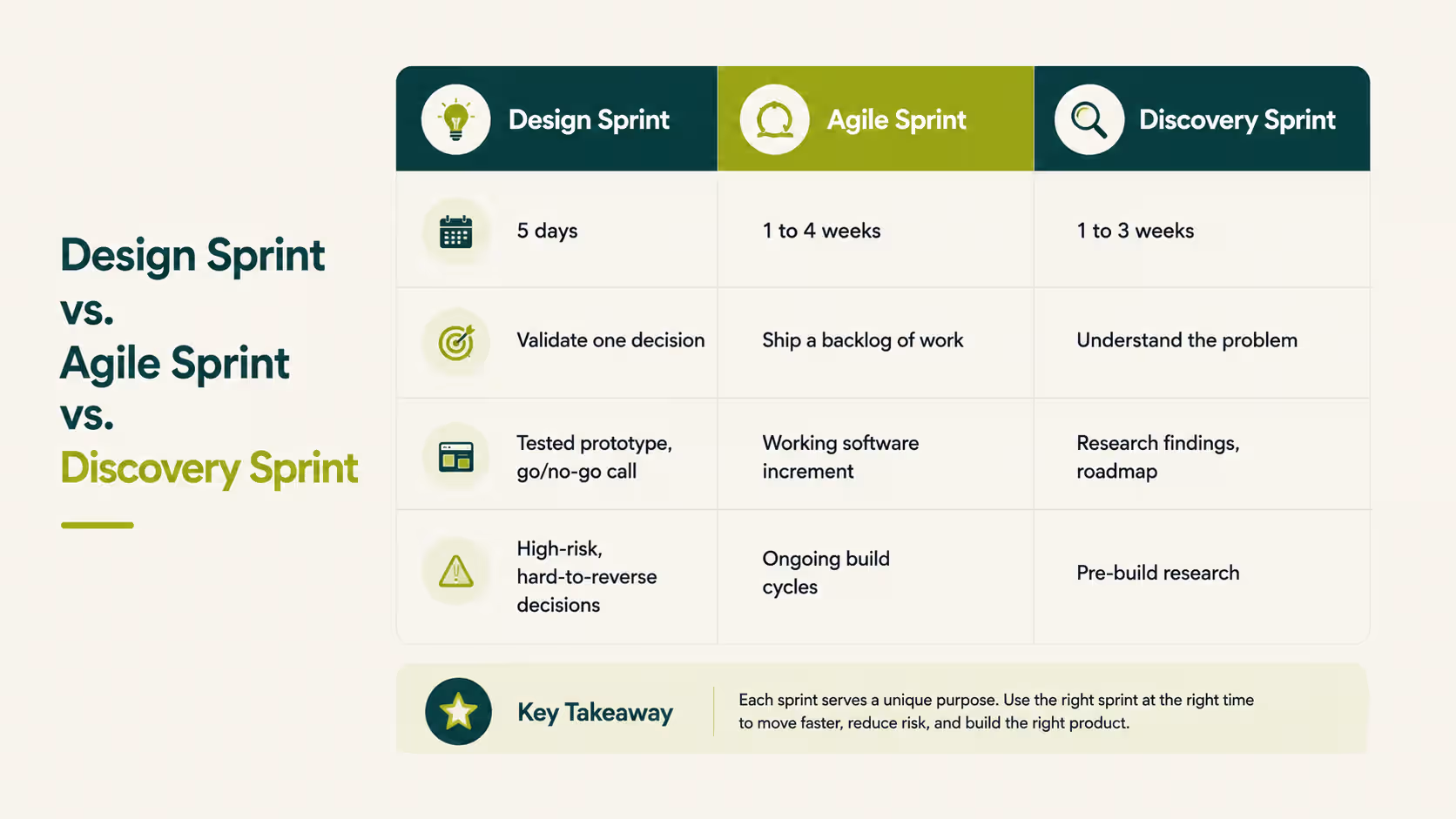
A design sprint, an Agile sprint, and a discovery sprint solve three different problems, even though the names get used interchangeably. A design sprint tests one decision in five days and produces a tested prototype. An Agile sprint builds and ships working software over one to four weeks, against a backlog that's already been prioritized.
A discovery sprint sits earlier than both. It's research and strategy work: interviews, competitive analysis, a prioritized roadmap, with no prototype and no code. Confuse the three and you'll scope the wrong engagement. Hire a discovery sprint when you need a tested prototype, and you'll leave with a slide deck instead of evidence.
A design sprint answers one question fast. An Agile sprint ships what you already decided to build. For the exact difference between a prototype and the mockups your team probably already has, see Orbix's guide to wireframes, mockups, and prototypes. If the real gap is that you don't understand the problem yet, that's a discovery sprint question, and Orbix breaks down product research versus market research in more detail.
Design Sprint vs Design Thinking
Design thinking is a broad problem-solving framework: empathize, define, ideate, prototype, test. A design sprint is one specific, time-boxed way to run those steps on a single decision in five days. Every design sprint uses design thinking. Most design thinking work never fits into a single week.
Once you know which of the three you actually need, the next question is timing. Here's how to tell if now is the moment.
When to Run a Design Sprint
Run a design sprint when a decision is expensive to reverse and cheap to test. That's the filter that matters, not team size or company stage. A pricing page redesign, a new onboarding flow, or a core workflow change all qualify. Getting any of them wrong costs months of engineering time to undo.
Company stage doesn't decide this. A three-person startup and a 200-person SaaS company face the same math: the sprint costs five days, and the wrong build costs a whole quarter. The only variable that matters is how hard the decision is to reverse once it's live.
Run a sprint when:
- The decision touches a workflow thousands of existing users already depend on
- Reversing a wrong choice would cost a full engineering sprint or more
- Two decision-makers disagree and neither side has evidence to settle it
- The right five to seven people can actually clear their calendar for five days
Teams that skip this filter tend to run into the same wall. See Orbix's rundown of common SaaS UX mistakes a sprint would have caught early.
When to Skip It
Skip the sprint when the decision is small, cheap to test another way, or already has a clear answer. A button color change doesn't need five days and a facilitator. Neither does a decision your own analytics data already answers. Save the format for the decisions where being wrong actually costs something.
Skip it when:
- The fix is reversible in an afternoon, like copy or a button label
- A quick usability test with three users would answer it faster
- Your product analytics already shows the answer and nobody's checked
- Leadership won't commit real people for the full week, which turns the sprint into a watered-down meeting
Once the filter says go, the next question is mechanical: what actually happens across the five days?
How to Run a 5-Day SaaS Design Sprint
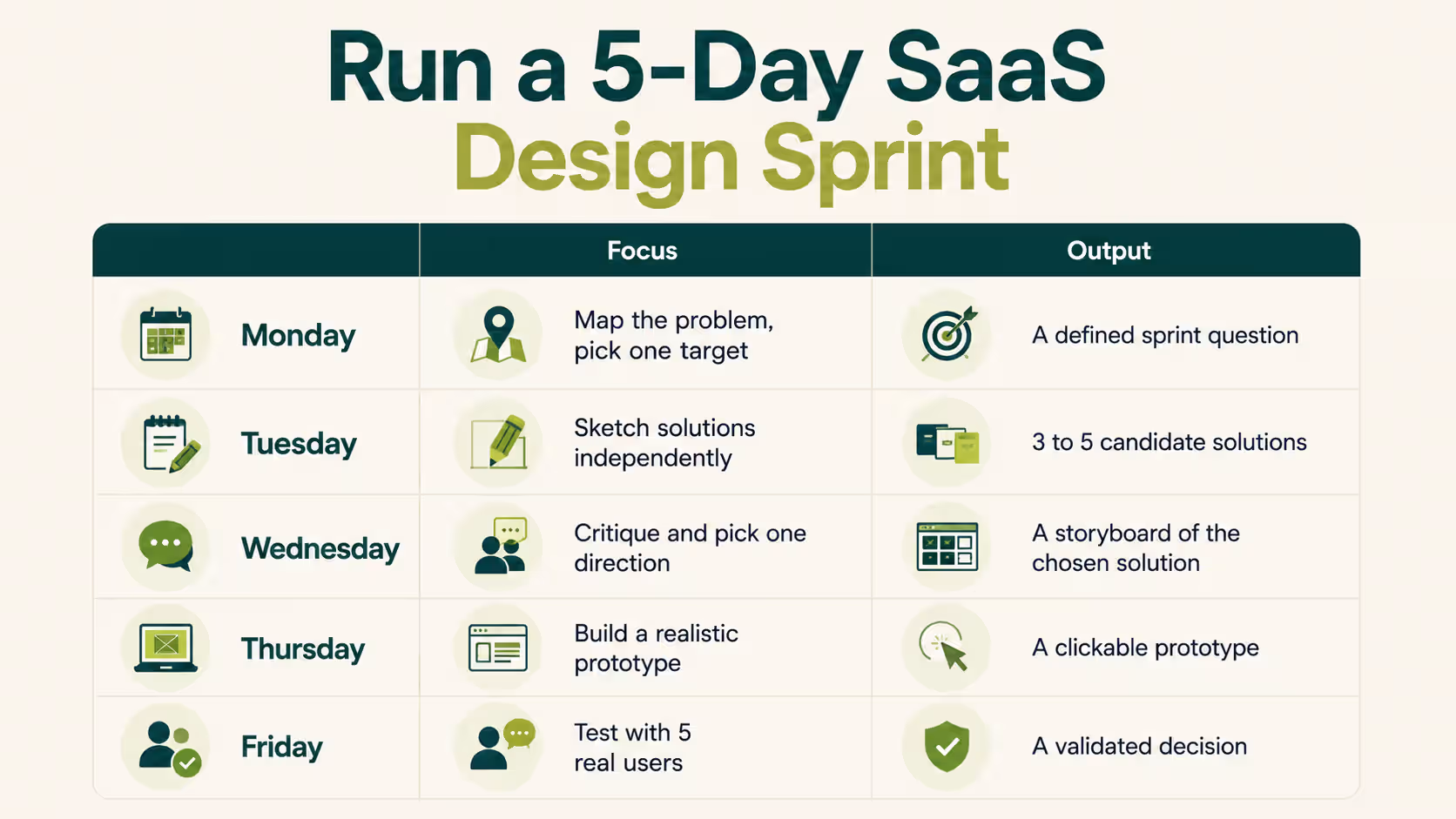
A design sprint runs across five structured days. Monday maps the problem, Tuesday generates solutions, and Wednesday picks the strongest one. Thursday builds a prototype, and Friday tests it with real users.
Some guides describe the same work as six phases instead: Understand, Diverge, Converge, Prototype, Test, Decide. That framing maps almost exactly onto the five days above. Both versions describe the identical process, so pick whichever one your team remembers.
Five users is not an arbitrary number. Nielsen Norman Group's research on usability testing found that five users typically surface about 85% of a product's usability problems. A sixth or seventh user mostly repeats what the first five already found.
Running It Remote or Async
A design sprint works fully remote if the core team blocks the whole week with no other meetings. Use a shared board for sketching and voting. Record every session, so anyone who drops offline can catch up fast.
The one thing that breaks remote sprints: letting people split attention between the sprint and their normal chat notifications. Turn off Slack for the week. Muting it isn't enough.
Who actually needs to be in that shared room, virtual or not?
Who Needs to Be in the Room
A design sprint needs five roles at minimum: a facilitator, a decision-maker, a product lead, a designer, and an engineer. That facilitator runs the exercises and keeps time. Whoever holds the decision-maker role says yes to a direction on Wednesday, without checking with someone else first.
Five roles, five jobs:
- Facilitator: runs every exercise, keeps strict time, stays neutral on the actual decision
- Decision-maker: the one person who can approve the direction without a follow-up meeting
- Product lead: owns the problem framing and the success criteria
- Designer: turns the chosen sketch into a realistic prototype
- Engineer: flags what's technically possible before the team spends a day sketching a fantasy
Founders running their first sprint often skip the facilitator role and try to run it themselves while also being the decision-maker. That collapses two jobs that need to stay separate: one person pushing the process forward, one person owning the call.
Bringing in an outside facilitator, whether from an agency or a freelancer, fixes that split. Orbix compares in-house teams versus outside design agencies in more depth. This guide breaks down hiring an agency versus a freelancer, if that's the specific choice in front of you.
If your team doesn't have a facilitator on staff, that's usually the first gap Orbix's UI/UX design work fills before the sprint even starts. With the right five people in the room, the next constraint is tools, not talent.
Design Sprint Workshop: Run It In-House or Hire a Facilitator?
Run the design sprint workshop in-house when someone on your team has facilitated sprints before and has no stake in the outcome. Hire a facilitator when the founder is also the decision-maker, or when the last internal workshop ended in a debate instead of a decision.
Tools and Templates for a Remote Sprint
A design sprint needs three tool categories. One for sketching and voting, one for the Thursday prototype build, and one for recruiting Friday's test users. A combined design tool covers the first two in one place for SaaS teams already working in Figma.
What each stage needs:
- Whiteboard and voting: FigJam, Miro, or Mural, whichever one your team already opens without thinking
- Prototype build: Figma, using real components from your existing design system if one exists
- User recruiting: Respondent, User Interviews, or your own customer list, 5 to 8 people is enough
- Session recording: Loom or the built-in recorder in your video call tool, turned on before the first user joins
The plugin and component setup speeds up the Thursday build specifically. See Orbix's list of Figma plugins and UI kits worth installing before sprint week starts.
Tip: Build a reusable sprint template once, in whichever whiteboard tool your team already uses. Every future sprint starts from the same board structure, which saves the first two hours of Monday from being eaten by setup.
Tools solve the how. The number founders actually ask about first is how much.
What a Design Sprint Costs
A design sprint costs $3,000 to $18,000 with an outside team, depending on scope. Run it in-house instead, and the real cost becomes five to seven internal salaries pulled off their normal work for a week.
According to UX Continuum's 2026 pricing guide for similar design engagements, fixed-fee pricing runs $8,000 to $18,000 for a single-focus SaaS decision. That's the rate for a senior practitioner running it solo. A quote far below these ranges usually means something got cut: user recruiting, the Friday test, or the senior facilitator
Figures are based on UX Continuum's published 2026 market-rate data for SaaS design and product engagements. Orbix's own pricing guide for SaaS design agency work breaks down where that $8,000 to $18,000 actually goes.
How to Price a Design Sprint: Fixed Fee, Day Rate or Retainer
The same sprint can be priced three ways, and the model changes the number more than the agency does.-
Fixed fee: one price for one sprint question, one prototype, and one round of user testing. It's the cleanest model when you can already write the decision in one sentence. Market rates sit at $8,000 to $18,000.
Day rate: you pay a senior facilitator by the day, and your own team does the sketching, prototyping, and testing. It's the cheapest cash option, but it only works if your designer can build a realistic prototype in one day.
Design partner retainer: the sprint runs inside a monthly engagement, so the work after Friday keeps moving without a new contract. Orbix Studio's ongoing SaaS design support runs around $4,500 to $9,000 a month, which makes a 30-day design partner sprint the price of one month.
Price the decision, not the days. If being wrong costs a quarter of engineering time, even the top of these ranges is the cheaper mistake.
Maybe the real question isn't the sprint cost at all. It's sprint first versus build an MVP and see what happens. Orbix's guide to MVP development cost shows what that second path costs when the guess turns out wrong.
Design Sprint Length: 5-Day vs 30-Day vs 6-Week Sprint
The classic design sprint runs five days, but agencies now sell longer formats under the same name. They are not the same product. Check what happens after Friday before you compare prices.
A five-day sprint answers the question. A 30-day or six-week sprint answers it and then designs the answer. If your team has no designer to carry Friday's prototype into production, the longer format saves you a second hiring round.
Format and price only matter if the sprint produces something the team can act on. Here's what that looks like end to end, from Monday morning to Friday afternoon.
A Worked Example: Validating a SaaS Onboarding Redesign
Picture a mid-market B2B SaaS product with 4,000 active accounts and a nine-step onboarding wizard. Support tickets about setup confusion make up 30% of week-one contact volume. Engineering wants to rebuild the whole flow, a six-week project, based on a hunch that fewer steps will fix it. Nobody on the team has actually watched a new user get stuck.
A design sprint tests that hunch first. Monday maps the actual drop-off points using existing analytics, not guesses, and the team picks the single worst step to redesign. Tuesday and Wednesday produce three candidate flows, cut down to one. Thursday turns it into a clickable prototype with real product copy, not placeholder text.
Friday, five existing customers try it live, with someone watching where they hesitate. If two of the five still stall at the same step, the team just saved six weeks of engineering time. The fix wouldn't have worked anyway.
If all five sail through, the team has real evidence to greenlight the build, instead of a hunch. Teams without five willing customers on hand usually bring in a usability testing agency to recruit and moderate that Friday session.
This is the same logic behind how Orbix Studio approaches SaaS onboarding work: prototype and test the flow before a single production sprint gets scheduled. Orbix's build for Investiq followed the same sequence, a working prototype validated against real usage patterns before the production build started.
For the onboarding-specific checklist this example draws from, see Orbix's SaaS customer onboarding checklist and its companion guide to B2B customer onboarding best practices. A five-day test that kills a bad six-week build isn't a delay. It's the fastest six weeks you'll ever save.
Common Pitfalls That Waste the Five Days
A design sprint fails one way more than any other: the team tests the interface instead of the underlying assumption. A prototype that looks polished still fails on Friday if nobody actually needed the thing it represents. No amount of visual polish changes that outcome.
A designer can spend all of Thursday night getting the spacing and color right on a prototype nobody needed in the first place. Friday's users will still hesitate at the same step. The interface was never the problem the sprint was supposed to solve.
Four ways teams waste the week:
- Testing the interface instead of the underlying assumption
- No single decision-maker in the room, so Wednesday's pick gets relitigated later
- Recruiting the wrong users, existing power users instead of the segment the decision actually affects
- Treating Friday's prototype as a finished feature instead of a signal to build or stop
Getting this wrong once is normal. Repeating it is usually a sign the team running the sprint doesn't have SaaS-specific experience, worth checking before the next one. Orbix's guide on choosing a UI/UX agency for a SaaS startup covers the exact questions to ask before hiring one.
Those four mistakes explain nearly every "the sprint felt like a waste" complaint. Fix the assumption you're testing before Monday starts, and three of the four disappear on their own. Here are the specific questions that come up every time a team runs its first sprint.
How to Choose a Design Sprint Agency for a B2B SaaS Redesign
The right design sprint agency has run sprints on SaaS products before, tests with real users on Friday, and can carry the result into production design. Most agencies can run the five days. Fewer can tell you what happens the Monday after.
Five checks before you sign:
SaaS sprint experience: ask for a prototype from a past sprint on a SaaS product, not a workshop photo-
They own the Friday test: recruiting five real users is the step teams skip first, so confirm who recruits and who moderates-
Facilitator and designer are two people: one runs the room, one builds Thursday's prototype-
A fixed price tied to one question: if they can't name the sprint question in the proposal, the scope will drift-
A plan for after Friday: a validated prototype with no one to design it into production is a slide deck with extra steps**
For an onboarding redesign specifically, ask how they'd measure the result: setup completion, time to first value, or week-one support tickets. An agency that only talks about screens is designing the interface, not testing the assumption.
If you'd rather have one team run the sprint and then design the flow it validates, that's how Orbix works as a SaaS design agency for B2B product teams.Here are the specific questions that come up every time a team runs its first sprint.
Frequently Asked Questions
What is a design sprint?
A design sprint is a five-day process where a small team defines a problem, sketches solutions, and builds one clickable prototype. Real users test it before any production code ships. The goal is a validated decision, not a finished product. Google Ventures created the format in 2016.
How long does a design sprint take?
A classic design sprint runs five full working days, Monday through Friday, with the team fully focused and no other meetings scheduled. Some teams compress it into three or four days for a narrower problem. Anything shorter than three days rarely leaves enough time to test with real users.
Who should be involved in a design sprint?
A design sprint needs a facilitator and a decision-maker who can approve on the spot. It also needs a product lead, a designer, and an engineer who knows what's possible. Five to seven people work best. More than eight slows every exercise down.
What's the difference between a design sprint and an Agile sprint?
A design sprint tests one specific decision in five days and ends with a prototype and user feedback. An Agile sprint, typically two weeks, builds and ships working software against a backlog. Teams often run a design sprint before an Agile sprint starts, to validate direction first.
What is the difference between a design sprint and design thinking?
Design thinking is a broad problem-solving framework. A design sprint is a five-day, time-boxed way to apply it to one decision. Every sprint uses design thinking, but most design thinking work doesn't fit into a single week.
Can a design sprint be run remotely?
Yes. A design sprint works remotely if the core team blocks the full five days with no other meetings and uses a shared whiteboard tool. Remote sprints need a stricter facilitator, because side conversations that happen naturally in a room have to be scheduled instead.
How much does a design sprint cost?
Fixed-fee sprints from an outside team typically run $8,000 to $18,000 for a single-focus SaaS decision. That figure is based on 2026 market rates from firms running these engagements. Running one in-house costs less in cash but pulls five to seven people off their regular work for a full week.
How do you price a 30-day design partner sprint?
A 30-day design partner sprint is usually priced as a fixed fee or as one month of a design retainer. Fixed fees for senior-led sprints with build support start around $15,000. On a retainer, you pay one month of ongoing design support, which at Orbix runs about $4,500 to $9,000.
How do I choose the right team to run a design sprint?
Look for a team that has run sprints for SaaS products specifically, not just general workshops. Ask to see a prototype from a past sprint, not just a case study summary. A facilitator who has run 10 or more sprints reads a room faster than one running their third.
Conclusion
A design sprint earns its five days when the decision is expensive to reverse and cheap to test. That's the filter. If your team is about to commit a quarter of engineering time to a guess, run the sprint first, not the build.
Here's the one thing you can do today, alone, before booking a single meeting. Write down the exact decision the sprint would test, in one sentence. If you can't write that sentence yet, you're not ready to sprint, you're ready to define the problem first.
Ready to make the right call for your product? Book a free strategy call with Orbix Studio ->




.svg)
.svg)


.svg)







.avif)



.svg)

