- What makes healthcare website design different from other industries
- Core compliance requirements every healthcare website must meet
- Eight features every healthcare website must have
- Healthcare website ux design best practices
- Healthcare website design by provider type
- Healthcare web design trends in 2026
- How much does healthcare website design cost?
- Four mistakes that break healthcare website projects
- Frequently asked questions
- Conclusion


.svg)

%201%201.svg)
Healthcare Website Design Guide: HIPAA, UX & Compliance 2026


- Healthcare website design requires HIPAA compliance, WCAG 2.1 AA accessibility, and patient-first UX working in parallel, not as separate checklists.
- Compliance first, patient experience second, visual design third: that is the only order that works.
- Placing standard Google Analytics on appointment booking pages creates direct HIPAA exposure: it is the compliance failure appearing with highest frequency across healthcare website audits.
A healthcare organization in San Francisco spent $80,000 building a new patient portal in 2023. By May 2026, a federal compliance review found the site non-compliant. Standard Google Analytics was running on appointment booking pages. That is a direct HIPAA violation. The cost to rebuild exceeded the original project.
Following a healthcare website design guide from day one would have flagged that issue before the first line of code was written. Healthcare website design is not harder than other industries because patients are unusually picky. It is harder because the legal, ethical, and clinical stakes are higher than almost any other digital product.
Get the design wrong and patients leave. Get the compliance wrong and your organization faces enforcement from HHS, OCR, and the Department of Justice simultaneously.
This guide covers everything a healthcare organization or design team needs to build a patient-ready, HIPAA-compliant, and ADA-accessible website in 2026. You will learn the core compliance requirements, the UX principles that improve patient engagement, the eight features every healthcare site needs, what causes redesigns to fail, and what separates a site that ranks from one that converts.
What makes healthcare website design different from other industries
Healthcare website design is the practice of building digital platforms for medical organizations (clinics, hospitals, telehealth providers, and health startups) where every decision must balance patient usability, legal compliance, and clinical trust simultaneously.
No other website category carries this triple burden at once. An e-commerce site must be fast and trustworthy. A healthcare website must be fast, trustworthy, HIPAA-compliant, ADA-accessible, and built around the psychology of a patient in distress.
Three layers separate healthcare website design from standard web design.
The compliance layer. HIPAA governs how every form, portal, and analytics tool handles patient data. The ADA and WCAG 2.1 Level AA, now enforced under HHS Section 504, govern how every element on the page works for users with disabilities. Break either layer and the organization faces federal enforcement, not just user complaints.
The trust layer. Patients make life decisions on your site. Cleveland Clinic and Mayo Clinic did not build their digital presence with stock photography and generic layouts. Trust is earned through named physician credentials, board certifications, plain-language content, and accessibility that works for every patient regardless of ability or device.
The patient intent layer. A person visiting a healthcare website is in pain, worried about someone they love, or navigating a system they do not understand. Every design decision must serve that emotional state before it serves any organizational priority.

Core compliance requirements every healthcare website must meet
Healthcare websites operate under two overlapping federal compliance frameworks: HIPAA and WCAG 2.1 Level AA. Both are actively enforced in 2026. Treating either as optional creates legal exposure the organization cannot absorb.
HIPAA and Protected Health Information on Web Pages
HIPAA compliance on a healthcare website applies to any page or tool that touches Protected Health Information (PHI). PHI is not just medical records. A form where a patient submits their name, date of birth, and reason for a visit is PHI the moment it is transmitted to a server.
If any vendor processing that form data has not signed a Business Associate Agreement (BAA), the site is non-compliant before the form loads.
Three HIPAA failures appearing repeatedly in healthcare website audits:
- Google Analytics on appointment pages. Google has confirmed publicly that GA4 does not offer a BAA. Placing standard Google Analytics on appointment booking pages, intake forms, or any page where patients submit health-related data creates direct HIPAA exposure. The replacement is a HIPAA-compliant analytics tool that offers a signed BAA. Matomo (self-hosted) and Freshpaint are both in active healthcare use.
- Unsigned vendor contracts. Third-party chatbots, live chat widgets, support tools, and form processors all touch PHI if they run on patient-facing pages. Every vendor in that chain needs a signed BAA before deployment.
- Standard hosting configurations. HIPAA requires audit logging, breach notification protocols, and data encryption at rest and in transit. Standard shared hosting provides none of these by default.
The compliance requirement follows the data, not just the page type. A general content page carries zero HIPAA risk. A contact form that asks about health conditions carries full HIPAA requirements.
ADA compliance and wcag 2.1 aa: the 2026 enforcement landscape
In May 2024, HHS published its Section 504 Final Rule requiring all healthcare organizations receiving federal funding to meet WCAG 2.1 Level AA. The original compliance deadline for organizations with 15 or more employees was May 2026. In May 2026, HHS issued an Interim Final Rule extending that deadline to May 2027 for larger organizations and May 2028 for those with fewer than 15 employees.
The extension does not eliminate the requirement. It moves the deadline. Every healthcare organization on a federal funding path needs a compliant website, and the audit risk is already active.
WCAG 2.1 Level AA covers 50 testable success criteria organized under four principles: perceivable, operable, understandable, and robust. The four failure points appearing with the highest frequency on healthcare websites are:
- Color contrast ratios below 4.5:1 for body text
- Images served without alt text
- Form fields without accessible labels (invisible to screen readers)
- Video content without captions
Accessibility overlay widgets do not satisfy WCAG 2.1 AA. Tools like AccessiBe and AudioEye generate compliance-looking scores. Courts, HHS, and independent accessibility auditors have rejected overlay-based compliance as a legal defense. Real compliance requires fixing the source code. For the full technical specification, the W3C publishes the official WCAG 2.1 standard.
Eight features every healthcare website must have
A functional healthcare website connects a patient who needs care to the action that delivers it. Leave any of the following features out and you are inserting friction between the patient and the outcome they came for.
1. Online appointment scheduling with real-time calendar availability.
A phone number alone turns high-intent website visitors into no-shows before first contact. Scheduling tools must integrate with the provider's calendar, confirm appointments automatically, and operate on infrastructure covered by a BAA. Platforms like NexHealth, SimplePractice, and Zocdoc all offer compliant scheduling modules via API.
2. Secure patient portal access.
A patient portal lets users access records, request prescription refills, view test results, and message their care team. The portal does not need to live on the primary domain. The path to it must be visible and reachable in a single click from the homepage. Buried portal links are one of the leading drivers of inbound support call volume at large health systems.
3. Provider profiles with full credentials.
Patients search for a specific doctor before they book. A complete provider profile includes board certifications, specialty, education, accepted insurance plans, a professional photo, and patient reviews. According to Zocdoc's 2023 Provider Insights Report, provider profiles with photos receive measurably higher patient engagement than profiles without them.
4. Telemedicine access point.
Telehealth visit volume remains dramatically elevated compared to pre-2020 levels. According to McKinsey & Company research published in 2022, telehealth utilization was 38 times higher than pre-COVID benchmarks across behavioral health, primary care, and specialist categories. A healthcare website that does not surface a virtual visit entry point is losing a quantifiable share of appointment volume to competitors that do.
5. Emergency care navigation.
ER directions, urgent care hours, and emergency contact numbers must be reachable from any page in a single click. Burying emergency information behind a four-level navigation is not a UX problem. It is a patient safety problem.
6. HIPAA-compliant contact and intake forms.
Standard form plugins (Contact Form 7, WPForms on shared hosting, generic website contact forms) do not meet HIPAA requirements without specific compliance configuration, hosting on HIPAA-eligible infrastructure, and a signed BAA from the form processor. Patients submit health-adjacent data in intake forms. That data requires protection from the moment it is entered.
7. Multilingual content support.
According to U.S. Census Bureau data, 68 million people in the United States speak a language other than English at home. For healthcare organizations in urban and suburban markets, multilingual content is a health equity and access requirement, not a feature request. Organizations receiving federal funding may also carry Title VI obligations to serve patients in their preferred language.
8. Mobile-first layout and performance.
Google's Mobile-First Index uses the mobile version of a website as the primary ranking signal. According to Google Health consumer research, over 70% of health-related searches originate on mobile devices. A healthcare website that performs poorly on mobile will be outranked by competitors with faster mobile load times, regardless of content quality.
Healthcare website ux design best practices
A healthcare website with strong UX does one thing above all others: it removes friction between a patient who needs help and the action that delivers that help. Speed, clarity, and trust are the three instruments that execute that goal.
Start with patient journey mapping, not wireframes. The single largest UX mistake in healthcare website projects is skipping patient research and going straight to layout design. A design team that does not know where patients abandon the booking flow cannot fix it. Journey mapping forces the team to trace the actual paths real patients take, identify where they stall, and remove those blockers before a single screen is drawn.
The San Francisco Health Service System website earns strong patient usability scores not because it is visually sophisticated (it is not) but because its FAQ section is organized around the six real questions patients call about. That is patient journey mapping applied directly to navigation architecture.
Write for a patient, not a physician. Healthcare providers write for colleagues. Patients search for clarity. A service page titled "Cardiovascular Electrophysiology Services" will rank below "Heart Rhythm and Pacemaker Care" because patients do not search in diagnostic codes. The Nielsen Norman Group's health literacy research shows that patients reading content written at a significantly higher grade level than their own disengage from health pages within 90 seconds. Plain language is not a writing style preference. It is a retention and access strategy.
Keep the path to high-value actions under three clicks. Every route from the homepage to "Book Appointment," "Find a Doctor," or "Access Patient Portal" should complete in three clicks or fewer. Cleveland Clinic surfaces these three actions as primary homepage CTAs. Nothing competes with them for visual hierarchy on load. The pattern is deliberate: identify what 80% of patients arrive to do and put those actions at zero friction from the entry point.
Design trust signals into every patient touchpoint, not just the homepage. Trust signals in healthcare include board certifications, URAC or NCQA accreditation badges, named patient testimonials (with consent), and links to peer-reviewed provider activity. A decorative hero image with a stock photo of a smiling nurse does not build trust. Named credentials from real providers on real service pages do.
Test on actual patients, not on colleagues. Healthcare professionals are the wrong user test subjects for a patient-facing website. They already understand the navigation categories, the terminology, and the service line structure. Recruit first-time patients for usability testing. Ask them to complete one task: book an appointment with a specific type of provider. Watch where they stop.
Healthcare website design by provider type
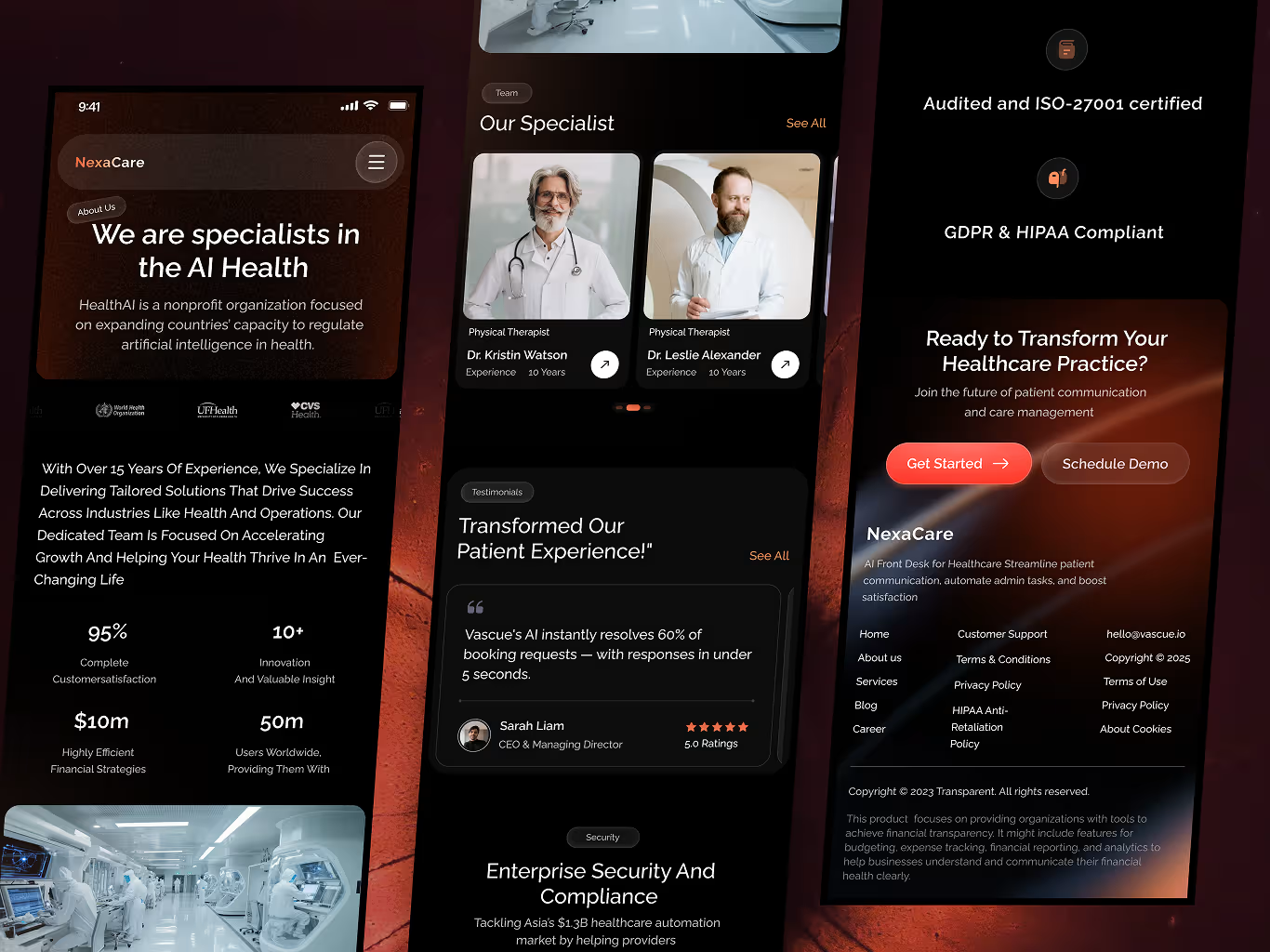
A single-physician family practice in a rural market and a 12-hospital academic health system have overlapping compliance requirements and almost nothing else in common. The design approach changes based on scale, patient population, and clinical scope.
Hospital systems. Hospital websites carry the highest structural complexity: service line navigation, physician directories with hundreds of providers, multi-location finders, billing portals, career sections, research publications, and patient education libraries. The core UX challenge is managing that depth without burying the actions a patient actually needs. Johns Hopkins Medicine uses a service-line hub model, where each specialty has its own entry page linked from a central "Find a Doctor" starting point. Depth without a clear patient entry path creates a labyrinth.
Private practices and clinics. Single-location clinics have a simpler goal: booking conversion. Every page on a private practice website is ultimately a path to the appointment form. Clear provider bios on the homepage, insurance information above the fold, and a frictionless booking flow deliver more patient volume than sophisticated navigation architecture ever will. Reduce clicks. Remove friction. Keep the focus.
Practices that reach that point usually work with a website design agency that builds intake forms, scheduling, and provider profiles into the templates rather than adding them after launch.
Telemedicine and digital health platforms. Telehealth websites carry a design challenge that hospital sites do not: explaining an unfamiliar clinical experience before the patient has completed it once. The design must answer the patient's implicit question ("will this actually work for me?") before asking for a single personal detail. Teladoc's onboarding flow addresses six patient objections in sequence before requesting registration information. That sequencing is a design decision rooted in patient psychology, not just UX convention.
Healthcare startups and HealthTech products. HealthTech startups frequently apply SaaS conversion patterns to healthcare patient acquisition, and the results underperform. Patients are not evaluating a feature set. Patients are deciding whether to trust an unfamiliar organization with health data that can affect their employment, insurance, and relationships. Lead with compliance proof, clinical outcomes, and named credentials. Feature lists and pricing grids are secondary to trust architecture in healthcare conversion design.
Healthcare web design trends in 2026
Design trends in healthcare websites follow one filter: clinical utility before visual novelty. Any trend that adds friction, reduces clarity, or introduces accessibility risk is the wrong trend for a healthcare site.
AI-powered appointment routing and symptom triage. Conversational AI on healthcare websites shifted from basic FAQ chatbots to clinical symptom triage tools between 2024 and 2026. Platforms like Buoy Health and K Health route patients to the right level of care before they book, reducing unnecessary ER visits and no-shows simultaneously. The design challenge is building patient trust in AI guidance without creating diagnostic liability. Clear disclaimers, visible clinical oversight, and escalation paths to human care teams are non-negotiable design requirements alongside the AI feature.
Embedded telemedicine portals on the main website. Telemedicine features moved from standalone apps to embedded experiences within the primary healthcare website. Patients now complete registration, insurance verification, consent, and video visit entry without leaving the provider's main domain. This reduces drop-off between booking confirmation and actual visit completion, a measurable improvement in care access rates.
Accessibility-first design systems. Following the HHS Section 504 compliance deadline, healthcare organizations building new websites in 2026 are constructing design systems with WCAG 2.1 AA validation built into every component. Color tokens, heading hierarchies, form label patterns, and keyboard focus states are pre-validated before any page is built. This shifts accessibility from a QA audit task at the end of a project to a design foundation at the beginning. For teams building design systems in healthcare contexts, the core process is covered in detail in Orbix Studio's UI design system guide.
Personalized returning-patient experiences. Healthcare websites are beginning to differentiate the experience for returning authenticated patients versus anonymous first-time visitors. A patient managing a chronic condition sees care continuity prompts. A first-time visitor sees provider selection and service discovery pathways. This is care-driven personalization using clinical context to serve the right content to the right patient stage, not behavioral advertising.
How much does healthcare website design cost?

Healthcare website design for a small practice typically runs between $4,000 and $8,000. A custom multi-location health system or telehealth platform with full compliance infrastructure runs $15,000 to $50,000 or more depending on portal integration depth, EHR connections, and multilingual requirements.
What drives cost up:
- HIPAA-compliant form infrastructure and a fully documented BAA vendor chain
- Custom patient portal development versus off-the-shelf integration
- Multilingual content architecture and accessible PDF libraries
- EHR or EMR integration (Epic, Cerner, Athenahealth each carry significant API scope)
- Custom provider directories with search, specialty filtering, and insurance matching
What keeps cost manageable:
- Phased builds: launch the compliant patient acquisition foundation, add portal and telehealth in Phase 2
- HIPAA-eligible hosted platforms: Webflow with compliant hosting or WordPress with properly configured infrastructure cuts custom development significantly
- Scope discipline: a private practice needs a homepage, service pages, provider bios, a booking integration, and compliant forms, not a content management system with 40 page templates
Monthly maintenance on a HIPAA-compliant healthcare website runs between $300 and $700 per month, covering security patching, compliance monitoring, backup protocols, and performance maintenance.
Healthcare-specialized agencies, reviewed in detail in the top 10 healthcare website design agencies roundup, typically charge a premium over general web agencies. That premium reflects HIPAA-specific workflows, BAA documentation processes, and compliance QA that a generalist agency must build from scratch on every healthcare engagement.
Four mistakes that break healthcare website projects
Every healthcare website project faces the same failure points. None of them are design failures. All of them are scope failures: cutting compliance, patient research, or performance testing to hit a budget or timeline.
Mistake 1: Running Google Analytics on patient-facing regulated pages.
Google confirmed GA4 does not provide a Business Associate Agreement. Placing standard Google Analytics on appointment booking pages, patient intake flows, or any page collecting health-adjacent data creates direct HIPAA exposure. Remove GA4 from regulated pages and replace it with a HIPAA-compliant analytics platform that issues a signed BAA. Matomo (self-hosted) and Freshpaint are both options in active healthcare use.
Mistake 2: Installing an accessibility overlay and treating it as WCAG compliance.
Accessibility overlay widgets generate accessibility score improvements. Courts have not accepted overlay compliance as a defense in ADA lawsuits. Multiple federal cases have found that overlays do not address the underlying code issues WCAG 2.1 AA requires. Real compliance means fixing the source code of the site. An overlay is a reporting patch, not a structural fix.
Mistake 3: Designing the navigation around the organization's internal structure.
A hospital website redesign that begins by mapping departmental org charts will produce navigation organized by how the hospital is structured internally, not by how a patient searches. Patients search by symptom, body part, and care type. They do not understand the operational boundary between "Cardiology" and "Cardiovascular Surgery." Navigation built on internal departmental labels creates confusion at the exact moment a patient is trying to find care.
Mistake 4: Launching without a mobile performance audit.
Google's Mobile-First Index ranks the mobile version of a site. A healthcare website with a PageSpeed Insights mobile score below 70 will lose ranking position to competitors with faster mobile load times, regardless of content depth. Run the audit before launch, not after the first traffic report shows a performance drop. For current federal accessibility technical standards, ADA.gov publishes its web rule guidance as a free reference.
Frequently asked questions
What should a healthcare website include?
A healthcare website needs online appointment scheduling, a patient portal access link, provider profiles with full credentials, HIPAA-compliant contact and intake forms, a telemedicine entry point, emergency care navigation, multilingual support, and a mobile-first layout. Every element must meet WCAG 2.1 Level AA accessibility standards under HHS Section 504.
How much does healthcare website design cost?
Small private practice websites run $4,000 to $8,000. Mid-size clinic builds with custom design and booking integrations range from $8,000 to $20,000. Hospital systems or telehealth platforms requiring EHR integration, HIPAA-compliant portals, and provider directories run $15,000 to $50,000 or more. Monthly maintenance adds $300 to $700 depending on compliance scope.
What is HIPAA-compliant website design?
HIPAA-compliant website design means every tool, form, and analytics system that handles Protected Health Information operates under signed Business Associate Agreements. It requires encrypted form transmission, HIPAA-eligible hosting infrastructure, compliant analytics on regulated pages, and a documented audit trail for any patient data submission.
What are the ADA requirements for healthcare websites in 2026?
Healthcare organizations receiving federal funding must meet WCAG 2.1 Level AA under HHS Section 504. Requirements include color contrast ratios of 4.5:1 or higher for body text, alt text on all images, accessible form labels, full keyboard navigation, and captions on video content. The compliance deadline for organizations with 15 or more employees was extended to May 2027.
What makes a healthcare website effective for patients?
An effective healthcare website earns patient trust within the first 10 seconds, routes any visitor to their target action within three clicks, passes WCAG 2.1 AA accessibility, meets HIPAA compliance on all patient-facing data collection, and loads on mobile in under 2.5 seconds measured by Core Web Vitals LCP. Named provider credentials, real photos, and plain-language content all contribute directly to patient conversion.
Does Google Analytics violate HIPAA on healthcare websites?
Google has confirmed that GA4 does not offer a Business Associate Agreement. Placing standard Google Analytics on healthcare pages involving appointment booking, patient registration, or health-related form submissions creates HIPAA exposure. Use a HIPAA-compliant analytics platform with a signed BAA on any page where patients interact with health-related content or forms.
What is the best platform for building a healthcare website?
Platform choice depends on scale. WordPress with HIPAA-compliant hosting works for small-to-mid-size practices when configured with the correct plugins and infrastructure. Webflow with compliant hosting suits design-led healthcare brands and HealthTech startups. Enterprise health systems typically use custom builds or CMS platforms such as Drupal or Sitecore, with compliance configurations built into the architecture from the ground up.
Conclusion
The line between a compliant healthcare website and a non-compliant one is not how it looks. It is where the data flows and whether every vendor touching that data has signed a BAA.
Fix the compliance foundation first: document your BAA vendor chain, replace GA4 on regulated pages, and run a WCAG 2.1 AA audit on your highest-traffic patient pages. Those three steps will identify the highest-risk issues before any redesign budget is committed. Everything else in this guide builds on that foundation.
Want to go deeper on healthcare UX and patient-facing design systems? Orbix Studio works with HealthTech founders and healthcare organizations on exactly this. Explore our UI/UX design services







.svg)
.svg)


.svg)







.avif)



.svg)

