- What is a website redesign?
- Mistake that inflates website redesign cost
- Website redesign cost breakdown by project type
- What actually drives website redesign pricing up
- Agency vs Freelancer vs In-House: real cost and outcome compared
- Website redesign cost for specific business types
- How Orbix Studio scopes and prices website redesign projects
- How to reduce website redesign cost without cutting results
- Measuring website redesign roi
- Frequently asked questions
- Final Thoughts


.svg)

%201%201.svg)
Website Redesign Cost in 2026: $2K–$150K Pricing Breakdown

- Before: Website redesign cost ranges from $2,000 for a visual refresh to $150,000+ for a full enterprise rebuild.
- After: Website redesign cost ranges from $2,000 for a visual refresh to $150,000+ for a full enterprise rebuild most mid-size business sites in 2025–2026 land between $18,000 and $35,000.
A business owner requests three quotes for the same website. One agency says $8,000. Another says $65,000. A freelancer says $2,200. No scope document. No discovery session. Three wildly different numbers for one project.
That gap comes from one place: nobody defined what "redesign" means before pricing it. And without a shared definition, every quote is built on a different assumption.
Website redesign cost depends on three variables: what you're starting with, where you need to end up, and who does the work. A visual refresh of a 10-page brochure site runs $2,000–$8,000. A full rebuild of a B2B platform with CRM integration, custom workflows, and conversion-optimized architecture lands at $40,000–$150,000+.
Understanding website redesign pricing before requesting a single quote saves weeks of back-and-forth and prevents scope mismatches that cost more than the redesign itself. This guide breaks down costs by project type, explains every factor that shifts the number up or down, and gives you a clear framework to evaluate any quote before signing.
Free website redesign scope checklist
Every accurate quote starts with the same input: a written scope. Use this checklist before you request pricing from anyone.
- Business goal — what should the new site do that the old one doesn't (more signups, faster checkout, better mobile speed)?
- Page templates — how many unique page layouts, not total pages (a blog with 200 posts still uses 1 template)?
- Current platform — WordPress, Webflow, Shopify, custom CMS, or something else?
- Integrations — CRM, payment processor, marketing automation, or booking tools required at launch?
- Content status — is copy final, or does it need to be written during the project?
- Go-live date — a fixed deadline changes which team (freelancer, agency, in-house) can realistically deliver.
Bring these six answers to your first pricing conversation. Agencies that quote from a brief give you a real number. Agencies that quote without one give you an estimate that will change.
What is a website redesign?
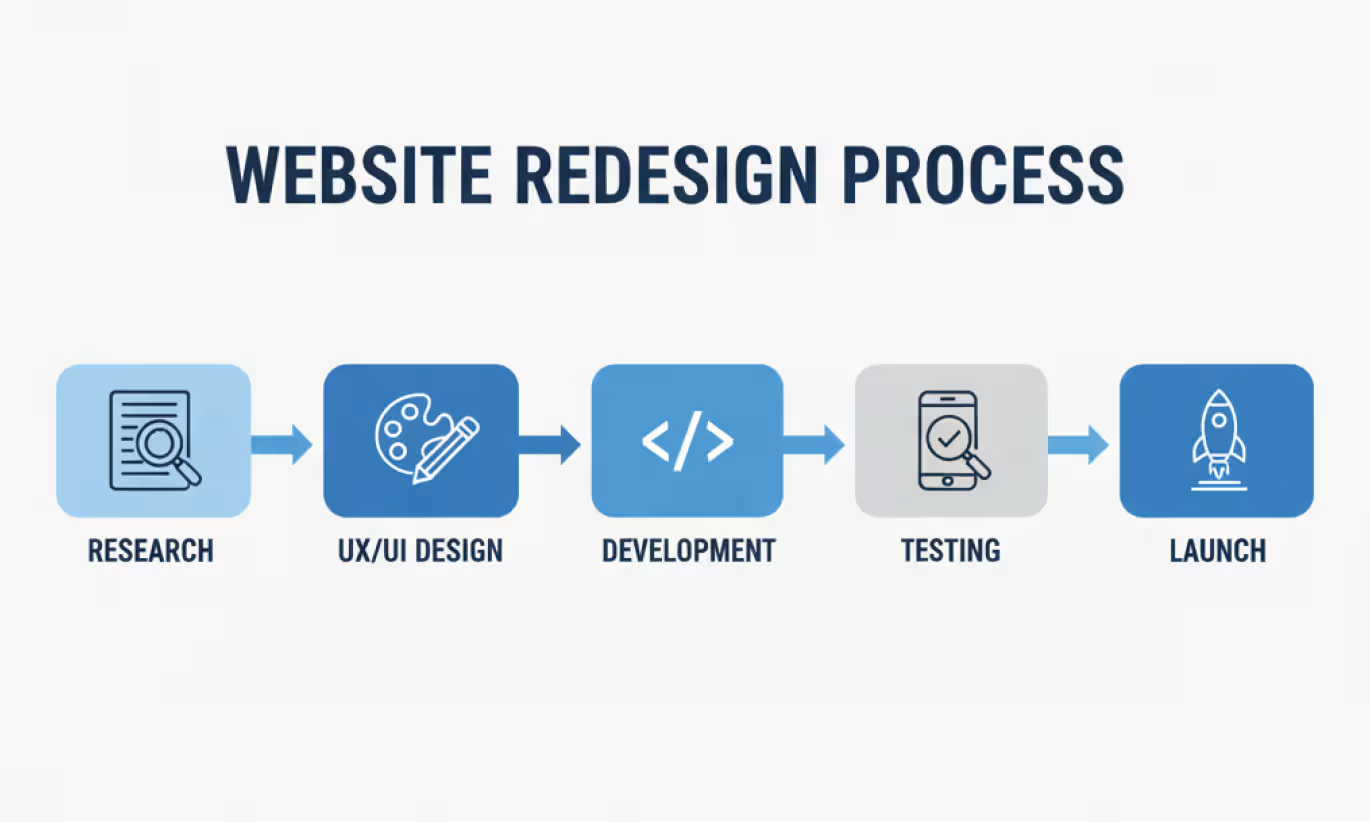
A website redesign is the process of rebuilding or updating an existing site to improve performance, user experience, or business results. Not every update qualifies as a redesign. Swapping a logo or updating colors is a visual refresh. Rebuilding navigation, restructuring page flows, migrating to a new CMS, or rebuilding conversion funnels is a redesign.
Pricing reflects scope, not effort alone. Agencies quote visual refreshes at $2,000–$8,000. Full redesigns start at $10,000 and scale based on features, unique page templates, and integration requirements. Confusing these two project types is the starting point for every misaligned quote.
A complete redesign addresses six layers: information architecture, UX flows, visual design, content structure, technical development, and SEO preservation during migration. Skip one layer and technical debt surfaces six months after launch. That gap shows up as a drop in organic traffic or a conversion rate that never recovers.
For context on what UX and UI design work costs when separated from development, see the complete UX/UI design cost guide before locking your budget.
Mistake that inflates website redesign cost
Scope creep starts before the contract is signed. A founder says "we need a new website." An agency hears new CMS, new integrations, custom animations, and fifty pages. The quote comes back at $80,000. Neither side is wrong. Both defined the project differently from the start.
Here's where it breaks down: agencies quote what they can build, not what you actually need. Without a scope document before the quote, every line item becomes a negotiation after the contract starts. That negotiation always runs in one direction.
A brief before the quote fixes this. Before requesting any pricing, define four things: how many unique page templates your site needs, which integrations are required at launch, whether you're migrating platforms, and which specific business outcome you're measuring. A redesign built to increase demo bookings has a different scope than one built to modernize brand perception. Pricing reflects that difference.
Orbix Studio runs a discovery session before producing any quote. That session maps the business goal, audits current site performance, and locks the template count before design begins. Projects scoped this way finish on time and on budget because the brief exists before the contract does.
Website redesign cost breakdown by project type
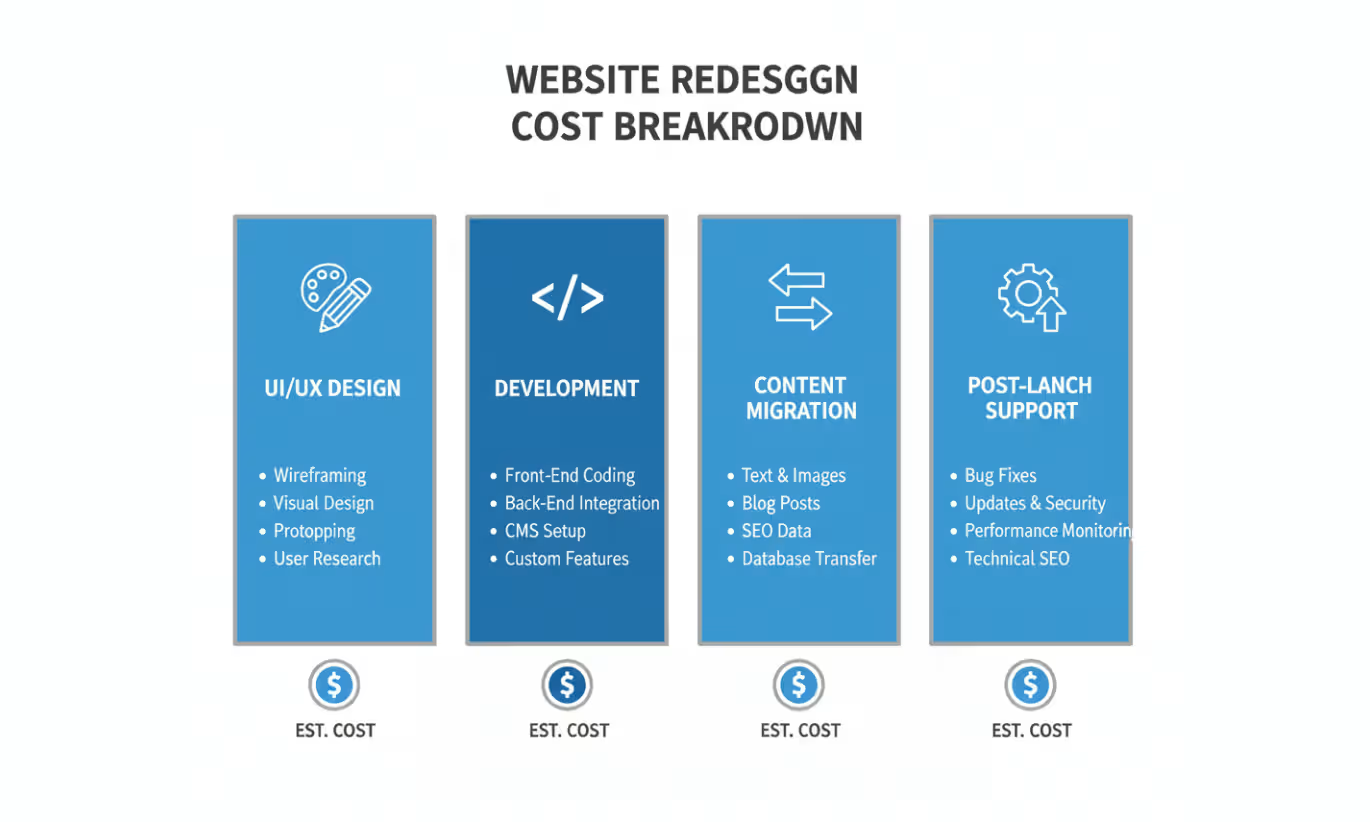
Website redesign pricing falls into three tiers based on project complexity and business requirements. Knowing which tier your project sits in cuts the quote evaluation process from weeks to hours.
If you're earlier than that stage still validating an idea before committing to a full site - see our MVP development cost guide first.
What actually drives website redesign pricing up
Six factors push the cost of a website redesign above the base estimate. Every quote should map to at least one of these drivers. If it doesn't, the extra cost isn't justified.
1. Number of unique page templates
Page count matters less than template count. Agencies price per unique layout, not per URL. A 40-page site with four reusable templates costs less to design than a 15-page site with twelve custom layouts. Before requesting a quote, list every distinct page type your site needs. That list is your real design scope.
2. Platform migration
Moving from WordPress to Webflow, or from a custom CMS to Shopify, adds $3,000–$15,000 to a typical project. The exact number depends on page count and the platform you're migrating to:
- 1–25 pages: $3,000–$6,000
- 25–50 pages: $6,000–$12,000
- 50–100+ pages: $12,000–$25,000, depending on custom functionality and integrations
Content migration, redirect mapping, and SEO preservation during migration each carry a cost on top of the base build. According to Google Search Central, a poorly managed site migration can reduce organic traffic by 30–40% in the first 90 days post-launch — budget for a redirect audit and a 30-day post-launch monitoring window, not just the migration itself.
3. Custom development
Template-based builds cost less. Custom interactions, calculated fields, booking systems, membership portals, and API integrations require a developer alongside the designer. If those features add up to a full web application rather than a marketing site, see our web app development cost guide for a separate estimate.
Each custom feature adds 15–40 hours of development time on top of the design estimate.
4. Third-party integrations
Every tool the site connects to adds scope. HubSpot, Salesforce, Stripe, Intercom, and Klaviyo each require setup, testing, and QA cycles. A site with five integrations costs 20–35% more than the same site built without them.
5. Content strategy and copywriting
Design doesn't write. If your project needs new page copy, messaging refinement, or blog content migration, that's a separate budget line. Professional page copy for a 20-page site runs $3,000–$10,000 depending on complexity and research requirements.
6. Post-launch support
Ask every agency what happens after the site goes live. UX adjustments, SEO monitoring, performance fixes, and CMS training are often billed separately. Build this line into the initial budget rather than treating it as optional. Sites that receive post-launch iteration consistently outperform those that don't.
Agency vs Freelancer vs In-House: real cost and outcome compared
Three hiring paths exist for a website redesign. Each has a clear use case and a clear failure mode. Choosing the wrong path adds cost in places the initial quote never shows.
Freelancer: $1,500–$25,000
Best for small sites, visual refreshes, and template-based projects with a locked scope and no complex integrations. A skilled Webflow freelancer delivers a clean 10-page site in four to six weeks. Risks include no QA layer, no backup when the freelancer is unavailable, and limited capacity when the project grows mid-build.
Agency: $8,000–$150,000+
Best for mid-size to enterprise projects where UX research, visual design, development, and QA need to run in parallel. See how that looked in practice for one client.
Agencies carry project management overhead, which increases cost but reduces the time a founder needs to spend managing the project directly. When evaluating agencies, the discovery process matters more than the portfolio. For a framework on vetting the right partner, see this guide on how to choose a UI/UX agency for a SaaS startup.
That overhead sits inside the agency number, not next to it. A website redesign agency quote already covers the coordination a freelancer quote leaves for the founder to absorb.
In-house team: $80,000–$200,000 per year
Hiring a full-stack designer and developer costs more per project than an agency at small or mid-size scale. An in-house team makes financial sense only when redesigns happen continuously and the team maintains the product long-term. For a one-time or annual project, the hiring timeline and ramp-up cost make agencies more cost-effective in every scenario.
Want to see how a website redesign scope gets built before a single dollar is quoted?
Website redesign cost for specific business types
Average website redesign cost shifts depending on the business model, not just the page count. Three business types see different cost structures for the same project size.
E-commerce redesign: $15,000–$80,000
E-commerce redesigns carry higher costs because product pages, checkout flows, filtering systems, and payment integrations all require custom design and QA. A Shopify redesign for a 500-product store requires a different scope than a Webflow redesign for a 20-product brand. Checkout redesigns consistently deliver the highest ROI: one mid-size e-commerce client who rebuilt their mobile checkout and product card layout saw a 20% increase in purchase completion within four months of launch.
B2B SaaS redesign: $20,000–$100,000
SaaS websites carry the weight of trial signups, feature communication, and pricing page conversion. Every page in a SaaS redesign serves a specific funnel stage. Navigation structure, pricing page layout, and feature comparison blocks require UX research before design begins. Skipping research at this stage produces a site that looks new but converts at the same rate as the old one.
Enterprise SaaS platforms migrating to a composable or headless CMS see costs land at the top of this range $70,000–$100,000+ because content modeling, API integrations, and Core Web Vitals optimization all happen before a single page is designed. Replatforming to a composable CMS pays off when marketing needs to publish and test pages without engineering support; it's not worth the added cost for a site under 30 pages.
Mobile-first redesign: $10,000–$60,000
A redesign driven by poor mobile performance addresses layout, touch target sizing, page speed, and Core Web Vitals scores for mobile devices specifically. According to Google's Core Web Vitals documentation, pages that pass LCP, CLS, and INP thresholds on mobile see a measurable reduction in abandonment rate. For mobile-specific UX strategy, see the mobile app redesign guide for parallel frameworks that apply to web as well.
Nonprofit and association redesign: $8,000–$40,000
Nonprofit and association sites carry a different cost driver than commercial sites: membership portals, donation flows, and event registration systems replace e-commerce checkout as the highest-cost feature. A basic nonprofit site with a donation form and events calendar runs $8,000–$18,000. Association sites with gated member content, dues billing, and a searchable resource library run $20,000–$40,000. Budget an extra $2,000–$5,000 for payment processor compliance (PCI) if the site handles recurring donations or membership dues directly.
Orbix applied this same mobile-UX discipline to Gen.ho, a smart home app redesign that cut time-to-access by 48%.
How Orbix Studio scopes and prices website redesign projects
Orbix Studio's process starts with a two-hour discovery session, not a proposal deck. That session maps the business goal, audits the current site's conversion and performance data, and defines the page template count before any design begins.
Design-only projects pricing start at $2,000–$5,000 and deliver core page templates, responsive layouts, and a Webflow-ready design file. Full design and development projects through the Webflow expert agency process start at $8,000 and scale based on integration complexity and template count.
31% more demo bookings. A B2B SaaS client restructured their pricing and features pages with Orbix Studio a five-item flat menu became a two-tier structure by user role, and the hero CTA changed from "Request access" to an ROI calculator.
Post-launch, Orbix provides UX monitoring and iteration support on a monthly basis. A B2B SaaS client with 1,400 monthly demo page visitors rebuilt their pricing and features pages through Orbix Studio. Navigation was restructured from a five-item flat menu into a two-tier structure organized by user role. The hero CTA changed from "Request access" to a calculator that showed ROI before the visitor reached a contact form. Demo bookings increased 31% in the first three months post-launch.
For projects where mobile experience is central to the redesign brief, the mobile app development cost guide provides parallel cost frameworks for teams building both a website and a product simultaneously.
How to reduce website redesign cost without cutting results
Reducing website redesign cost means cutting scope to what the site actually needs at launch, not cutting quality. Four decisions create the biggest savings.
Standardize templates, not pages.
A 30-page site with three templates costs less to design than a 15-page site with ten. Identify which page types share a layout and standardize them. CMS collections in Webflow and WordPress handle content variation without adding design cost per item.
Build with reusable components.
A button, card, navigation bar, or pricing table designed once gets used everywhere. Ask whether your agency builds a component library or redesigns elements on each new page. Agencies that build systems deliver the same quality at lower long-term cost.
Phase non-launch features.
A resource library, events calendar, or partner directory can launch two months after the main site. Phasing reduces the initial build cost by 20–40% and lets you validate core site performance before investing in additional content infrastructure.
Finalize copy before design starts.
Content changes after design approval add billable hours for every layout adjustment that follows. Finalizing page copy before wireframing removes the single largest source of revision cost in any redesign project.
Pricing conventions shift by region too - see our breakdowns for UI/UX design cost in Dubai and UI/UX design pricing in Saudi Arabia if you're scoping this from the Gulf.
Measuring website redesign roi
A website redesign is a capital expense. Measuring its return tells you whether it worked and whether the investment was sized correctly.
Three metrics define ROI for a redesign:
- Conversion rate by page type. Track the percentage of visitors completing a target action on each key page. A contact page converting 2% of visitors before the redesign should convert 4–6% after, if the redesign addressed the right UX problems. Anything less signals a content or CTA issue, not a design failure.
- Core Web Vitals scores. Run Google PageSpeed Insights on every primary page before launch and again 30 days after. According to Google's developer documentation, pages passing Core Web Vitals thresholds see lower abandonment rates and stronger search rankings over time.
- Organic traffic trend at 90 days. A redesign that maps all redirects, preserves meta structure, and improves page speed holds or grows organic traffic within 90 days. A drop signals a migration error that needs immediate diagnosis. If traffic decline is the actual symptom rather than a one-off migration error, see the signs your SaaS website needs a redesign.
Knowing what to measure before launch turns the website redesign quote into a performance contract, not a creative expense.
Frequently asked questions
How much does a website redesign cost in 2026?
Website redesign cost in 2026 ranges from $2,000 for a small visual refresh to $150,000 or more for a full enterprise platform rebuild. A mid-size business site with custom UX design, CMS development, and basic integrations typically costs $10,000–$50,000 depending on scope, platform, and team type selected.
What factors affect website redesign cost?
Platform migration, unique page template count, and custom development are the three largest cost drivers. Moving CMS platforms adds $3,000–$15,000. Custom integrations each add 15–40 development hours. Template count drives design cost more than total page count. Sites with fewer unique layouts cost less regardless of content volume.
What is the difference between a visual refresh and a full website redesign?
A visual refresh updates colors, typography, imagery, and minor layout elements without changing site architecture or CMS. A full redesign rebuilds information architecture, UX flows, navigation, and often migrates platforms entirely. Refreshes cost $2,000–$8,000. Full redesigns start at $10,000 and scale with complexity.
How long does a website redesign take?
Small visual refreshes take 3–6 weeks. Mid-size business redesigns run 8–14 weeks. Enterprise projects span 3–9 months. Two factors extend timelines beyond initial estimates: slow feedback cycles between client and agency, and scope changes requested after the design phase has been approved.
Should I hire a freelancer or an agency for a website redesign?
Hire a freelancer for sites under 15 pages with a locked scope and no complex integrations. Hire an agency when UX research, visual design, development, and QA need to run at the same time. Agency overhead costs more but reduces the founder's time managing the project and lowers the risk of mid-project delays.
How do I know if my site needs a full redesign or just targeted updates?
A full redesign makes sense when: conversion rates have declined for two or more consecutive quarters, the site fails Core Web Vitals on mobile, the CMS cannot support new business requirements, or the brand has changed substantially. Copy edits, image updates, or adding a blog section do not require a full redesign.
How do I get an accurate website redesign quote?
Write a one-page brief before requesting any quote. Include: your business goal, the number of unique page templates needed, the platform you're currently on, which integrations are required at launch, and your target go-live date. Agencies that price from a brief give you a real number. Those that quote without one give you an estimate that will change.
Will migrating platforms hurt my SEO or organic traffic?
A migration only hurts SEO when redirects, meta data, or URL structure are handled poorly. According to Google Search Central, a poorly managed migration can drop organic traffic 30–40% in the first 90 days. A managed migration full redirect mapping, preserved meta titles and descriptions, and a post-launch monitoring window typically holds traffic flat or grows it within 90 days, since the new site also improves Core Web Vitals and page speed.
Is an agency or an in-house team a better ROI for a one-time redesign?
For a one-time or annual redesign, an agency is the better ROI in nearly every case. An in-house full-stack hire costs $80,000–$200,000 per year before a single project ships, and that cost is fixed whether or not you're actively redesigning. An agency's project management overhead adds to the invoice, but it replaces months of hiring and ramp-up time. In-house only wins when redesigns and ongoing site changes happen continuously, not as a one-time project.
How do I estimate a website redesign project before contacting an agency?
Start with the six inputs in the free scope checklist above: business goal, page template count, current platform, required integrations, content status, and go-live date. Multiply your unique page template count (not total pages) by platform complexity a template-based Webflow site runs $500–$1,500 per template, while custom-coded templates run $2,000–$5,000 each. This gives you a working range before any agency quotes you a number, so you can tell a fair quote from an inflated one.
What's the average website redesign cost in 2025–2026?
The average website redesign in 2025–2026 costs $18,000–$35,000 for a mid-size business site with custom UX design, CMS development, and basic integrations. Enterprise and B2B SaaS projects average $50,000–$100,000+. Visual refreshes without a full rebuild average $4,000–$8,000. These figures held steady through 2026 as platform migration costs not design costs became the largest driver of year-over-year increases.
Final Thoughts
Website redesign pricing is not arbitrary. Every number reflects a decision: how many templates, which platform, which integrations, and what post-launch support looks like. Quotes that skip those decisions are ranges, not prices.
Before requesting a website redesign quote, write a one-page scope brief. Name the business goal, the template count, the platform, and the integrations required at launch. Run a site audit using Google PageSpeed Insights and identify your three highest-converting pages and the three with the highest exit rate. That audit becomes the brief, and the brief becomes the real price.
A redesign scoped this way costs what the quote says it will and delivers outcomes you can measure from day one.
Ready to scope your website redesign from a brief that prevents surprises? Book a free strategy call with Orbix Studio →







.svg)
.svg)


.svg)







.avif)



.svg)

