- AI Integration Companies at a Glance: A Quick Comparison
- How We Selected the Best AI Integration Companies
- The 10 Best AI Integration Companies in 2027
- How Much Does AI Integration Cost in 2027?
- How to Choose the Right AI Integration Company
- Should You Implement AI in Your Business?
- Why Businesses Choose Orbix Studio for AI Integration
- Frequently Asked Questions
- Final Thoughts


Find the Right AI Integration Partner: 10 Companies Compared
- The right AI integration company depends on your existing software, goals, and technical needs. A team strong in LLM development may not suit workflow automation or enterprise integration.
- Look past the services listed on a website. Case studies, past integrations, client reviews, and measurable results show what an agency can actually deliver.
- Check that the company works with your current stack, including CRM, ERP, databases, APIs, and cloud. Poor compatibility can turn a simple integration into an expensive build.
- Ask how the agency handles testing, deployment, monitoring, and failures. A working AI feature is only half the job; keeping it reliable matters just as much.
- Don't adopt AI just because a competitor did. Start with a business problem, then compare AI with traditional automation to see if the benefit justifies the cost.
Hiring an AI integration company is a big investment, and the first quote rarely shows what it costs to get a reliable solution into production.
Poor data quality, incompatible software, extra API needs, and ongoing maintenance can all push the cost up. A cheap proposal can end up costing more if it needs repeated fixes.
Before you commit, compare each provider's expertise, project experience, pricing, and process. Here are the 10 best AI integration companies to consider in 2027, from design studios to enterprise AI implementation companies.
Disclosure: Orbix Studio published this guide and lists itself as the first company. Every company, Orbix included, is judged on the same criteria, and results a company reports about itself are labeled as self-reported.
AI Integration Companies at a Glance: A Quick Comparison
Use this table to compare these top AI integration companies by expertise, capabilities, size, pricing, and engagement model, then shortlist the ones that fit your project and budget.
How We Selected the Best AI Integration Companies
We chose these 10 AI integration companies, a mix of specialist studios and top AI consulting companies, for their technical expertise, integration experience, portfolios, and client feedback. We looked for different specializations rather than simply ranking the biggest names.
- Technical expertise: Experience with LLMs, RAG, AI agents, machine learning, APIs, and workflow automation, plus the skill to apply them to real business problems.
- Integration experience: Connecting AI to existing applications, CRM and ERP platforms, databases, and workflows without adding unnecessary complexity.
- Project experience: Published case studies and completed projects with technical detail and measurable client results, not just a list of services.
- Client feedback: Clutch reviews, testimonials, and third-party feedback on communication, technical skill, project management, and delivery.
- Implementation approach: The process from discovery and planning to development, testing, deployment, and maintenance, including documentation and monitoring.
- Pricing and suitability: Published rates, minimum budgets, engagement models, and company size. The company's experience and capacity should match your project's complexity.
The 10 Best AI Integration Companies in 2027
These 10 AI integration companies cover very different ground, from design-led product studios to cloud consultancies and Python engineering teams. Each entry covers the basics (location, size, Clutch rating and pricing), what its AI integration services actually involve, and the kind of project it suits best. Results the companies report about themselves are labeled as self-reported, so you can tell them apart from client reviews.
1. Orbix Studio: Best for Adding AI to SaaS Products Without Hurting the Experience
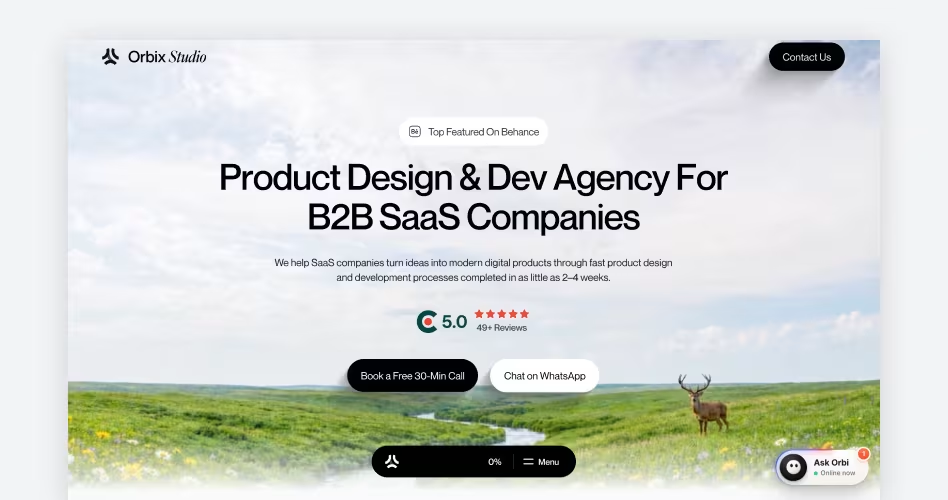
- Best for: SaaS startups and product teams that want AI features their users actually trust and use
- Headquarters: New York, USA (teams in Dubai, Riyadh and Dhaka)
- Founded: 2023
- Team size: 35+
- Clutch rating: 5.0 on every reviewed project (49 reviews)
- Pricing: Monthly plans from $4,299 per month
- Hourly rate: $50–99 (listed on Clutch)
About Orbix Studio
Orbix Studio is a design-led product studio, and it published this guide, so treat its place on the list with that in mind. Since 2023, the studio has delivered 140+ projects for startups and growing companies, with a team of 35+ people spread across New York, Dubai, Riyadh and Dhaka. The Dubai team also makes it a practical option if you're looking for an AI agency in Dubai or elsewhere in the UAE.
So why is it on an AI integration list? Because the part of an AI feature that most often goes wrong isn't the model. It's the experience around it. An assistant nobody can find, answers users don't trust, a "smart" feature that adds a step instead of removing one. That's the problem Orbix likes solving. New projects also start with a one-week trial, so you see real work before you commit.
AI Integration Services
- AI integration starts with the products and workflows you already have, so AI is added where it saves time instead of bolted on.
- Generative AI integration services connect language models to your own documents and data through LLM and RAG integration, so answers come from what your business actually knows.
- Chatbots and assistants are designed and built to sit inside the product, not on top of it.
- Repetitive workflows can be automated with AI, from routing requests to drafting first replies.
- AI integration for existing software, including CRM, ERP and SaaS tools, adds AI features without a rebuild.
- UI/UX design for AI features covers how users find, trust and use them.
- MVP development gets a first AI product in front of real users quickly.
Notable Projects
- PXGEN, an AI image generation product
- An AI study assistant app and an AI travel booking app from its portfolio
- A system migration for an event marketing company, where a PHP system moved to Azure and was rebuilt in JavaScript with a custom dashboard and ERP features (rated 5.0 on Clutch)
Who Should Choose Orbix Studio
Orbix is a good fit if you're adding AI to a SaaS product and the look and feel matter as much as the code. Most of its Clutch reviews are design and software builds, and the AI work is newer, so ask to see it. For custom model training or large enterprise data rollouts, a specialist like deepsense.ai or Caylent suits better.
2. Master of Code Global: Best for Conversational AI With a Low-Risk Start
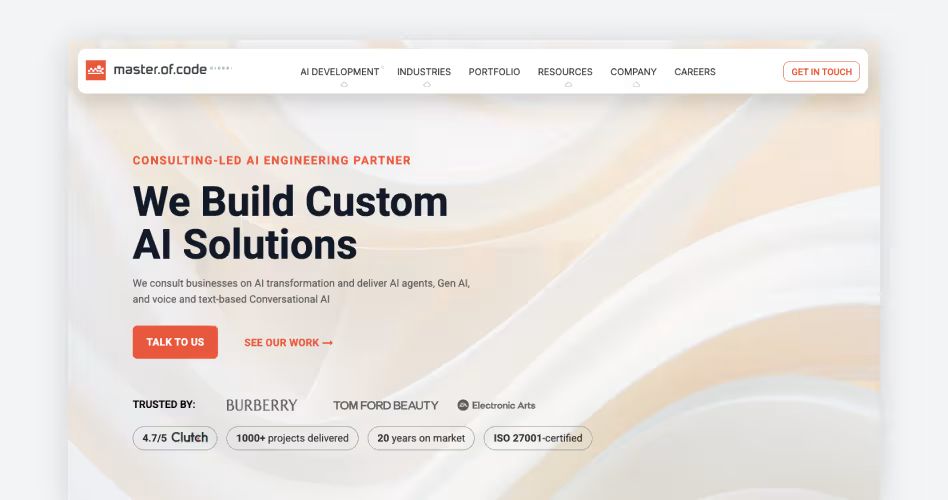
- Best for: Brands that want AI agents or chatbots but want to test the idea before a big commitment
- Headquarters: Redwood City, USA (also Winnipeg, Canada)
- Founded: 2004
- Team size: 150+
- Clutch rating: 4.7 (37 reviews)
- Pricing: Not published. $25,000+ minimum on Clutch, and most projects fall between $50,000 and $199,999
- Hourly rate: $50–99
About Master of Code Global
Most AI vendors want a big commitment before you've seen anything work. Master of Code Global does it the other way around. Its AI Pilot is a 30-day build on a fixed budget, and its AI Compass Sprint is a four-week engagement that leaves you with a 90-day roadmap.
The company has been in conversational AI since 2004 and now has 150+ people across Winnipeg, Redwood City and Seattle. It says it has delivered 1,000+ projects for brands like Burberry, T-Mobile and EA. Clutch reviewers rate it 4.7 from 37 reviews.
AI Integration Services
- A 30-day AI Pilot on a fixed budget lets a team test a real AI feature before committing to a larger project.
- The four-week AI Compass Sprint helps a company shape its AI integration strategy and ends with a 90-day roadmap.
- Chat and voice assistants that handle real customer conversations are its core strength, a field the company has worked in since 2004.
- Generative AI can be connected to CRM and ERP systems, so answers draw on real customer and order data.
- Teams choosing between models get Claude and OpenAI consulting on which one suits their use case.
- LLM training on company data and internal MCP setups let assistants safely reach private tools.
Notable Projects
- Zipify's Agent Assist, which the company says brought 65% faster response times, tickets closed twice as fast and 30% lower operating costs (self-reported)
- A wellness onboarding agent using RAG, which it says lifted conversion by 22% and cut acquisition cost by 17% (self-reported)
- A voice bot that replaced a legacy IVR and connected to a CRM through its REST API (Clutch review)
Who Should Choose Master of Code Global
This one suits a brand that wants conversational AI but would rather test it first, since the 30-day pilot and four-week sprint keep the early risk low. The $25,000 minimum is real, though, and one low Clutch review mentions budget overruns and a payment dispute. If your budget is smaller, Azumo starts at $10,000 and charges $25–49 an hour.
3. LeewayHertz: Best for Governed, Enterprise-Grade AI Agents
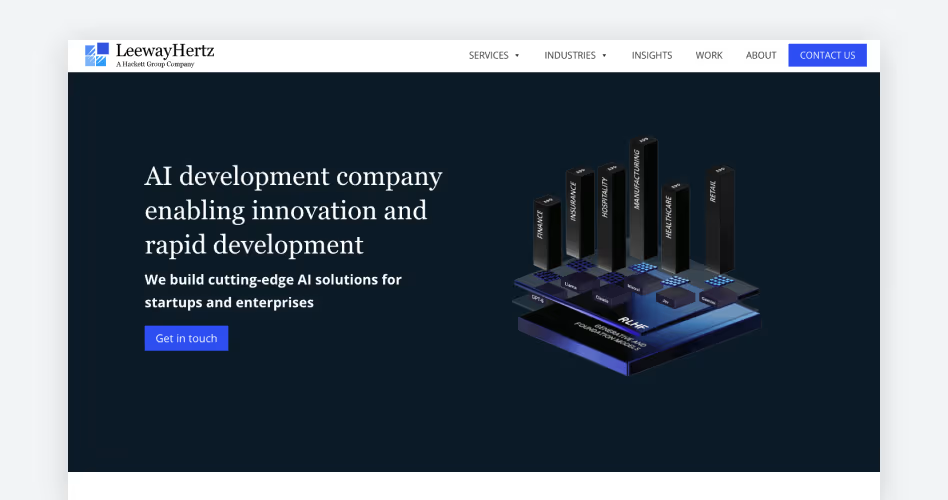
- Best for: Larger companies that need AI agents with governance and compliance built in
- Headquarters: Gurugram, India
- Founded: 2007
- Team size: 50–249
- Clutch rating: 4.7 (9 reviews)
- Pricing: Not published. $10,000+ minimum on Clutch
- Hourly rate: $50–99
About LeewayHertz
LeewayHertz builds its own AI platform, which says a lot about how it approaches client work. ZBrain is its governance-first platform for building agentic apps on Azure AI Foundry, AWS Bedrock or Google Vertex. It also made Scrut, an LLM-powered compliance app.
Founded in 2007 in Gurugram, the company covers AI strategy, development and integration, and builds agents with tools like crewAI and AutoGen. Clutch shows 4.7 from 9 reviews and a $10,000 minimum. The Hackett Group has also announced plans to acquire it.
AI Integration Services
- Larger companies get AI strategy and consulting that settles which use cases are worth building before any code is written.
- Agentic AI integration services start with multi-step agents built on frameworks like crewAI and AutoGen.
- Existing software gets AI features added instead of being rebuilt from scratch.
- ZBrain, its own governance-first platform, lets teams build agentic apps on Azure AI Foundry, AWS Bedrock or Google Vertex with controls built in.
- Custom LLM applications are built around a business's own data and workflows.
- Clients can hire a dedicated team, extend their own, or scope a fixed project.
Notable Projects
- ZBrain, its own platform for building governed agentic apps (company-described)
- Scrut, an LLM-powered compliance app (company-described)
- A troubleshooting app built on an LLM for an unnamed Fortune 500 manufacturer (company-described)
Who Should Choose LeewayHertz
Pick LeewayHertz for enterprise AI integration that needs agents with governance built in, especially on Azure, AWS or Google. Its Clutch profile is thin on AI proof: nine reviews, none about AI work, with some mixed comments on project management and communication. If you want reviews that speak directly to AI projects, Master of Code Global has more.
4. Azumo: Best for US Teams That Want Nearshore AI Engineers

- Best for: US companies that want AI engineers working in their time zone
- Headquarters: San Francisco, USA (developers mostly in South America)
- Founded: 2016
- Team size: 50–249
- Clutch rating: 4.9 (27 reviews, Premier Verified)
- Pricing: Not published. $10,000+ minimum on Clutch
- Hourly rate: $25–49
About Azumo
If your team works US hours, Azumo's setup is easy to like. Its developers sit mostly in South America, so your calls happen in the same part of the day. The San Francisco company was founded in 2016, and Clutch gives it Premier Verified status.
It isn't loyal to one model, either. Azumo builds on OpenAI, Claude, Gemini, LLaMA, Qwen and DeepSeek, and handles agents, RAG, fine-tuning and voice bots. One law firm client reported an 85% cut in staff labor time from an automated workflow. Clutch rates it 4.9 from 27 reviews.
AI Integration Services
- AI agents take over multi-step tasks, so teams spend less time on manual work.
- Existing language models can be fine-tuned on a company's own data and terminology.
- Retrieval setups let a model answer from a company's documents instead of guessing.
- Language-heavy work like classification, extraction and summarizing falls under its NLP practice.
- Voice bots and chatbots cover conversational AI for customer-facing support.
- Projects can run on OpenAI, Claude, Gemini, LLaMA, Qwen or DeepSeek, so the model follows the project.
Notable Projects
- An automated workflow for a law firm that cut staff labor time by 85% (Clutch review)
- Conversational AI for a Fortune 100 customer, built through nlx.ai (Clutch review)
- Fairwater, a fleet management platform (Clutch review)
Who Should Choose Azumo
Azumo works well for a US team that wants nearshore engineers in its own time zone and doesn't want to be locked to one model. Some reviewers mention team turnover during a project, and one noted a budget overrun, which the client attributed to added requests. It also publishes no pricing. If you want a fixed price up front, Monterail is the better match.
5. Miquido: Best for AI Inside Mobile Apps
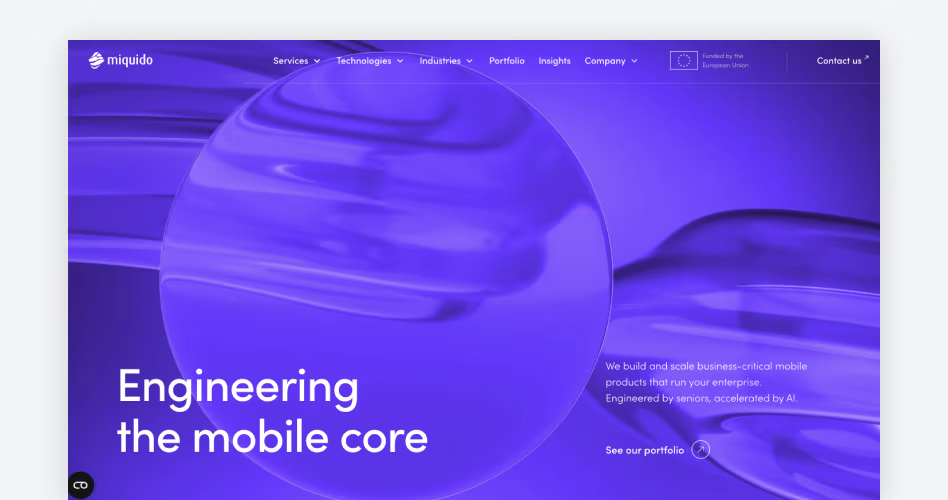
- Best for: Product teams adding AI features to a mobile app
- Headquarters: Kraków, Poland
- Founded: 2011
- Team size: 200+ (per its site)
- Clutch rating: 4.9 (51 reviews)
- Pricing: Not published. $25,000+ minimum on Clutch
- Hourly rate: $50–99
About Miquido
Plenty of AI agencies treat the phone as an afterthought. Miquido started there. The Kraków company, founded in 2011, built its name on mobile apps, and its AI work still leans that way, with on-device AI and mobile AI development alongside broader AI integration.
Two of its own examples show the range. Nextbank's AI credit scoring reached 97% accuracy, and Nolej's GenAI tool made course creation 83% faster. Both numbers come from Miquido, not from an outside review. Clutch gives it 4.9 from 51 reviews.
AI Integration Services
- A mobile-first background means AI features feel native inside an app.
- Models that run directly on the phone suit features that need speed or privacy.
- AI integration for existing mobile apps and platforms adds AI where users already are, such as an AI document-analysis feature built for a client.
- Generative AI products and features are built for tasks like creating content.
- Machine learning for credit scoring and customer churn prediction covers the predictive side.
- Organizations that need to keep data and models under their own control can get sovereign AI infrastructure.
Notable Projects
- Nextbank's AI credit scoring, which Miquido reports at 97% accuracy (self-reported)
- Nolej's GenAI course creator, which Miquido says made course creation 83% faster (self-reported)
- A churn prediction model with 96.5% reported accuracy, and an AI document-analysis feature delivered on time (Clutch reviews)
Who Should Choose Miquido
Miquido is the pick when AI needs to live inside a mobile app, especially if on-device models matter. Some clients mention resource availability challenges when scaling quickly, and its site doesn't name LLMs, RAG or CRM and ERP integrations. If you need AI wired into business systems, Master of Code Global is the closer fit.
6. deepsense.ai: Best for Data-Heavy AI and Custom ML
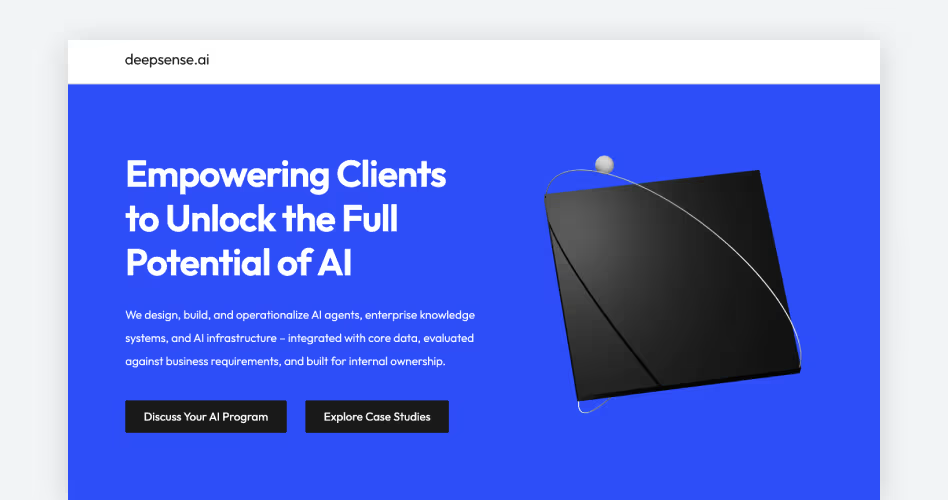
- Best for: Companies whose AI project depends on messy data, custom models or MLOps
- Headquarters: Warsaw, Poland (also Palo Alto, USA)
- Founded: 2014 (per Clutch)
- Team size: 120+ (per its site)
- Clutch rating: 5.0 (11 reviews, Premier Verified)
- Pricing: Not published. $25,000+ minimum on Clutch
- Hourly rate: $100–149
About deepsense.ai
Sometimes the hard part of an AI project isn't the chatbot. It's the data behind it, and that's where deepsense.ai is strongest. The Warsaw firm, with a second office in Palo Alto, works on MLOps, enterprise RAG, agents and custom MCP servers. Its site cites 120+ experts.
It is both an Anthropic Service Partner and an OpenAI Services Partner. For Docplanner it built a voicebot for booking appointments, and booking conversion went from about 10% to about 20%. Its Clutch rating is 5.0 from 11 reviews, and at $100–149 an hour it's the priciest firm here.
AI Integration Services
- Agents and generative AI features are built on a company's own data, with the engineering depth of a machine learning shop.
- Voice bots are built for conversations like booking appointments.
- Large document sets are handled through enterprise and agentic RAG, using its own open source framework, ragbits.
- MCP AI integration connects Claude to internal tools through custom MCP servers and connectors, so the model can safely take action.
- Deploying, monitoring and maintaining models in production is covered by its MLOps work.
Notable Projects
- Docplanner's appointment booking voicebot, which took booking conversion from about 10% to about 20% (Clutch review)
- ragbits, its open source framework for building RAG pipelines (company-described)
Who Should Choose deepsense.ai
Choose deepsense.ai when the hard part is data, custom models or running ML in production. It costs the most here at $100–149 an hour, and some clients wanted deeper early alignment on outcomes. Its site also doesn't mention ERP or CRM integration, and only 11 reviews back the 5.0 rating. For a lower rate on a simpler build, look at Azumo.
7. Caylent: Best for Teams Already Building on AWS
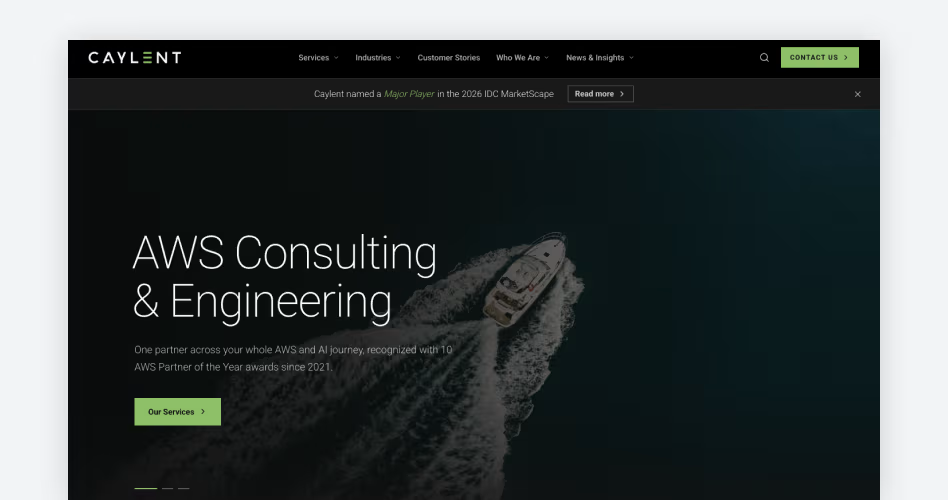
- Best for: Companies whose systems already run on AWS and want to add Claude-based AI
- Headquarters: Irvine, California, USA
- Founded: 2015 (per Clutch)
- Team size: 250–999
- Clutch rating: Not yet reviewed
- Pricing: Not published
- Hourly rate: Not listed
About Caylent
Caylent comes at AI from the cloud side. It's an AWS Premier Tier Services Partner, so if your systems already run on AWS, that's the natural place to start. Clutch lists the company in Irvine, California, with 250 to 999 employees.
Its AI work runs through Anthropic Consulting & Engineering, which it describes as covering everything from a first Claude adoption to full agentic transformation. Glean, Jungle Scout and United Airlines appear among its case studies, but none of them include measured results. Clutch has no reviews for it yet, and pricing isn't published.
AI Integration Services
- Teams adopting Claude get guidance from Anthropic Consulting & Engineering, from the first use case to full agentic transformation.
- Getting from an AI idea to a working build faster on AWS is the aim of its use case acceleration.
- Moving existing systems to AWS is often the groundwork an AI project needs.
- Older applications can be modernized so they support AI features without breaking.
Notable Projects
- Glean, a case study on its site, with no measured results published
- Jungle Scout, a case study on its site, with no measured results published
- United Airlines, a case study on its site, with no measured results published
Who Should Choose Caylent
Caylent fits teams that already build on AWS and want to adopt Claude with a partner who knows both. The gap is evidence: no Clutch reviews, an unclaimed profile, no pricing and no quantified results in its case studies. If you want Claude on AWS Bedrock with a measured result behind it, Monterail has one.
8. Monterail: Best for Fast, Fixed-Price AI Builds
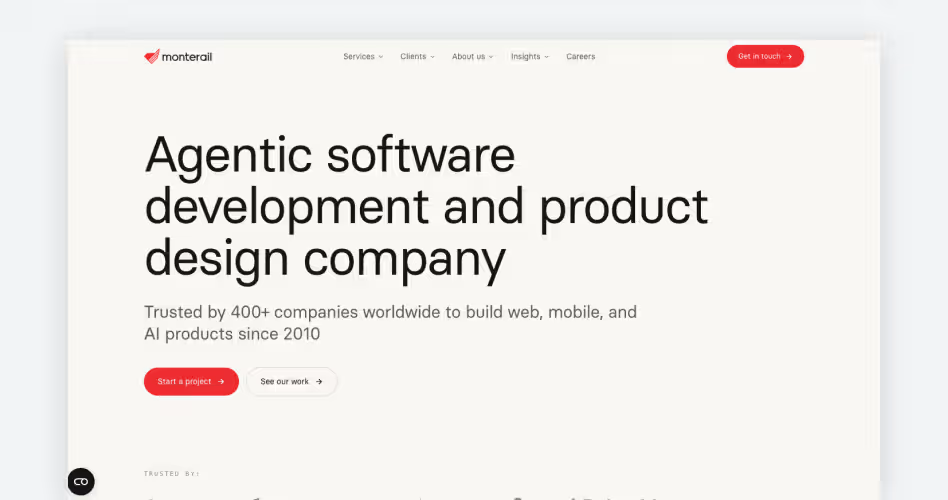
- Best for: Teams that want an AI feature or automation live in weeks at a known cost
- Headquarters: Wrocław, Poland (also Chicago and Berlin)
- Founded: 2010
- Team size: 130+ (per its site)
- Clutch rating: 4.8 (65 reviews)
- Pricing: Not published. $10,000+ minimum on Clutch, with fixed-price projects available
- Hourly rate: $25–49
About Monterail
Monterail's best pitch is one number: 100 hours a week. That's how much work it freed up at SPIE Belgium, and the project went live in seven weeks on a fixed price. It's the kind of result that's easy to picture, which is why it opens this entry.
The Wrocław company, founded in 2010, has 130+ people and offices in Chicago and Berlin. It also built Insights AI for Simfoni on Claude through AWS Bedrock. Clutch rates it 4.8 from 65 reviews, with some clients noting it costs more and occasionally runs late.
AI Integration Services
- Agentic software development uses AI agents to speed up how products are built.
- AI features are added inside web products people already use, built on models like Claude through AWS Bedrock.
- Workflow automation takes over repetitive work so teams can focus on higher-value tasks.
- AI-powered platforms, such as pricing tools, are built end to end.
- Fixed-price delivery scopes AI builds at a set cost.
Notable Projects
- SPIE Belgium, where 100 hours of work a week were reclaimed, live in seven weeks at a fixed price (company case study)
- Insights AI for Simfoni, built on Claude through AWS Bedrock (company-described)
- An AI pricing platform for BookingHost, and court writ automation for a law firm (Clutch reviews)
Who Should Choose Monterail
Monterail is a strong pick if you want an AI feature live in weeks at a price you know up front. Some clients say it costs more and runs late occasionally, though they often felt the quality justified it. It doesn't publish rates, and RAG and CRM or ERP work aren't detailed on its site. For deeper system integration, Master of Code Global is stronger.
9. Uvik: Best for Adding Python AI Engineers to Your Team
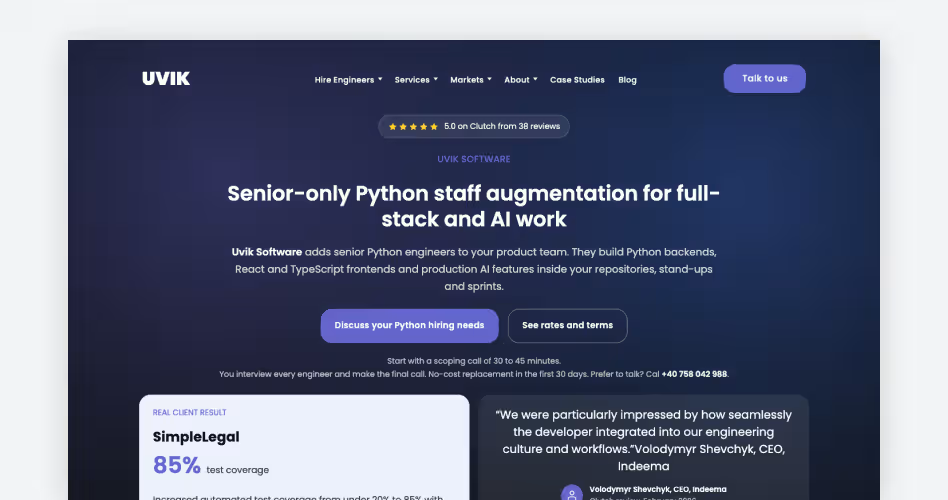
- Best for: Teams that already know what they want built and need Python engineers to build it
- Headquarters: Tallinn, Estonia (also London, UK)
- Founded: 2015
- Team size: 50+ in-house engineers
- Clutch rating: 5.0 (38 reviews)
- Pricing: Not published. $25,000+ minimum on Clutch, and AI delivery pods priced per accepted deliverable
- Hourly rate: $50–99
About Uvik
Uvik is a little different from everyone else on this list, and its own site is upfront about it. It's a Python-first staff augmentation company, not an AI integration specialist. What it offers is engineers who happen to be good at building AI: LLM agents, RAG, MCP servers and LangGraph, with evals and guardrails.
It's based in Tallinn with a London office and 50+ in-house engineers. Its AI delivery pods are priced per accepted deliverable, so you pay for finished work. Most of its 38 Clutch reviews (5.0) are for data engineering, and it says projects under $25,000 aren't a fit.
AI Integration Services
- Python engineers build agents that plan and carry out tasks across a company's tools.
- Models are connected to documents and APIs through RAG and tool calling, so they answer from real data and take real actions.
- MCP and LangGraph handle the orchestration of multi-step AI workflows.
- Tests and safety checks around AI features help them behave as expected in production.
- Small AI teams are offered as delivery pods, priced per accepted deliverable, so a client pays for finished work.
- Adding Python engineers to a client's own team is its core service.
Notable Projects
- A data platform for Skyvia, with 38% fewer data quality issues and 93% automated classification of recurring failures (Clutch review)
- Most of its other Clutch reviews describe data engineering work, not AI builds
Who Should Choose Uvik
Uvik works when you already know what you want built and need strong Python engineers to build it. It's staff augmentation, not an AI integration specialist, and it says it isn't certified for ISO 27001 or SOC 2, only aligned with them. It also isn't suited to projects under $25,000. For a specialist AI consultancy, deepsense.ai is the better match.
10. RTS Labs: Best for Small, Hands-On Applied AI Projects
- Best for: Companies that want a small consultancy involved closely in a focused AI project
- Headquarters: Glen Allen, Virginia, USA
- Founded: 2010 (per its site)
- Team size: 10–49
- Clutch rating: Not yet reviewed
- Pricing: Not published. $5,000+ minimum on Clutch
- Hourly rate: $25–49
About RTS Labs
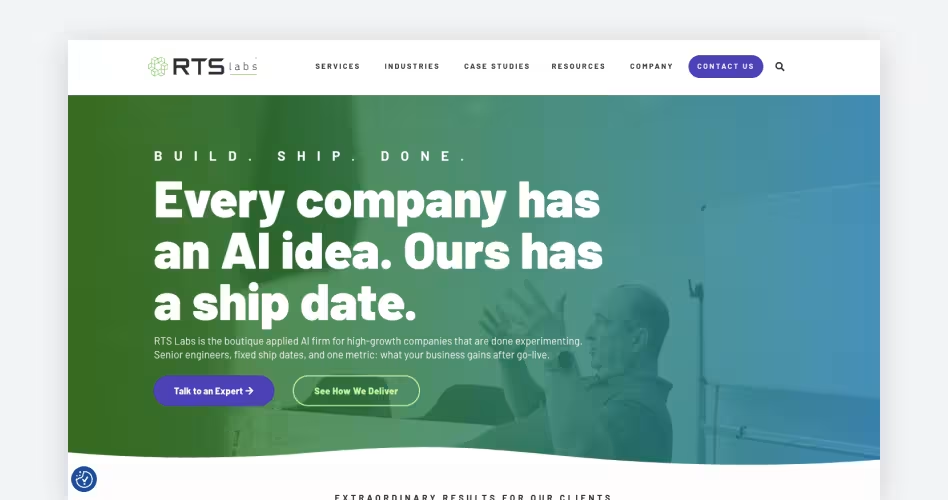
RTS Labs is small, and it leans into that. The Glen Allen, Virginia firm calls itself a boutique applied AI consultancy, with 10 to 49 people and AI Integration Services as one of its named offerings. Its site says it has been working since 2010.
Its case studies are specific, though they're self-reported. It says it cut integration time for a payments company from six weeks to four days, and cut agent portal search time at Landstar by 90%. There are no Clutch reviews yet, so those results are the main thing to go on.
AI Integration Services
- AI integration consulting is part of its applied AI work, adding AI to a company's existing systems.
- As a small, hands-on partner, it helps companies pick and build practical AI use cases.
- System integrations connect AI with the tools a business already runs.
- Internal search tools help teams find information across their own systems.
Notable Projects
- A payments company integration, where RTS Labs says integration time fell from six weeks to four days (self-reported)
- An agent portal search tool for Landstar, which it says cut search time by 90% (self-reported)
Who Should Choose RTS Labs
RTS Labs suits a company that wants a small, hands-on consultancy on a focused AI project. It has no Clutch reviews yet, so its results are its own claims, and its site doesn't name LLM providers, RAG or ERP work. Salesforce is the only CRM it mentions. For a similar hourly rate with 27 reviews behind it, Azumo is the safer bet.
How Much Does AI Integration Cost in 2027?
AI integration costs depend on what you're building, which systems are involved, and how much development it needs. A basic chatbot costs far less than a custom AI agent or an enterprise-wide integration.
AI Integration Costs by Project Type
The type of AI solution has a big impact on cost. A basic chatbot needs less engineering than an AI agent that accesses business systems, processes data, and completes tasks on its own.
The number of integrations, data preparation, security controls, and testing also change the final quote. Here's an estimated budget range for different AI integration projects in 2027.
These are indicative estimates based on published 2026 agency pricing guides and industry benchmarks. They are planning figures for 2027, not confirmed market averages.
AI Integration Costs by Industry
Budgets vary by industry because technical and operational needs differ. A SaaS company adding an AI support assistant may only need API and database integrations.
AI integration in healthcare needs extra privacy controls, security reviews, and compliance checks, because providers handle patient data. Teams building a care app can also compare healthcare app development companies.
Existing systems matter too. Manufacturers may need to connect AI to equipment and sensor data, while financial institutions often need explainability, audit trails, and stricter access controls.
Source: Focus Digital's 2026 AI Implementation Cost Study. Figures are reported average first-year AI spending, not the cost of a single project. Professional services are not separately reported; legal services are reported at $72,380.
AI Integration Engagement Models
AI integration companies offer different engagement models depending on scope and budget. Some businesses need a team for a clearly defined integration, while others need ongoing engineering support.
How to Choose the Right AI Integration Company
Choosing an AI integration agency takes more than comparing services and quotes. You need a company that understands your goals, works with your tech stack, and can handle your project's technical demands.
Start With Your Existing Technology Stack
Before contacting any company, map the software and infrastructure you already use. AI rarely works alone. It needs access to your data, applications, and workflows.
Check whether the agency has experience with your stack:
- CRM platforms: Can it integrate AI with tools like Salesforce, HubSpot, or Zoho to pull customer records, qualify leads, and automate sales tasks?
- ERP systems: Can it connect AI with platforms like SAP, Oracle, or Microsoft Dynamics to access inventory, financial, and operational data?
- Internal databases: Can it securely retrieve and update data in SQL databases, data warehouses, or internal knowledge bases?
- Cloud infrastructure: Has it deployed AI on AWS, Microsoft Azure, or Google Cloud?
- APIs and third-party applications: Can it connect services, handle authentication, manage API limits, and keep data in sync?
- Existing SaaS products: Can it add AI features to your current software without a full rebuild?
Define What You Want AI to Accomplish
A chatbot, an automated workflow, and a predictive model solve very different problems, yet companies often group them all under "AI development." Choosing an agency by that broad label can leave you with a mismatch.
Decide on the outcome before discussing technologies with potential partners.
Do you want to reduce repetitive work, help customers find information, add smart features to your SaaS product, or make better decisions using business data?
Each goal needs different expertise. Workflow automation calls for experience with APIs, process orchestration, and AI agents.
A knowledge assistant needs LLM integration and retrieval-augmented generation (RAG). Predictive analytics needs data science and machine learning skills.
Look at an agency's past projects through this lens. Did it solve a problem like yours, or does its portfolio just mention the technologies you want? Relevant experience is a stronger signal than a long list of services.
Evaluate the Company's Implementation Process
A polished demo can make an AI solution look production-ready. But what happens with messy data, unexpected inputs, or problems in connected systems? The implementation process often decides whether a solution holds up beyond the demo.
A typical implementation has several stages:
- Discovery and requirement analysis: the team should understand your goals, users, existing software, and challenges, and check whether AI is the right approach before recommending one.
- Architecture and technical planning: this stage defines how the system's parts communicate. The agency should document model choice, data flows, API connections, infrastructure, security controls, and fallbacks.
- Development and integration: engineers build the solution and connect it to your applications, databases, and services, using LLM integration, RAG pipelines, custom APIs, or workflow automation as needed.
- Testing and validation: AI outputs need more than a quick check. Test for accuracy, response quality, security, compatibility, and unexpected inputs. Agent-based systems also need clear permissions and safeguards.
- Deployment and monitoring: production should include performance monitoring, error tracking, and a plan for fixing issues. The team should explain how it handles model updates, API changes, and growing usage.
- Documentation and ongoing support: your team needs documentation to manage the integration. Clarify who handles maintenance, troubleshooting, and updates after delivery.
Ask About Testing, Reliability, and Rollback Procedures
AI doesn't always give the same result for similar inputs. A chatbot might give wrong information, an agent could trigger the wrong action, or an integration might break when an external API goes down. These aren't rare edge cases.
Your partner should have a plan for them before launch. Testing outputs is only part of reliability; the system also needs safeguards for when AI gets something wrong.
- Human review and escalation: Ask when the system hands a task to a human. Sensitive decisions, uncertain answers, and high-impact actions may need approval first.
- Failure handling: Find out what happens when a model returns a bad response, an API fails, or data is missing. The system needs fallback behavior, not broken workflows.
- Data security and access permissions: Check how the agency protects sensitive data and limits what the AI can access. Permissions should follow existing user roles, with proper authentication.
- Rollback procedures: Ask how the team would reverse a bad deployment, including recovery steps, version control, configuration backups, and a way to restore the previous system.
- Monitoring and performance tracking: Confirm how the agency tracks accuracy, errors, latency, usage, and costs after launch, so problems surface before they affect more users.
Understand Pricing, Timelines, and Post-Launch Support
The first quote rarely tells the whole story. Model usage, cloud infrastructure, third-party APIs, testing, and maintenance can add costs. A lower quote may leave out services you'll need after launch.
Before committing, clarify three things:
- Pricing: Does the quote include discovery, development, testing, deployment, and documentation? Are API usage, hosting, and maintenance billed separately?
- Timeline: What are the delivery dates for each milestone? What could cause delays, and how are scope changes handled?
- Post-launch support: How long does support last after launch? Are maintenance, updates, monitoring, and troubleshooting included or part of a separate agreement?
Should You Implement AI in Your Business?
AI integration into business operations can improve efficiency, but not every process needs it. Some tasks are faster and cheaper with traditional automation.
When AI Integration Makes Sense
AI is worth considering when processes involve repetitive work, lots of information, or decisions that need more than fixed rules. AI integration for small businesses often starts with one focused workflow, like support replies or invoice sorting. New to the basics? Start with this beginner's guide to AI integration.
Common examples include:
- Repetitive business processes: Automate document classification, invoice processing, email sorting, data extraction, and data entry.
- High volumes of customer requests: Handle common questions, recommend information, and help support teams keep up as volume grows.
- Decision support: Analyze large datasets and spot patterns for financial planning, sales forecasting, or inventory management.
- Existing product improvements: Add AI-powered search, recommendations, assistants, or predictive features to a SaaS product.
When AI Integration Might Not Make Sense
Not every problem needs AI. Adding a model to a process that already works adds development cost, maintenance, and complexity.
AI might not be the right investment when:
- The problem isn't clearly defined: Without a clear goal, it's hard to pick the right technology or measure success.
- You don't have enough usable data: Poor-quality, incomplete, or inaccessible data limits AI performance and raises preparation costs.
- The task happens infrequently: Automating a process that takes a few minutes a month rarely justifies the development cost.
- Traditional automation is sufficient: Predictable inputs and fixed rules are often easier to handle with scripts, APIs, or workflow tools.
- Implementation costs exceed potential benefits: If development, infrastructure, and maintenance cost more than the expected savings or revenue, it doesn't make financial sense.
How to Calculate AI Integration ROI
An AI project should deliver measurable business value. Return on investment (ROI) estimates whether the expected benefits justify the cost.
Use this formula:
Both figures should cover the same period. For a first-year calculation, include implementation costs and the operating expenses expected that year.
- Annual business impact Annual business impact is the financial value the AI generates, such as lower labor costs, higher revenue, reduced operating expenses, and savings from fewer errors.
- Total AI integration cost Total AI integration cost covers more than the development fee. Include infrastructure, API usage, model subscriptions, maintenance, employee training, and ongoing evaluation.
Say a business spends $30,000 on an AI-powered customer support system, and it saves an estimated $50,000 in its first year through less manual work and better support efficiency.
Its first-year ROI would be:
ROI = ($50,000 - $30,000) ÷ $30,000 × 100 = 66.7%
Illustrative example. Actual returns depend on implementation cost, adoption, usage, and measurable outcomes.
Why Businesses Choose Orbix Studio for AI Integration
Orbix Studio combines product design and software development to help businesses build AI integration solutions and AI-powered digital products. Instead of treating AI as a standalone feature, the team builds it into products, user experiences, and existing workflows.
Businesses can work with Orbix Studio to:
- Integrate LLMs, APIs, and databases into existing applications and business workflows.
- Build AI-powered features for new and existing SaaS products.
- Design intuitive interfaces for AI-powered products.
Considering AI integration for your SaaS product? Explore Orbix Studio to discuss your project requirements.
Frequently Asked Questions
What is AI integration?
AI integration means connecting AI tools, such as language models, chatbots, or prediction models, to the software and data a business already uses. The goal is to add AI to existing workflows like support, sales, or reporting instead of building a separate product from scratch.
How much do AI integration services cost?
AI integration services typically cost $15,000 to $100,000+, depending on workflow complexity, data readiness, and custom UI needs. Focused MVP sprints start lower, while enterprise rollouts scale higher. For a tailored 24-hour estimate from Orbix Studio, call +1 (415) 800-3298.
How long does an AI integration project take?
Most AI integration projects take 4 to 12 weeks from discovery to production deployment. Focused proof-of-concept workflows launch in 4 to 6 weeks, whereas multi-system enterprise integrations require 8 to 12 weeks for security, testing, and UI design. Contact Orbix Studio at hello@orbix.studio to scope your sprint.
Can AI be integrated into existing software?
Yes, experienced AI integration companies connect directly to your existing CRM, ERP, databases, and cloud infrastructure using secure APIs and webhooks. Rather than replacing legacy tools, specialists like Orbix Studio embed AI workflows and intuitive dashboards into your current stack without disrupting daily operations.
Do I need to train my own AI model?
No, most businesses do not need to train a custom AI model from scratch. Integration partners leverage proven foundation models like GPT, Claude, or Gemini paired with Retrieval-Augmented Generation (RAG) and prompt engineering, delivering accurate, domain-specific results at a fraction of the cost.
What is the difference between AI integration and AI development?
AI integration connects existing pre-trained models, APIs, and automation tools into your current software workflows for rapid ROI. AI development involves building, training, and fine-tuning custom machine learning algorithms from the ground up, which requires significantly more proprietary data, specialized engineering, time, and capital.
How do AI integration companies protect business data?
Reputable AI integration companies protect data with encryption, role-based access controls, and enterprise API agreements that stop your records from training public models. Teams like Orbix Studio also add SOC 2-aligned governance, private hosting, and removal of personal data before it reaches the AI.
What are the biggest AI integration challenges?
The most common challenges are poor data quality, software that doesn't connect easily, and extra API work that shows up midway through a project. Keeping the system reliable after launch, with testing, monitoring, and a plan for wrong answers, is the other big hurdle.
Is it better to hire an AI integration company or an in-house specialist?
It depends on how much AI work you expect. An in-house AI integration specialist suits steady, long-term work on one product, while an AI integration company brings a ready team and experience from past projects, which helps with a defined project or a first build. Some businesses start with a company and bring in-house help once the work becomes regular.
What happens if an integrated AI system produces incorrect results?
When an AI system gives a wrong answer, built-in guardrails, confidence thresholds, and human review catch or block low-confidence outputs before they reach users. Teams also monitor logs, improve data retrieval, and update prompts to stop repeat mistakes.
Final Thoughts
Choosing the right AI integration company starts with understanding your business needs. Compare each company's expertise, relevant projects, process, pricing, and post-launch support before you decide.
Most importantly, make sure AI solves a real problem. Weigh the expected benefits against the total investment, and pick a partner that can deliver a reliable solution that works with your existing systems.