


.svg)


%201%201.svg)
Healthcare Website Design Cost: Complete Pricing Guide for Clinics, Hospitals & Medical Practices
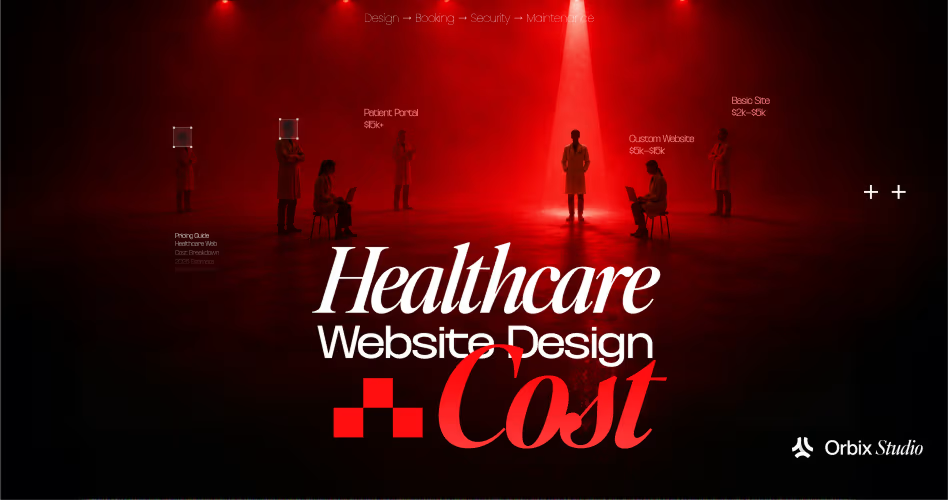

- Healthcare website design typically costs between $15,000 and $75,000+, with enterprise platforms often exceeding $100,000.
- Compliance, custom integrations, and patient-facing features have a much greater impact on pricing than website size alone.
- Hospitals, telehealth platforms, and multi-location providers require significantly larger budgets than private practices or clinics.
- Planning for scalability, security, and long-term maintenance helps reduce costly redesigns and future development expenses.
Healthcare website design typically costs between $15,000 and $75,000+, but no two healthcare organizations require the same website. A small practice, dental clinic, hospital, and telehealth platform all have different goals, compliance requirements, and technology needs. Those differences have a direct impact on the final project cost.
Instead of focusing only on price ranges, it's more useful to understand what you're actually paying for. Features like HIPAA compliance, secure patient portals, appointment scheduling, and EHR integrations all add different levels of complexity. They also influence the long-term value your website delivers.
This guide breaks down healthcare website costs by organization type, explains the biggest pricing factors, compares template and custom websites, and shares practical budgeting advice. By the end, you'll have a clearer idea of what to budget and where your investment will have the greatest impact.
How Much Does Healthcare Website Design Cost?

Healthcare website design typically costs between $5,000 and $150,000+, depending on your organization's size, required functionality, and compliance needs.
A private practice website is far less complex than a hospital or telehealth platform, which is why healthcare web design pricing, medical website design costs, and medical website development costs vary so widely.
These are average industry benchmarks, not fixed quotes. The final investment depends on features such as HIPAA compliance, patient portals, appointment scheduling, EHR/EMR integrations, accessibility, and the amount of custom UI/UX design and development required.
If you're comparing proposals, remember that healthcare website pricing should include more than visual design. It should also account for planning, responsive development, security, testing, content migration, and any ongoing healthcare website costs, such as hosting, maintenance, and future updates.
If you'd like to understand how research, wireframing, and interface design affect pricing, see our UI/UX design cost guide.
Healthcare websites are also expected to deliver a fast, accessible, and secure user experience. Google recommends optimizing for Core Web Vitals, making performance just as important as design and functionality.
The next section breaks down website costs by healthcare organization type, helping you find a budget that best matches your specific needs.
Healthcare Website Design Cost by Organization Type
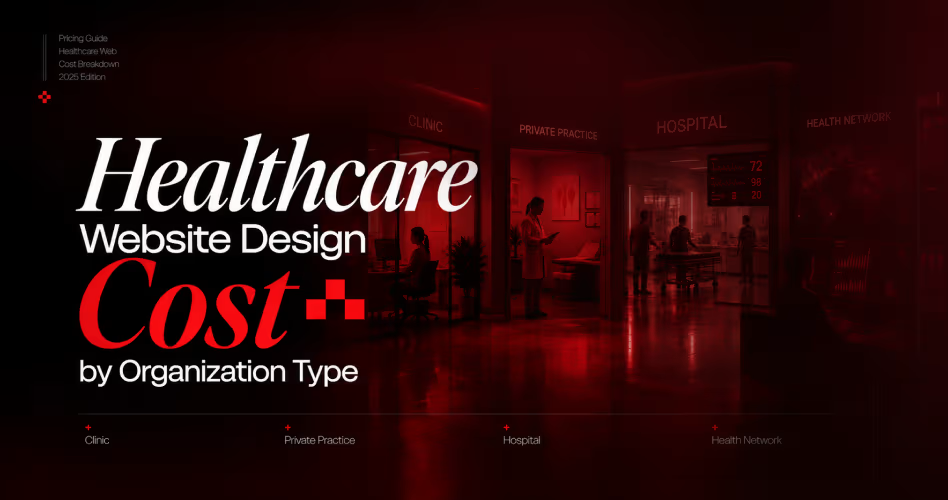
Healthcare website costs vary based on the type of organization you operate. A private practice, dental clinic, hospital, and telehealth platform all have different goals, features, and technical requirements.
The estimates below will help you find a realistic budget for your healthcare website.
Healthcare Website Design Cost for Small Practices
If you're running a small medical practice, your website has one main job: help people find you, trust you, and book an appointment. You don't need a complex healthcare platform to do that. A simple, well-designed website is often enough to bring in new patients.
That's why most small practice websites cost between $5,000 and $15,000, with a typical timeline of 4–8 weeks.
The cost stays lower because the website focuses on helping patients, not running the practice. Most small clinics don't need patient portals, EHR/EMR integrations, or other advanced systems right away. A fast WordPress website, a complete Google Business Profile, and a mobile-friendly design usually provide much better value.
As your practice grows, your website can grow too. Adding more doctors, multilingual content, or third-party integrations will increase the project cost. But those upgrades are usually easier and more affordable to add when your practice is ready for them.
If you're planning a dental practice website, exploring real dental website examples can help you understand which features are worth investing in.
Medical Clinic Website Design Cost
Once a clinic has multiple doctors or specialists, the website has a bigger job to do. Instead of simply introducing the practice, it needs to help patients choose the right provider, compare services, and book appointments with confidence. That extra planning is why medical clinic websites typically cost between $15,000 and $40,000.
The higher cost comes from organizing more information, not simply adding more pages. Every doctor needs a profile, every service needs its own page, and patients should be able to quickly find the right provider without feeling overwhelmed. A well-structured Content Management System (CMS) also makes it easier for staff to update providers, services, and clinic information over time.
As more patients browse on their phones, speed and accessibility become increasingly important. Optimizing for Google Core Web Vitals reports helps create a smoother experience for every visitor.
Budget Tip: If your clinic regularly adds doctors or services, invest in a flexible CMS first. It's much easier to update one well-organized website than to rebuild it every time your clinic grows.
Multi-location Healthcare Website Design Cost
Managing one clinic is straightforward. Managing five, ten, or even fifty locations is a different challenge. Every location has its own doctors, services, phone numbers, office hours, and directions. Keeping all of that information accurate is why multi-location healthcare websites typically cost between $25,000 and $60,000.
The biggest challenge isn't building more pages - it's managing them over time. A centralized CMS lets staff update providers, contact details, and services across every location without editing dozens of pages manually. That saves time and helps keep information consistent across the entire healthcare network.
Local search is another major investment. Each clinic should have its own optimized location page so nearby patients can quickly find the right location. Tracking performance with Google Analytics also helps identify which locations generate the most appointments and where improvements are needed.
Budget Tip: If you expect to open new locations, invest in a scalable website from the beginning. It's much easier to add another clinic than to rebuild your entire website every time your organization grows.
Hospital Website Design Cost
A hospital website does much more than share information. It becomes a digital front door where patients book appointments, access medical records, pay bills, and communicate with healthcare providers. Supporting these services is why hospital website projects typically cost between $50,000 and $150,000+, with most taking 4–8 months to complete.
The biggest investment happens behind the scenes. Hospital websites often connect with patient portals, EHR/EMR systems, payment gateways, and other healthcare applications through secure API integrations. These connections require scalable architecture, careful testing, and reliable backend development to ensure every system works together.
Security is just as important as functionality. Hospitals must protect patient information, follow HIPAA requirements, meet WCAG accessibility standards, and support thousands of users every day. Building those safeguards takes more planning, development, and testing than a standard healthcare website.
Budget Tip: Plan for future integrations from the beginning. Adding new hospital systems after launch is often more expensive than designing a flexible platform that can grow with your organization.
Telehealth Platform Website Design Cost
If patients never visit your clinic, your website becomes the clinic. That's what makes a telehealth platform different from every other healthcare website.
Instead of helping patients find a doctor, it becomes the place where appointments happen, prescriptions are managed, and conversations with healthcare providers take place. Building that experience is why telehealth platforms typically cost between $75,000 and $150,000+.
Rather than publishing pages, you're building software. Every feature from video consultations and patient dashboards to secure messaging, authentication, and EHR integration - must work together without slowing down or exposing sensitive patient information. That's why development takes longer and requires far more backend engineering than a traditional healthcare website.
Platforms like Zocdoc prove that convenience is now part of the healthcare experience. Patients increasingly expect healthcare to be available wherever they are, which is why telehealth projects are planned as digital products that continue evolving long after launch.
Features That Increase Healthcare Website Cost

After choosing the right type of website, the next step is deciding which features you actually need. Some improve the patient experience, while others connect your website with healthcare systems or help your practice grow.
Let's look at the features that have the biggest impact on your website's cost and long-term value.
UX Research & Planning
A healthcare website isn't successful because it looks good. It's successful because patients can quickly find the right information, trust your practice, and complete important tasks like booking an appointment. That's what UX research and planning are designed to achieve.
Before any design work begins, the team maps out how patients will move through the website. They decide what pages are needed, how information should be organized, and where actions like appointment booking or provider search should appear. This creates a clear plan before development starts.
Although this stage adds to the initial budget, it often reduces costs later. Finding usability problems before development is much faster and less expensive than complete healthcare website redesign cost. That's why healthcare organizations invest in planning first. It saves time, improves the patient experience, and helps every feature work as intended.
This is also where you decide which features are truly necessary. A small practice may only need appointment scheduling, while a hospital might require patient portals, EHR integrations, and multilingual support. Making those decisions early helps keep the project focused and avoid unnecessary costs.
Responsive Website Design
More than half of healthcare website visitors browse on their phones. Whether someone is looking for a nearby clinic, checking office hours, or booking an appointment, they expect the website to load quickly and work smoothly on any device.
Building that experience takes more than shrinking a desktop website to fit a smaller screen. Every page, button, form, and menu needs to be designed and tested for different screen sizes while meeting WCAG accessibility standards. That extra design and development work naturally increases the project cost.
A responsive website design also improves the patient experience. Visitors can find information faster, complete forms more easily, and book appointments without frustration.
For most healthcare organizations, investing in a fast, mobile-friendly website delivers a much better return than adding advanced features that patients rarely use.
Appointment Scheduling
For many healthcare providers, the website's main goal is simple - turn visitors into patients. That's why online appointment scheduling is often one of the first features worth investing in. It removes unnecessary steps and lets patients book a visit whenever it's convenient.
The cost depends on how the booking system works. A basic appointment request form is quick to set up, while a scheduling system with real-time availability, calendar syncing, automated confirmations, and cancellation management requires more development and third-party integrations.
Small practices can often start with a simple booking form, while larger clinics and hospitals usually benefit from a more advanced scheduling system that supports multiple providers and locations.
Patient Portal & Secure Patient Access
A patient portal gives people a secure place to manage their healthcare online. Instead of calling the clinic, patients can log in to view medical records, check test results, request prescription refills, complete forms, or send messages to their healthcare provider.
For many hospitals and larger clinics, these self-service features improve convenience while reducing administrative work.
Adding a patient portal is one of the biggest factors that increases website cost. Unlike a standard webpage, it requires secure user accounts, encrypted data, authentication, and connections to healthcare systems such as EHR or EMR platforms.
These extra security and integration requirements make development more complex and require careful testing before launch. Patient portals are usually unnecessary for small practices that only need appointment requests and basic contact forms.
However, they become a valuable investment for multi-provider clinics, hospitals, and healthcare organizations that manage large numbers of patients. As more healthcare services move online, giving patients secure access to their information can improve both the patient experience and day-to-day operations.
EHR / EMR Integration
Imagine a patient books an appointment on your website. Without an EHR or EMR integration, someone on your team may have to enter that information into another system manually. It doesn't sound like much, but repeating that process hundreds of times each week creates more work and increases the chance of mistakes.
That's why many growing clinics and hospitals connect their websites directly with platforms like Epic or Cerner. Appointments, patient information, and medical records can move automatically between systems, saving staff time and reducing manual data entry.
The trade-off is complexity. Every integration needs custom APIs, secure data exchange, and compatibility with healthcare standards like FHIR and HL7.
If your website only shares information, you probably don't need this investment. But if it's part of your daily workflow, connecting your systems can save countless hours over time.
HIPAA Compliance & Data Security
Patients share personal information because they trust your organization to keep it safe. That trust can disappear quickly if sensitive data is exposed or handled incorrectly.
Building a HIPAA-compliant website means thinking about security from the very beginning. Contact forms, appointment requests, patient logins, and file uploads all need secure encryption, controlled access, and protected data storage. These aren't features visitors notice, but they're some of the most important parts of the project.
Not every healthcare website has the same compliance requirements. A simple website that only displays information has very different security needs than a platform that stores patient records or offers online consultations. Understanding that difference helps you invest in the level of protection your organization actually needs.
How to Reduce Healthcare Website Costs Without Sacrificing Quality

The lowest-priced website isn't always the best investment. Instead of removing important features, focus on building the right features at the right time. With a clear plan, you can reduce upfront costs while creating a website that supports future growth.
- Start with the features patients actually need: Focus on essentials like appointment booking, service pages, and contact forms before investing in advanced functionality.
- Launch a simple website first: Build an MVP with your core features, then add patient portals, telehealth, or other tools as your practice grows.
- Build your website in phases: Splitting the project into stages reduces upfront costs and lets you invest based on real patient needs.
- Reuse your existing content and branding: Keeping your logo, colors, photos, and provider information can reduce design and content costs.
- Choose technology that can grow with you: A scalable CMS or development approach makes it easier to add new features later without rebuilding the website.
- Plan integrations before development starts: Decide early if you need EHR, CRM, payment gateways, or other systems to avoid expensive changes later.
- Invest in UX before adding more features: A website that's easy to use will usually deliver better results than one packed with unnecessary functionality.
- Avoid paying for features you won't use: Every extra feature adds cost, so only invest in tools that support your current business goals.
- Think about long-term maintenance: Choosing a website that's easy to update and maintain can reduce costs long after the project is finished.
Frequently Asked Questions
How much does a healthcare website design cost?
A healthcare website typically costs $5,000 to $150,000+, depending on the size of the organization, required features, HIPAA compliance, integrations, and level of customization.
Why does medical website design cost more than a regular website?
Healthcare websites often require stronger security, HIPAA compliance, accessibility, appointment scheduling, patient portals, and integrations with healthcare systems, making them more complex to design and develop.
What factors affect the cost of a healthcare website?
The biggest cost factors include website size, custom design, HIPAA compliance, patient portals, EHR/EMR integrations, appointment scheduling, accessibility requirements, and third-party integrations.
Do I need a HIPAA-compliant website?
If your website collects, stores, or shares protected health information (PHI), HIPAA compliance is typically required. Informational websites that don't handle patient data may not need the same level of compliance.
How much does HIPAA compliance add to website design cost?
There's no fixed price, but HIPAA compliance website design costs by requiring secure forms, encryption, access controls, secure hosting, and additional testing throughout the project.
What is the average hospital website cost?
Hospital websites typically cost $50,000 to $150,000+ because they often include patient portals, EHR integrations, enterprise CMS platforms, and advanced security features.
Can WordPress be HIPAA compliant?
Yes. WordPress can support a HIPAA-compliant website when it's configured with secure hosting, encryption, access controls, HIPAA-compliant plugins or integrations, and proper security practices. WordPress alone is not automatically HIPAA compliant
Final Thoughts
Healthcare website design costs can vary widely, but the best investment isn't always the biggest one. The right budget depends on your organization, the features you actually need, and how well the website supports your patients, staff, and long-term goals.
Instead of trying to build everything at once, focus on creating a secure, easy-to-use website that solves today's needs and can grow over time. A clear strategy, thoughtful planning,























.avif)
