


.svg)

%201%201.svg)
UI/UX Agency vs Freelancer: Which Option Fits Your Project and Budget?
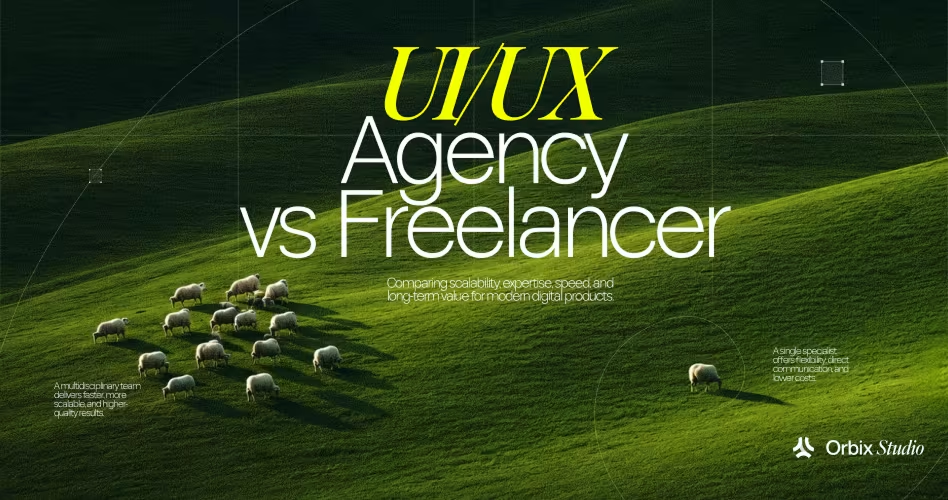
- A UI/UX agency usually offers team-based, structured support, while a freelancer usually offers one-to-one, flexible support.
- Freelancers often work best for smaller projects, MVPs, and tight budgets.
- Agencies often work best for complex projects, larger teams, and long-term growth.
- The right choice depends on your project size, budget, timeline, and support needs.
If you are planning a website, app, or product design project, one of the first questions you may ask is this: should I hire a UI/UX agency or a freelancer? It sounds like a simple question, but it can be hard to know which option is actually better.
The truth is, there is no one-size-fits-all answer. Some projects need the flexibility and affordability of a freelancer, while others need the team support and structure that an agency can offer. Choosing the wrong option can lead to delays, miscommunication, or a final result that does not match your expectations.
This article will help you understand both options in a clear and easy way. We will compare UI/UX agencies and freelancers based on pricing, workflow, quality, reliability, and the kind of projects they handle best.
What is a ui/ux agency?
A UI/UX agency is a company that helps businesses design digital products and user experiences. This can include websites, mobile apps, dashboards, landing pages, and other digital platforms.
Unlike a freelancer, an agency usually has a team of specialists working on the same project. That means you are not hiring just one designer. You are hiring a group with different skills.
UI/UX agency often looks beyond visual design. It may also focus on how users move through a product, where problems happen, and how the design supports business goals. This is why agencies are often chosen for projects that need a more structured process.
A typical agency team can include UI designers, UX designers, UX researchers, strategists, and project managers.
What is a ui/ux freelancer?
A UI/UX freelancer is an independent designer who works directly with clients. They often help with websites, mobile apps, landing pages, dashboards, and software interfaces.
Unlike an agency, a freelancer usually works alone. In many cases, the same person handles the design, feedback, revisions, and final delivery.
That is one reason many businesses choose freelancers. The process often feels simpler, faster, and more personal.
You usually work directly with the person doing the job. That can make communication easier and decisions quicker, especially on smaller projects.
Freelancers are also often more flexible. They may support a full project, a specific task, short-term work, or ongoing design help.
Because they have lower overhead than agencies, freelancers are usually more affordable too. That makes them a common choice for startups, small businesses, and teams with tighter budgets.
A freelancer may help with wireframes, UI design, prototypes, UX improvements, and developer handoff. Some offer broad UX support, while others focus on one area. That is why it is important to check their skills and scope before hiring.
UI/UX agency vs freelancer: what’s the difference?
The main difference comes down to how the work is delivered. A UI/UX design agency usually works as a team, while a freelancer usually works as one person. That core difference shapes everything else, including cost, speed, process, and project fit.
Team-based support vs one-to-one collaboration
One major difference is who you work with during the project. With a UI/UX agency, support is usually team-based. More than one person may be involved. For example, one person may handle research, another may focus on design, while a project manager keeps the work organized.
This setup often works well for larger projects because different specialists can handle different parts at the same time.
With a freelancer, the experience is usually more direct. You work with the same person throughout the project. That can make communication feel simpler, faster, and more personal.
Neither option is always better. Team-based support is often stronger for complex work. One-to-one collaboration is often better for smaller projects that need speed and flexibility.
Structured process vs flexible workflow
Another difference is how the work moves from start to finish. A UI/UX agency usually follows a more structured process. That may include discovery, research, wireframes, design, revisions, testing, and handoff. This can be useful for businesses that want a clear workflow and more organization.
A freelancer often works in a more flexible way. The process may be lighter, faster, and easier to adjust as the project changes. That can work well for clients who want quicker decisions and fewer steps.
In simple terms, agencies usually bring more structure, while freelancers usually bring more flexibility. The better fit depends on how much process your project needs.
Breadth of services vs specialized focus
If your project needs help across many areas, an agency is often the better fit. If you only need one clear type of support, a freelancer may make more sense. That is the simplest way to understand this difference.
UI/UX agency usually offers broader support. Along with design, you may also get research, user flows, wireframes, prototyping, testing, brand support, and developer handoff.
A freelancer usually offers a narrower scope. But that is not a downside if the need is specific. Some freelancers are highly skilled in one area, such as mobile UI, SaaS dashboards, landing pages, or UX audits.
So the difference is not really about who offers more. It is about what your project actually needs. If the work is broad, an agency may be the better fit. If the work is focused, a specialist freelancer may be enough.
UI/UX agency vs freelancer cost comparison
For many businesses, cost is the first thing they compare. That makes sense. The budget often shapes the whole decision.
But the cheaper option is not always the better value. A freelancer may cost less upfront. An agency may cost more, but include broader support, more process, and more people.
That is the real difference. An agency usually costs more because you are paying for a team, not just one designer. The work may include research, strategy, wireframes, UI design, prototyping, testing, project management, and developer handoff.
Typical agency pricing often looks like this:
A freelancer often gives better value when the project is smaller or more focused. That can include a landing page, a few app screens, an MVP, a website refresh, or short-term design help.
Typical freelance pricing often looks like this:
Which delivers better quality of work?
Quality is not decided by the label. It is not about the word agency or freelancer. It is about the people, the process, and how well their skills fit your project.
A strong freelancer can deliver excellent work. A strong agency can do the same. The real difference is often in how that quality is produced.
A freelancer may bring focused expertise, direct involvement, and a more personal design approach. An agency may bring broader team input, a clearer review process, and more consistency across larger projects.
Experience matters too. If a freelancer has deep experience in the exact type of product you need, they may be the better choice. But if the project needs research, strategy, visual design, testing, and handoff, an agency may deliver a stronger result because more specialists are involved.
Process matters just as much as talent. Even a skilled designer can miss the mark if the workflow is weak. Good quality usually comes from clear discovery, thoughtful design decisions, feedback, and refinement.
Communication and collaboration: which is easier?
Good design work depends on good communication. When communication is unclear, the project becomes harder to manage. Feedback gets messy. Revisions take longer. Small issues turn into bigger ones.
This is where agencies and freelancers feel different. With a freelancer, communication is usually more direct. You often speak with the same person who is doing the work. That can make feedback faster, meetings shorter, and decisions easier.
With an agency, communication is usually more structured. You may speak with a project lead, account manager, or design lead instead of every person on the team. That can feel less personal, but often more organized.
In simple terms:
- freelancers usually offer direct access
- agencies usually offer managed communication
Speed and turnaround time
Speed is one of the first things clients compare. That makes sense. Some projects need to move quickly. A startup may need an MVP in a few weeks. A business may want a new page ready before a campaign goes live.
So who is faster? It depends on the type of work.
A freelancer is often faster on small, focused tasks. There are usually fewer layers in the process. You speak directly with the person doing the work, which can make feedback and revisions move more quickly.
This often works well for:
- landing pages
- a few app screens
- simple website updates
- small UX improvements
An agency works differently. It may take longer to get started because there is usually more planning, more meetings, and more people involved. But once the project is moving, an agency can often work faster on larger jobs because different team members can handle different parts at the same time.
For example:
- one person handles research
- another builds wireframes
- another designs the final UI
That kind of shared workload can speed up complex projects. Turnaround time also depends on scope, revision rounds, and how quickly feedback comes from your side. So the better choice is not just about who replies faster. It is about which setup fits the size of the job.
Range of services: what do you actually get?
This is where many clients get confused. They assume “UI/UX design” means the same thing no matter who they hire. It usually does not.
Some designers only handle the visual side. Some help with the full product experience. Some cover research, strategy, testing, and handoff. Others do not, and that is why service range matters so much.
A UI/UX agency often offers a wider package of UI/UX design services. The work may include research, user flows, wireframes, UI design, interactive prototypes, testing, design systems, UX writing, branding support, and developer handoff. In many cases, the agency is set up to guide the project from early thinking to final delivery.
Freelancer may offer some of these services, but not always all of them. One freelancer may be excellent at UI design and prototypes. Another may focus more on UX audits or product flows. Some can handle end-to-end work, but many work best in a specific area.
That is why it is important not to assume. Before hiring, ask what is actually included. Common services can include: UX research, wireframes, UI design, interactive prototypes, usability testing, design systems, UX writing, branding support, and developer handoff.
Project size and complexity: which option fits better?
Project size changes the answer. So does complexity. A simple landing page does not need the same setup as a SaaS platform. An early MVP is very different from an enterprise system.
For smaller, focused projects, a freelancer is often enough. This usually works well for:
- small business websites
- landing pages
- startup MVPs with limited screens
- light redesign work
- one specific feature or user flow
As the project gets bigger, the needs change. More screens appear. More user journeys need attention.and more people get involved in decisions.
That is where an agency often becomes the better fit. When the harder question is which problems to fix first, that call usually sits with UX consultants rather than a production team. Agencies are usually stronger for:
- full product redesigns
- complex SaaS platforms
- enterprise dashboards
- products with multiple user roles
- long-term product ecosystems
A project can also look small and still be complex. If it involves strategy, testing, multiple stakeholders, or detailed workflows, an agency may still make more sense.
Flexibility vs scalability
Some projects need room to move. Others need room to grow. That is the key difference here.
A freelancer is often more flexible. The workflow is usually lighter, communication is more direct, and changes can be easier to make along the way.
This often works well for early-stage startups, MVPs, smaller teams, and projects that need quick changes.
An agency is usually better at scaling. As the project grows, more support may be needed for research, testing, design systems, or developer coordination.
That often makes agencies a better fit for: growing products, larger teams, multi-stage projects, and ongoing design support. In simple terms freelancers are often easier to adjust, and agencies are often easier to expand.
So if the project needs agility, a freelancer may be enough. If it needs to grow into something larger, an agency is often better prepared.
Reliability and accountability
A strong portfolio is helpful. A fair price is helpful too. But the real question is simple: can they deliver the work properly and on time?
That is where reliability and accountability come in. With a freelancer, accountability is usually very direct. You are working with one person, so it is clear who is responsible. That can make the process feel simple. But it also means the project depends heavily on that one person’s time and availability.
With an agency, responsibility is often shared across a team. One person may lead communication, while others handle the design work. That can feel less personal, but it usually gives the project more continuity.
In simple terms:
- freelancers often offer clearer one-to-one ownership
- agencies often offer stronger backup support
If your main concern is direct responsibility, a freelancer may feel easier to manage. If your main concern is delivery risk, an agency may feel safer.
Which option is best for your type of business?
The right choice often depends on the kind of business you run. A startup usually has different needs than a small business. A larger company works in a very different way again. Budget, speed, team size, and project complexity all change the decision.
To make this easier, let’s look at what usually works best for startups, small businesses, and larger companies.
Is a ui/ux agency or freelancer better for startups?
For startups, the choice usually comes down to speed, budget, and stage.
Early-stage startups often prefer freelancers because the process is simpler, the communication is direct, and the cost is easier to manage. This can work well for MVPs, quick testing, and fast-moving ideas.
Agencies often make more sense for startups that are further along. If the product is getting more complex, the team is growing, or the business needs stronger structure, broader support can be more useful.
In simple terms:
- early-stage startups often fit freelancers
- growth-stage startups often fit agencies
If the answer turns out to be a permanent hire rather than either one, hiring a UI/UX designer covers that route and what it costs.
Freelancer vs agency for small business: which makes more sense?
Small businesses usually care about two things first: cost and simplicity. They often do not need a large design team. They do not want a complicated process either.
In many cases, a freelancer is enough. If the project is clear and manageable, direct communication and a lighter workflow can make the process easier.
This often works well for:
- a website refresh
- a landing page
- a few service pages
- a better mobile layout
- a simple booking or contact flow
An agency can still make sense when the project is larger or needs broader support. That may include branding, UX research, a conversion-focused redesign, or a more structured rollout.
So for many small businesses, a freelancer is often the practical choice. But if the work has more layers, an agency may be worth it.
Is an agency better for larger companies?
In many cases, yes. Larger companies usually have more moving parts. There may be multiple teams, more decision-makers, longer approval cycles, and higher expectations around process and reporting.
That is why agencies often make more sense. They are usually better set up for structured communication, cross-team collaboration, and long-term support. If the project grows, more people can be added. If leadership needs updates, reporting is often already part of the process.
A freelancer can still be useful for a specific task or a short-term need. But for broader projects, agencies are often the safer and more scalable option.
Pros and cons of hiring a ui/ux freelancer
Hiring a UI/UX freelancer can be a smart choice when the project is focused, the budget is limited, or the business wants a simpler working setup. Here is a clear look at both sides.
Pros
- Lower cost: Freelancers are usually more affordable than agencies.
- Direct communication: You often speak directly with the person doing the work.
- More flexibility: Changes in scope or timelines can be easier to manage.
- Faster for smaller projects: Fewer layers can help work move quicker.
- Strong specialist value: Some freelancers are highly skilled in one area.
Cons
- Limited capacity: One person can only handle so much at once.
- Narrower service range: Not every freelancer offers research, testing, or strategy.
- Less backup support: If they become unavailable, the project may slow down.
- Quality depends on one person: The result relies heavily on that individual.
- Less structure for larger teams: Complex projects may need more support.
Pros and cons of hiring a ui/ux agency
Hiring a UI/UX agency can be a strong choice when the project needs more than one kind of support. Here is a clear look at both sides.
Pros
- Broader support: Agencies can cover more parts of the project, from research to delivery.
- Team-based expertise: Different specialists can handle different parts of the work.
- Better for complex projects: Agencies are often stronger on larger or multi-step projects.
- More structure: Timelines, reviews, and handoffs are usually more organized.
- Stronger backup support: If one person is unavailable, the project can still move forward.
Cons
- Higher cost: Agencies usually charge more than freelancers.
- Less direct access: You may not always speak with the person doing the design.
- More layers in communication: Feedback and approvals can take longer.
- Can feel heavy for small projects: A simple job may not need a full agency process.
- Quality can still vary: An agency name alone does not guarantee strong work.
Frequently asked questions
Is it better to hire a UI/UX agency or a freelancer?
If you need broader support, stronger processes, and a team that can handle more moving parts, a UI/UX agency is usually the better choice than a freelancer.
Is a UI/UX freelancer cheaper than an agency?
Yes, a freelancer is usually cheaper in the short term. But for larger or growing projects, an agency can offer better long-term value through strategy, consistency, and wider support.
Do small businesses need a UI/UX agency?
Yes, sometimes they do. If a small business needs more than basic design, such as strategy, branding, conversion support, or a stronger online presence, an agency like Orbix Studio can be a better fit.
Which is faster: a UI/UX agency or a freelancer?
A UI/UX agency is often faster on larger projects because a team can work on multiple parts at the same time, which helps reduce delays.
What services does a UI/UX agency usually provide?
A UI/UX agency usually provides UX research, user flows, wireframes, UI design, prototypes, usability testing, design systems, UX writing, branding support, and developer handoff.
How do I choose between a freelancer and an agency?
Choose based on the size of your project, your budget, your timeline, and how much support you need. If the work is bigger and more complex, an agency usually makes more sense.
What should I ask before hiring a UI/UX designer or agency?
Ask if they have handled similar projects, what is included in the work, how communication will happen, how revisions are handled, and what you will receive at the end.
Final Verdict
There is no one answer that fits every business. A freelancer is often best for smaller projects, tighter budgets, and simpler workflows. An agency is often better for larger projects, broader support, and more structured execution.
The right choice depends on your budget, timeline, project complexity, and long-term goals. If the work is focused, a freelancer may be enough. If the work is bigger and more demanding, an agency usually makes more sense.




.svg)
.svg)


.svg)







.avif)



.svg)

