- What is AI product design for saas?
- Why AI product design is important for saas startups
- AI product design process: how to design ai features for a saas product
- AI ux design best practices for saas
- Common ai design patterns for saas products
- AI tools for saas product design in 2026
- AI-enabled vs ai-native saas design
- Common mistakes in AI product design for saas
- Frequently Asked Questions
- Conclusion


.svg)

%201%201.svg)
AI Product Design for SaaS: Best Practices, Patterns, and Examples
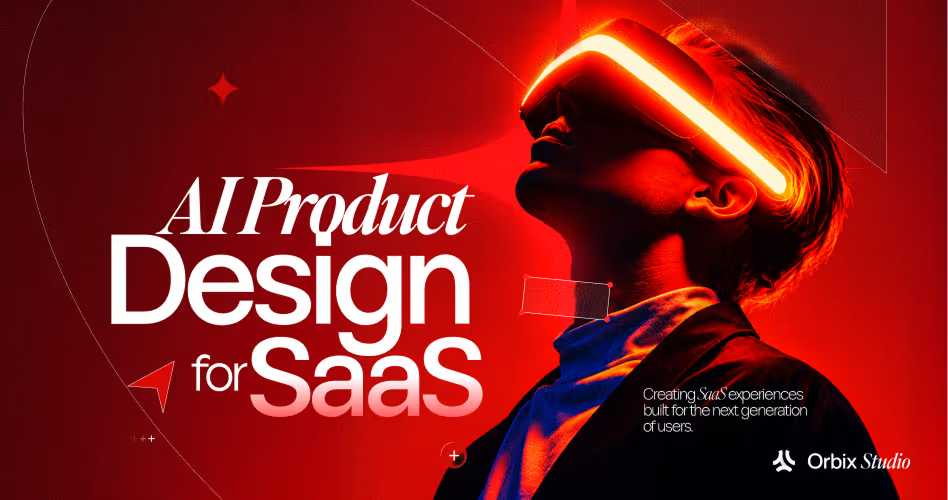
- AI product design for SaaS helps users finish work faster with trusted automation.
- Start with one repeated workflow, not a generic assistant.
- Most teams ship AI output before they design trust.
AI product design for SaaS is no longer a niche topic. It now shapes how users sign up, learn a product, complete daily work, and decide whether your software is worth paying for. That changes the standard. A polished interface is not enough. A good model is not enough either. What matters is whether AI helps a user reach a result faster, with less friction, and with fewer doubts along the way.
That is where many teams get stuck. They add an in-app AI assistant, a summary button, or a prompt box and expect adoption to follow. Adoption rarely works like that. Users return to AI-powered UX for SaaS when the feature solves a clear job, fits the screen they already use, and makes the result easy to review or act on. According to Nielsen Norman Group's AI design study guide, narrowly scoped AI features are easier to understand and easier to trust than broad, open-ended implementations.
So this guide focuses on the part that decides whether the feature gets used: how to design AI features for a SaaS product that feel useful, readable, and trustworthy from the first session.
What is AI product design for SaaS?
AI product design for SaaS is the practice of shaping screens, workflows, prompts, interface states, feedback, and approvals so AI helps users complete real work inside software. Real work is the key idea. You are not designing a demo. You are designing a workflow.
That workflow might be:
- summarizing customer calls
- grouping duplicate feedback
- drafting support replies
- generating a first dashboard view
- suggesting next steps after onboarding
- explaining a code change
- classifying product issues
A standard interface usually works with fixed behavior. Click a button, open a modal, save a setting. AI-first product design works with changing outputs. Changing outputs create uncertainty. Uncertainty changes how your interface should behave.
That is why AI UX design SaaS teams need stronger decisions around:
- context collection
- output review
- trust signals in AI UX
- confidence display
- human approval
- fallback actions
A simple way to frame it is this: traditional UX asks whether the user can complete the flow. AI product design asks whether the user can judge, edit, trust, and act on a result that may change every time.
If you want a useful internal companion piece, AI-driven UX patterns for SaaS expands on the interaction side of the same problem.
Why AI product design is important for saas startups
AI product design matters because it affects activation, feature adoption, retention, and perceived product quality at the same time. Those are not small levers. They decide whether early users stick around long enough to become paying customers.
Most early teams do not have that depth in-house, which is why outside UX design services often get pulled in before the first AI feature ships.
Activation comes first. A lot of SaaS products lose users in the first session because the product asks for too much setup before it gives value back. AI can improve that moment. A good AI onboarding flow can generate a starter workspace, suggest the next action, prefill fields, or turn a blank screen into something usable.
Adoption comes next. An AI feature may look impressive in a launch post and still fail inside the product if it demands too much prompting, hides its logic, or interrupts a job the user already understands. That is why AI feature adoption depends more on workflow fit than on novelty.
Retention sits under both. When AI saves time inside a repeated task, users form a habit. Habits are what keep SaaS products alive. If your retention goals are weak already, these UX strategies for reducing customer churn connect the same issue to long-term product use.
Real products show this clearly.
Notion AI frames its value around tasks such as meeting notes, workspace search, research, and feedback synthesis. That works because users can see the job before they see the interface.
GitHub Copilot's pull request summaries help reviewers understand changes inside the pull request itself. Same page. Same job. Less switching.
Intercom Fin uses configured roles, policy boundaries, and human handoff for support workflows. Intercom says Fin resolves an average of 67% of customer queries. The bigger design lesson is not the number alone. It is the boundary around where the system should act and where a person should step in.
That boundary is where trust begins.
AI product design process: how to design ai features for a saas product
A clean AI product design process starts with the workflow, not the model. That sounds obvious, but many teams still begin by asking what the model can do instead of what the user needs done. Here is the process that works better.
1. Start with one repeated job
Pick a task users already do often. Repetition gives AI a reason to exist.
Good candidates:
- summarize long conversations
- cluster customer feedback
- draft a follow-up email
- explain an account anomaly
- generate release notes
- prepare a meeting recap
Bad candidates:
- tasks users do once every few months
- tasks with no stable input
- tasks where the cost of a wrong answer is too high for version one
Jobs-to-be-Done thinking helps here. Ask what progress the user is trying to make at that moment. That progress should become the feature angle.
2. Map the friction before adding AI
Look at the current flow and mark where users slow down.
Useful questions:
- What information do they gather manually?
- What step feels repetitive?
- What step is mostly sorting or formatting?
- What step still needs judgment?
- Where do they leave the page to finish the task somewhere else?
This is where product-led onboarding, AI workflow design, and real product strategy meet. If the friction is already visible, the feature will make sense faster.
3. Choose the right AI shape
Not every feature needs chat. Conversational UI for SaaS gets overused because it is easy to imagine and easy to demo.
Use this filter:
- open-ended exploration: guided chat
- repeated structured task: form plus AI output
- dense information review: summary plus citations
- blank first session: starter generation
- role-based workflow: adaptive interface with task suggestions
That decision matters. An intent-based interface usually beats a generic prompt box when the user already knows the job.
4. Design for AI outputs, not just AI input
Prompt-driven interface thinking gets too much attention. Output handling matters more.
Your interface should answer:
- What did the AI produce?
- What context did it use?
- What can the user edit?
- What can the user approve?
- What happens if it is wrong?
This is where human-centered AI design becomes practical instead of abstract.
5. Add a human-in-the-loop path
Human-in-the-loop design is not just a safety note. It is a usability feature. Users trust AI more when they can interrupt it, review it, or take over without friction.
That path might be:
- edit before send
- escalate to human
- compare versions
- open raw source material
- rerun with narrower scope
- keep a manual path as fallback
6. Measure one behavior first
Do not launch an AI feature with ten success metrics. Pick one.
Good first metrics:
- first-use rate
- repeat-use rate
- task completion rate
- time saved
- manual steps removed
- handoff reduction
One metric tells you whether the feature deserves another sprint.
AI ux design best practices for saas
AI UX design best practices matter because AI can look persuasive in a prototype and still fail in production. Production is where permission rules, empty states, output quality, and user impatience show up.
Use progressive feature disclosure
Users do not need every AI capability at once. Progressive feature disclosure helps them discover help when the moment is right.
Examples:
- show rewrite options only after text exists
- show summary tools only when content is long enough
- show suggestion chips when users pause on a task
- show onboarding help when the first workspace is empty
That keeps the feature relevant instead of noisy.
Keep the interface adaptive, not chaotic
Adaptive interface design should reduce choices, not create surprise. If an AI-native interface changes too aggressively, users lose orientation.
A better pattern is this:
- adapt suggestions based on role
- adapt defaults based on context
- keep core navigation stable
That supports real-time UX adaptation without making the product feel unstable.
Show trust signals in AI UX
Trust signals should live on the screen, not in a help article nobody reads.
Good trust signals include:
- source links
- visible context scope
- "AI-generated" labels
- edit history
- approval states
- confidence cues in plain language
- permission and privacy notes where relevant
Figma's AI documentation shows this well. It tells users to verify AI-generated information and explains when some outputs are AI-generated. That is good product behavior, not just policy language.
Make corrections local
Users should not need to rerun everything to fix one line. A local edit path makes AI feel lighter and more controllable.
That means:
- edit one suggestion
- accept one block
- reject one item
- rerun one section
- compare two outputs
Preserve accessibility-first design
AI does not remove accessibility obligations. It usually increases them.
Check:
- focus order
- readable status messages
- keyboard access
- screen reader labels for AI actions
- color-independent confidence states
- plain language in system text
If you want the wider foundation behind this, accessibility in UI/UX design and the broader 7 pillars of UX design both fit naturally into this topic.
Common ai design patterns for saas products
Patterns help because they turn strategy into screen-level decisions.
Here is what those patterns look like in practice.
Suggested prompt chips work because many users do not know what to ask first. Prompt examples such as "summarize blockers," "extract action items," or "group duplicate reports" guide the user toward useful output.
AI onboarding flow works because blank states kill momentum. A generated starter workspace shows what successful use looks like before the user has real data.
Inline rewrite tools work because they stay inside the task. Friction drops when the user can shorten, clarify, or change tone without leaving the editor.
Summary with citations works because explainability in AI design improves when users can check the source. This is one of the strongest ways to design for uncertainty.
AI co-pilot UX panels work best in high-context jobs such as analytics review, issue triage, support routing, or code review. A side panel that keeps context, actions, and next steps visible often works better than a floating universal assistant.
Generative UI is the emerging pattern to watch. Instead of forcing users through one fixed layout, a generative UI can build a role-specific or task-specific view. That idea is still early, but it fits where AI-native SaaS design is heading.
If you are mapping these patterns into dashboard-heavy products, B2B SaaS dashboard design examples and the broader SaaS dashboard design complete guide are both relevant follow-up reads.
AI tools for saas product design in 2026
AI tools for SaaS product design are useful when they support a real workflow, not when they just create a flashy output. Product design with AI 2026 is moving toward integrated stacks instead of disconnected experiments.
Useful categories include:
Interface and prototyping tools
Figma AI, Framer AI, V0 by Vercel, and Lovable help teams move faster from concept to structured interface output. They work best when the workflow is already clear and the team needs faster iteration.
Workflow and documentation tools
Notion AI, Loom AI, and Productboard support summarization, documentation, planning, and insight capture. These tools help with AI-assisted user research and decision clarity.
Product and behavior tools
Amplitude and Productboard help teams connect AI ideas to actual product behavior. That matters because AI UX design best practices need evidence, not guesses.
Coding and implementation tools
Cursor, GitHub Copilot, Claude, GPT-4, and Gemini support delivery around the product. They are often part of the implementation layer rather than the interface layer, but they still influence how fast teams can test and refine ideas.
Communication and support tools
Intercom AI shows what AI workflow design looks like when the output leads directly to conversation, routing, or resolution.
One warning here. Tools do not create AI-first product design by themselves. A team with ten AI tools and no workflow clarity will still ship a weak experience. Start with the job. Then choose the tool that helps you test, design, or ship it faster.
If you are cleaning up the product around the AI layer at the same time, this SaaS UX redesign guide for conversions is a strong related piece.
AI-enabled vs ai-native saas design
This distinction is one of the most useful in space.
AI-enabled SaaS design adds AI to an existing workflow. AI-native SaaS design builds the workflow around automation from the start.
AI-enabled examples:
- summarize this thread
- rewrite this note
- classify these tickets
- suggest next steps
AI-native examples:
- generate the first workspace from your goals
- adapt the interface based on role and intent
- route tasks automatically across the product
- surface the next action without the user asking
Neither approach is always better.
AI-enabled design is often the safer path for existing SaaS products. It carries less rollout risk, simpler measurement, and faster learning.
AI-native SaaS design makes more sense when the category itself depends on automation, adaptive flows, or generated outputs. That is where AI-native interface thinking, hyper-personalized UX, and user journey AI automation start to matter.
Here is the decision filter:
- existing product with a clear manual workflow: start AI-enabled
- new category with automation at the core: explore AI-native
- uncertain use case: test one narrow AI-enabled flow first
That is the honest trade-off. Many founders want the AI-native story because it sounds bigger. In practice, the AI-enabled path is more likely to create a useful first win.
Common mistakes in AI product design for saas
Mistakes repeat because teams rush to ship the visible part of AI and ignore the UX around it.
Mistake 1: forcing chat where structure would work better
A prompt box is not a strategy. Structured tasks often need a structured interface.
Mistake 2: hiding the logic
If users cannot tell what context the system used, they will hesitate to trust the output.
Mistake 3: treating AI as the destination
Users want progress, not generated content for its own sake. Every output should lead to a clear next action.
Mistake 4: skipping the design system layer
AI introduces new states, notices, controls, labels, and approval patterns. Without a reusable system, these states get messy fast. This SaaS design systems guide and the more tactical zero-to-one design system article both become relevant here.
Mistake 5: measuring curiosity instead of usage
Launch clicks do not prove adoption. Repeat-use rate tells the truth.
Mistake 6: assuming AI will fix weak product structure
It will not. If your base layout, information hierarchy, and task flow are already confusing, AI will expose the problem faster. That is why the surrounding product matters just as much as the assistant. If your team needs that broader lens, current SaaS product design trends help place AI inside the bigger product shift.
Frequently Asked Questions
What is AI product design?
AI product design is the practice of shaping prompts, workflows, feedback, and control states so AI helps users complete real tasks inside software. Good AI product design focuses on useful outcomes, trust, and editability instead of novelty or model branding.
How does AI change product design for SaaS?
AI changes product design for SaaS by adding uncertainty, variable outputs, and new trust requirements to standard workflows. That shift means SaaS teams must design context collection, output review, fallback actions, and confidence cues more carefully than before.
What is AI-first design in SaaS?
AI-first design in SaaS means the product experience is built around automation from the start, not added later as a side feature. AI-first design usually shapes onboarding, workflow routing, interface adaptation, and task completion across the whole product.
How do you design AI features for a SaaS product?
You design AI features for a SaaS product by starting with one repeated user job, mapping the friction, choosing the right interface shape, and adding review controls. Strong AI product design also measures repeat use, not launch curiosity alone.
What are the best AI tools for SaaS product design?
Best AI tools for SaaS product design include Figma AI, Notion AI, Amplitude, Productboard, Framer AI, V0 by Vercel, Cursor, Intercom AI, Claude, GPT-4, and Gemini. Each fits a different stage of research, prototyping, workflow design, or delivery.
What is the difference between AI-enabled and AI-native SaaS design?
AI-enabled SaaS design adds automation to an existing workflow, while AI-native SaaS design builds the workflow around automation from the beginning. AI-enabled design is lower risk for mature products, while AI-native design suits categories shaped by generated output.
How do you build trust in an AI-powered UI?
You build trust in an AI-powered UI by showing source context, marking AI-generated output, keeping fallback actions visible, and making edits easy. Trust grows when users understand what the system used, what it changed, and what they control next.
Conclusion
AI product design for SaaS works when the feature reduces real work, explains enough to earn trust, and keeps the next action obvious. Pick one repeated workflow in your product this week, decide whether it needs a summary, a starter state, a structured assistant, or a review layer, and design the trust path before you design the launch copy.
If you want help shaping the product layer around these workflows, Orbix Studio works with SaaS founders on SaaS design and UI/UX design.



.svg)
.svg)


.svg)







.avif)



.svg)

